Assume that $100 drops from the beak of a seagull. You pick it up and immediately...
-
Assume that $100 drops from the beak of a seagull. You pick it up and immediately deposit it in your checking account. If the bank keeps 5% of deposits in required reserves:
-
How much money can this bank now lend out?
-
Calculate the simple money multiplier: ______________
-
Using the money multiplier, how much money will eventually be created in total from this $100?
-
2. What is the role of financial intermediaries? What is the difference between stocks and bonds? Describe how interest rates are determined in the bond market.
3. “The effects of open market operations are like a stone cast in a pond.” Describe the effect on bank reserves, interest rates, investment, and aggregate demand (GDP) and the price level when the Federal Reserve sells bonds on the open market.
Homework Answers

Add Answer to:
Assume that $100 drops from the beak of a seagull. You
pick it up and immediately...
While Jon is walking to school one morning, a helicopter flying overhead drops a $20 bill....
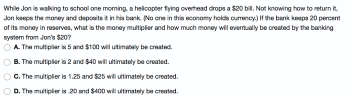 While Jon is walking to school one morning, a helicopter flying overhead drops a $20 bill. Not knowing how to return it, Jon keeps the money and deposits it in his bank. (No one in this economy holds currency.) If the bank keeps 20 percent of its money in reserves, what is the money multiplier and how much money will eventually be created by the banking system from Jon's $20? O A. The multiplier is 5 and $100 will ultimately...
Let's say that the Federal Reserve purchases $1 Million worth of U.S. Treasury bonds from a...
Let's say that the Federal Reserve purchases $1 Million worth of U.S. Treasury bonds from a bond dealer in the open market, and the dealer's bank credits the dealer's account. The required reserve ratio is 15 percent, and the bank typically lends any excess reserves immediately. a) Assuming that no currency leakage occurs, how much will the bank be able to lend to its customers following the Fed's purchase? Please explain and show your calculations. b) Using the simple money...
1.If you deposit $100 in a bank account and the reserve ratio is 20 percent. a.What...
1.If you deposit $100 in a bank account and the reserve ratio is 20 percent. a.What is the minimum amount of money banks will be required to keep in reserves? How much loans can banks make at most? What is the money multiplier? How much money can be created from $100 of reserves? b.If the fed raises the required reserve ratio to 30 percent. What is the minimum amount of money banks will be required to keep in reserves? How...
Please Please answer if you are Expert and you know the answer 100% correct. Also, please...
 Please Please answer if you are Expert and you know
the answer 100% correct. Also, please include the Fred graph,
and send the graph link and explain how to get the graph as you got
it. thank you
Suppose that currency in circulation is $800 billion, the amount of checkable deposits is $1200 billion, the required reserve ratio is 10% and excess reserves are $12 billion a. Calculate the money supply, the currency-to-deposit ratio, the excess reserve ratio, and the...
Please Please answer if you are Expert and you know
the answer 100% correct. Also, please include the Fred graph,
and send the graph link and explain how to get the graph as you got
it. thank you
Suppose that currency in circulation is $800 billion, the amount of checkable deposits is $1200 billion, the required reserve ratio is 10% and excess reserves are $12 billion a. Calculate the money supply, the currency-to-deposit ratio, the excess reserve ratio, and the...
d. $200 reserve ratio is 5 percent and the bank has $1,000 in deposits. Its reserves...
 d. $200 reserve ratio is 5 percent and the bank has $1,000 in deposits. Its reserves amount to S5. S50. c. $95. d. $950 Suppose banks desire to hold no excess reserves and that the Fed has set a reserve requirement of 10 percent. If you deposit $9,000 into First Jayhawk Bank, a. First Jayhawk's required reserves increase by $900. b. First Jayhawk will be able to lend out $8,100 c. First Jayhawk's assets and liabilities both will increase by...
Skills Check: Skills Check: Money & Banking Money & Banking 11. Why does a bank prefer...
 Skills Check: Skills Check: Money & Banking Money & Banking 11. Why does a bank prefer to make loans rather than keep reserves? 14. Complete the statement with increase or decrease When the Bank of Canada buys bonds, it 12. If the reserve ratio is 0.2, the and a the money supply deposit of $100.00 is made into a bank, that bank will lend out 15. Complete the statement with sale or purchase 13. If the reserve ratio is 0.2,...
3. If you deposit $400 in a bank account and the reserve ratio is 20 percent....
3. If you deposit $400 in a bank account and the reserve ratio is 20 percent. a. What is the minimum amount of money banks will be required to keep in reserves? How much loans can banks make at most? What is the money multiplier? How much money can be created from $400 of reserves? b. If the fed raises the required reserve ratio to 30 percent. What is the minimum amount of money banks will be required to keep...
Assume that the banking system is loaned up and that any open-market purchase by the Fed...
Assume that the banking system is loaned up and that any open-market purchase by the Fed directly increases reserves in the banks. If the required reserve ratio is 0.2, by how much could the money supply expand if the Fed purchased $2 billion worth of bonds?
If the Open Market Purchase is $1 billion by approximately how much will the supply of...
 If the Open Market Purchase is $1 billion by approximately how
much will the supply of Money increase? Use my attached sheet to
answer this. How does your answer change if the reserve requirement
is lowered to 0%?
11 1x reserve requirement A c M 1 Transaction $1,000 2 1 3 reau in ce loan 51.000 51.000.00 $900.00 $310.00 5729.00 56561 $$90.43 5531.46 $478.30 $430.47 $187 42 $140.6 5311.30 5 6 7 G H percento Terve deposited Deposit Resverato requirement...
If the Open Market Purchase is $1 billion by approximately how
much will the supply of Money increase? Use my attached sheet to
answer this. How does your answer change if the reserve requirement
is lowered to 0%?
11 1x reserve requirement A c M 1 Transaction $1,000 2 1 3 reau in ce loan 51.000 51.000.00 $900.00 $310.00 5729.00 56561 $$90.43 5531.46 $478.30 $430.47 $187 42 $140.6 5311.30 5 6 7 G H percento Terve deposited Deposit Resverato requirement...
ECON2313 hw4 2019b View Review Mailings yout References AatbCeDE AaßbCcD: AalbCcDd E AaBb Aasb AaltbCeDdE Ap 4 A Aa...
 ECON2313 hw4 2019b View Review Mailings yout References AatbCeDE AaßbCcD: AalbCcDd E AaBb Aasb AaltbCeDdE Ap 4 A Aa Su Tele Heading 21 Headng 1 No Spacing Nerml A A Part II. Short Answer Questions 1. Explain how each of the following events affects the monetary base, the money multiplier, and the money supply. a. The Fed increases the interest rate it pays banks for holding reserves. When the Fed increases the interest rate, it pays banks to hold reserves....
 While Jon is walking to school one morning, a helicopter flying overhead drops a $20 bill. Not knowing how to return it, Jon keeps the money and deposits it in his bank. (No one in this economy holds currency.) If the bank keeps 20 percent of its money in reserves, what is the money multiplier and how much money will eventually be created by the banking system from Jon's $20? O A. The multiplier is 5 and $100 will ultimately...
 Please Please answer if you are Expert and you know
the answer 100% correct. Also, please include the Fred graph,
and send the graph link and explain how to get the graph as you got
it. thank you
Suppose that currency in circulation is $800 billion, the amount of checkable deposits is $1200 billion, the required reserve ratio is 10% and excess reserves are $12 billion a. Calculate the money supply, the currency-to-deposit ratio, the excess reserve ratio, and the...
Please Please answer if you are Expert and you know
the answer 100% correct. Also, please include the Fred graph,
and send the graph link and explain how to get the graph as you got
it. thank you
Suppose that currency in circulation is $800 billion, the amount of checkable deposits is $1200 billion, the required reserve ratio is 10% and excess reserves are $12 billion a. Calculate the money supply, the currency-to-deposit ratio, the excess reserve ratio, and the...
 d. $200 reserve ratio is 5 percent and the bank has $1,000 in deposits. Its reserves amount to S5. S50. c. $95. d. $950 Suppose banks desire to hold no excess reserves and that the Fed has set a reserve requirement of 10 percent. If you deposit $9,000 into First Jayhawk Bank, a. First Jayhawk's required reserves increase by $900. b. First Jayhawk will be able to lend out $8,100 c. First Jayhawk's assets and liabilities both will increase by...
 Skills Check: Skills Check: Money & Banking Money & Banking 11. Why does a bank prefer to make loans rather than keep reserves? 14. Complete the statement with increase or decrease When the Bank of Canada buys bonds, it 12. If the reserve ratio is 0.2, the and a the money supply deposit of $100.00 is made into a bank, that bank will lend out 15. Complete the statement with sale or purchase 13. If the reserve ratio is 0.2,...
 If the Open Market Purchase is $1 billion by approximately how
much will the supply of Money increase? Use my attached sheet to
answer this. How does your answer change if the reserve requirement
is lowered to 0%?
11 1x reserve requirement A c M 1 Transaction $1,000 2 1 3 reau in ce loan 51.000 51.000.00 $900.00 $310.00 5729.00 56561 $$90.43 5531.46 $478.30 $430.47 $187 42 $140.6 5311.30 5 6 7 G H percento Terve deposited Deposit Resverato requirement...
If the Open Market Purchase is $1 billion by approximately how
much will the supply of Money increase? Use my attached sheet to
answer this. How does your answer change if the reserve requirement
is lowered to 0%?
11 1x reserve requirement A c M 1 Transaction $1,000 2 1 3 reau in ce loan 51.000 51.000.00 $900.00 $310.00 5729.00 56561 $$90.43 5531.46 $478.30 $430.47 $187 42 $140.6 5311.30 5 6 7 G H percento Terve deposited Deposit Resverato requirement...
 ECON2313 hw4 2019b View Review Mailings yout References AatbCeDE AaßbCcD: AalbCcDd E AaBb Aasb AaltbCeDdE Ap 4 A Aa Su Tele Heading 21 Headng 1 No Spacing Nerml A A Part II. Short Answer Questions 1. Explain how each of the following events affects the monetary base, the money multiplier, and the money supply. a. The Fed increases the interest rate it pays banks for holding reserves. When the Fed increases the interest rate, it pays banks to hold reserves....
Most questions answered within 3 hours.
-
Where is the error in this code sequence?
String s1 = "Hello";
String s2 = "ello";...
asked 11 months ago -
Financial data for Joel de Paris, Inc., for last year
follow:
Joel de Paris, Inc.
Balance...
asked 11 months ago -
Consider this reaction:
Al2(SO4)3 (aq)+ BaCl3
(aq) Al2Cl6 (aq)- +
3BaSO4(s) . What is the...
asked 11 months ago -
Suppose that Savneet is considering increasing her
recent random sample from 20 car rentals to 40...
asked 11 months ago -
Trucks arrive at an unloading terminal at an average rate of 120
per hour.
Trucks arrive...
asked 11 months ago -
Why are methanol and ethanol completely soluble in water while
octanol is not very little soluble....
asked 11 months ago -
A facilities manager at a university reads in a research report
that the mean amount of...
asked 11 months ago -
When the CuSO4 is rehydrated by adding water to the anhydrous
compound, is this an endothermic...
asked 11 months ago -
A ray of sunlight is passing from diamond into crown glass; the
angle of incidence is...
asked 11 months ago -
A block of mass 0.249 kg is placed on top of a light, vertical
spring of...
asked 11 months ago -
how do the kidneys compensate in the presences of acidosis
a) trigger hyperventilate
b) reserve acid...
asked 11 months ago -
Question 501 pts
The rental rate of capital to the firm increases. Which of the
following...
asked 11 months ago