The steps in divide-and-conquer approach are: A) Divide an instance of a problem into one or...
The steps in divide-and-conquer approach are: A) Divide an instance of a problem into one or more smaller instances. B) Use recursion until the instances are sufficiently small. C) Conquer (solve) these small and manageable instances. D) Combine the solutions to obtain the solution of the original instance.
Select one:
True
False
Homework Answers

Yes, the divide and conquer alorihms are basically solve the algorithms by dividing them into small terms and they recursively solve them and make them small and combine all the small solutions appropriately to obtain the original instance.
Some famous divide and conquer algorithms are binary search, quick sort , merge sort etc
Add Answer to:
The steps in divide-and-conquer approach are: A) Divide an
instance of a problem into one or...
Suppose that, in a divide-and-conquer algorithm, we always divide an instance of size n of a...
 Suppose that, in a divide-and-conquer algorithm, we always
divide an instance of size n of a problem into 5 sub-instances of
size n/3, and the dividing and combining steps take a time
in Θ(n n). Write a recurrence equation for the running time T
(n) , and solve the
equation for T (n)
2. Suppose that, in a divide-and-conquer algorithm, we always divide an instance of size n of a problem into 5 sub-instances of size n/3, and the dividing...
Suppose that, in a divide-and-conquer algorithm, we always
divide an instance of size n of a problem into 5 sub-instances of
size n/3, and the dividing and combining steps take a time
in Θ(n n). Write a recurrence equation for the running time T
(n) , and solve the
equation for T (n)
2. Suppose that, in a divide-and-conquer algorithm, we always divide an instance of size n of a problem into 5 sub-instances of size n/3, and the dividing...
Q1) Using Divide and conquer approach, solve the kth element in 2 sorted arrays problem. Given...
Q1) Using Divide and conquer approach, solve the kth element in 2 sorted arrays problem. Given two sorted arrays both of size n find the element in k’th position of the combined sorted array. 1. Mention the steps of Divide, Conquer and Combine (refer to L5- Divide and Conquer Lecture notes, slide 3, to see an example on merge sort) 2. Draw the recursive tree. 3. What is the recurrence equation? 4. Guess a solution based on the recursive tree...
A divide-and-conquer algorithm solves a problem by dividing the input (of size n>1, T(1) =0) into...
A divide-and-conquer algorithm solves a problem by dividing the input (of size n>1, T(1) =0) into two inputs half as big using n/2-1 steps. The algorithm does n steps to combine the solutions to get a solution for the original input. Write a recurrence equation for the algorithm and solve it.
A divide-and-conquer algorithm solves a problem by dividing the input (of size n>1, T(1) =0) into...
A divide-and-conquer algorithm solves a problem by dividing the input (of size n>1, T(1) =0) into two inputs half as big using n/2-1 steps. The algorithm does n steps to combine the solutions to get a solution for the original input. Write a recurrence equation for the algorithm and solve it.
Suppose that, in a divide-and-conquer algorithm, we always divide an instance of size n of &nb
Suppose that, in a divide-and-conquer algorithm, we always divide an instance of size n of a problem into n subinstances of size n/3, and the dividing and combining steps take linear time. Write a recurrence equation for the running time T(n), and solve this recurrence equation for T(n). Show your solution in order notation. please help solve this..
Analysis Divide & Conquer: Analyze the complexity of algorithm A1 where the problem of size n...
Analysis Divide & Conquer: Analyze the complexity of algorithm A1 where the problem of size n is solved by dividing into 4 subprograms of size n - 4 to be recursively solved and then combining the solutions of the subprograms takes O(n2) time. Determine the recurrence and whether it is “Subtract and Conquer” or “Divide and Conquer“ type of problem. Solve the problem to the big O notation. Use the master theorem to solve, state which theorem you are using...
Steps to develop a dynamic programming algorithm: a) Establish a recursive property that gives the solution...
Steps to develop a dynamic programming algorithm: a) Establish a recursive property that gives the solution to an instance of the problem; b) Compute the value of an optimal solution in a bottom-up fashion by solving smaller instances first. Select one: True False
Suppose the following is a divide-and-conquer algorithm for some problem. "Make the input of size n...
Suppose the following is a divide-and-conquer algorithm for some problem. "Make the input of size n into 3 subproblems of sizes n/2 , n/4 , n/8 , respectively with O(n) time; Recursively call on these subproblems; and then combine the results in O(n) time. The recursive call returns when the problems become of size 1 and the time in this case is constant." (a) Let T(n) denote the worst-case running time of this approach on the problem of size n....
im not sure how to approach this problem please try to give explaination with an answer...
 im not sure how to approach this problem please try to give
explaination with an answer to this question
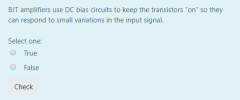
BJT amplifiers use DC bias circuits to keep the transistors "on" so they can respond to small variations in the input signal. Select one: O True O False Check
im not sure how to approach this problem please try to give
explaination with an answer to this question
BJT amplifiers use DC bias circuits to keep the transistors "on" so they can respond to small variations in the input signal. Select one: O True O False Check
I already solved part A and I just need help with part B 1. Matrix Multiplication...
 I already solved part A and I just need help with part B
1. Matrix Multiplication The product of two n xn matrices X and Y is a third n x n matrix 2 = XY, with entries 2 - 21; = xixYk x k=1 There are n’ entries to compute, each one at a cost of O(n). The formula implies an algorithm with O(nº) running time. For a long time this was widely believed to be the best running...
I already solved part A and I just need help with part B
1. Matrix Multiplication The product of two n xn matrices X and Y is a third n x n matrix 2 = XY, with entries 2 - 21; = xixYk x k=1 There are n’ entries to compute, each one at a cost of O(n). The formula implies an algorithm with O(nº) running time. For a long time this was widely believed to be the best running...
 Suppose that, in a divide-and-conquer algorithm, we always
divide an instance of size n of a problem into 5 sub-instances of
size n/3, and the dividing and combining steps take a time
in Θ(n n). Write a recurrence equation for the running time T
(n) , and solve the
equation for T (n)
2. Suppose that, in a divide-and-conquer algorithm, we always divide an instance of size n of a problem into 5 sub-instances of size n/3, and the dividing...
Suppose that, in a divide-and-conquer algorithm, we always
divide an instance of size n of a problem into 5 sub-instances of
size n/3, and the dividing and combining steps take a time
in Θ(n n). Write a recurrence equation for the running time T
(n) , and solve the
equation for T (n)
2. Suppose that, in a divide-and-conquer algorithm, we always divide an instance of size n of a problem into 5 sub-instances of size n/3, and the dividing...
 im not sure how to approach this problem please try to give
explaination with an answer to this question
BJT amplifiers use DC bias circuits to keep the transistors "on" so they can respond to small variations in the input signal. Select one: O True O False Check
im not sure how to approach this problem please try to give
explaination with an answer to this question
BJT amplifiers use DC bias circuits to keep the transistors "on" so they can respond to small variations in the input signal. Select one: O True O False Check
 I already solved part A and I just need help with part B
1. Matrix Multiplication The product of two n xn matrices X and Y is a third n x n matrix 2 = XY, with entries 2 - 21; = xixYk x k=1 There are n’ entries to compute, each one at a cost of O(n). The formula implies an algorithm with O(nº) running time. For a long time this was widely believed to be the best running...
I already solved part A and I just need help with part B
1. Matrix Multiplication The product of two n xn matrices X and Y is a third n x n matrix 2 = XY, with entries 2 - 21; = xixYk x k=1 There are n’ entries to compute, each one at a cost of O(n). The formula implies an algorithm with O(nº) running time. For a long time this was widely believed to be the best running...
Most questions answered within 3 hours.
-
Where is the error in this code sequence?
String s1 = "Hello";
String s2 = "ello";...
asked 10 months ago -
Financial data for Joel de Paris, Inc., for last year
follow:
Joel de Paris, Inc.
Balance...
asked 10 months ago -
Consider this reaction:
Al2(SO4)3 (aq)+ BaCl3
(aq) Al2Cl6 (aq)- +
3BaSO4(s) . What is the...
asked 10 months ago -
Suppose that Savneet is considering increasing her
recent random sample from 20 car rentals to 40...
asked 10 months ago -
Trucks arrive at an unloading terminal at an average rate of 120
per hour.
Trucks arrive...
asked 10 months ago -
Why are methanol and ethanol completely soluble in water while
octanol is not very little soluble....
asked 10 months ago -
A facilities manager at a university reads in a research report
that the mean amount of...
asked 10 months ago -
When the CuSO4 is rehydrated by adding water to the anhydrous
compound, is this an endothermic...
asked 10 months ago -
A ray of sunlight is passing from diamond into crown glass; the
angle of incidence is...
asked 10 months ago -
A block of mass 0.249 kg is placed on top of a light, vertical
spring of...
asked 10 months ago -
how do the kidneys compensate in the presences of acidosis
a) trigger hyperventilate
b) reserve acid...
asked 10 months ago -
Question 501 pts
The rental rate of capital to the firm increases. Which of the
following...
asked 10 months ago