Create a class 'ProblemSolution' with the following characteristics A public method 'solution' without parameters and return...
Create a class 'ProblemSolution' with the following characteristics A public method 'solution' without parameters and return type is int. Create object of class 'Student' inside 'solution' method and return the value of “rollNumber” from the class 'Student'.
Output: 10001
Homework Answers
Here is the complete code for this problem. Comments are included.
#include <iostream>
using namespace std;
class Student {
public:
int rollNumber = 10001;
};
//ProblemSolution class
class ProblemSolution {
public:
//method returning an int
int solution()
{
//creating a Student
Student s;
//returning roll number.
return s.rollNumber;
}
};
int main()
{
ProblemSolution problemSolution;
cout << problemSolution.solution();
}
OUTPUT:
10001
Add Answer to:
Create a class 'ProblemSolution' with the following
characteristics A public method 'solution' without parameters and
return...
In C++, please. Given an integer numbers N, create a class 'ProblemSolution' which demonstrates inheritance with...
In C++, please. Given an integer numbers N, create a class 'ProblemSolution' which demonstrates inheritance with the following characteristics 1. Must inherit from 'Base' class. 2. Create a 'solution' method with an integer parameter and void return type. 3. The 'solution' method should assign the given value N into 'Base' class property 'num' and call the 'display' function of 'Base' class. What is inheritance? Inheritance is a mechanism in which one object acquires all the properties and behaviors of the...
In this question, your task is to override a standard public method of the Object class...
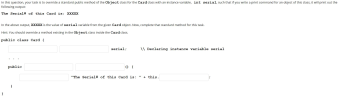 In this question, your task is to override a standard public method of the Object class for the Card class with an instance variable, int serial, such that if you write a print command for an object of this class, it will print out the following output: The Serial# of this Card is: XXXXX In the above output, XXXXX is the value of serial variable from the given Card object. Now, complete that standard method for this task. Hint: You...
IN C++ Given ProblemSolution class. Use a pointer to object of “ProblemSolution” class to invoke the...
IN C++ Given ProblemSolution class. Use a pointer to object of “ProblemSolution” class to invoke the “CalculateSum” and “Print” methods of “ProblemSolution”. Write a function: void Solution(int N1, int N2) that accepts two integers N1 and N2. The function should instantiate “ProblemSolution” object with N1 and N2 values and call “CalculateSum” and “Print” method by creating a pointer to the object of “ProblemSolution”. Input 12 5 Output 17 Assume that, N1, N2 and sum are integers within...
Create a LIFO class with following methods in java - public LifoList() The default constructor for...
Create a LIFO class with following methods in java - public LifoList() The default constructor for LifoList class which will initialize your class variables maxSize to 0 and the int array to null. public LifoList(int maxSize) The constructor for LifoList class which takes the int input maxSize to initialize the size of the array. You should NOT reinitialize the array elsewhere. For example, creating an object as new LifoList(5) should create a LifoList whose maximum size is 5. If the...
Create an abstract class “Appointment” that represents an event on a calendar. The “Appointment” class will...
Create an abstract class “Appointment” that represents an event on a calendar. The “Appointment” class will have four instance variables: • An instance variable called “year” which will be of type int • An instance variable called “month” which will be of type int • An instance variable called “day” which will be of type int • An instance variable called “description” which will be of type String The “Appointment” class must also implement the following methods: • A getter...
In the following program: public class Problem2{ public static int sample(int x, int y){ int z; .........
In the following program: public class Problem2{ public static int sample(int x, int y){ int z; ...... } public static void main(String[] args) { int a, b; ...... sample(a,b); } } (1) What is the return type of sample? (2) What are the local variables of sample? (3) What are the parameters of sample? (4) What are the arguments of sample? (5) Is sample a per-object method? Or a per-class method? (6) Is sample a public method, or private method?
CC++ Compiler: CPP (gcc-5.x) 0 Simple Calculator Given two integers and a string, create a simple...
 CC++
Compiler: CPP (gcc-5.x) 0 Simple Calculator Given two integers and a string, create a simple calculator which performs the following operations: • Addition if the string is "+" • Difference if the string is "-" Multiplication if the string is "*" • Return quotient (obtained by dividing the first number by the second) if the string is "/" • Return greater value if the string is "max" • Return lesser value if the string is "min" solution.cpp 2 Create...
CC++
Compiler: CPP (gcc-5.x) 0 Simple Calculator Given two integers and a string, create a simple calculator which performs the following operations: • Addition if the string is "+" • Difference if the string is "-" Multiplication if the string is "*" • Return quotient (obtained by dividing the first number by the second) if the string is "/" • Return greater value if the string is "max" • Return lesser value if the string is "min" solution.cpp 2 Create...
Step 1 Develop the following interface: Interface Name: QueueInterface<T> Access Modifier: public Methods Name: isEmpty Access...
Step 1 Develop the following interface: Interface Name: QueueInterface<T> Access Modifier: public Methods Name: isEmpty Access modifier: public Parameters: none Return type: boolean Name: dequeue Access modifier: public Parameters: none Return type: T (parameterized type) Name: enqueue Access modifier: public Parameters: element (data type T, parameterized type) Return type: void Step 2 Develop the following class: Class Name: QueueNode<T> Access Modifier: public Instance variables Name: info Access modifier: private Data type: T (parameterized type) Name: link Access modifier: private Data...
Step 1 Develop the following interface: Interface Name: QueueInterface<T> Access Modifier: public Methods Name: isEmpty Access...
Step 1 Develop the following interface: Interface Name: QueueInterface<T> Access Modifier: public Methods Name: isEmpty Access modifier: public Parameters: none Return type: boolean Name: dequeue Access modifier: public Parameters: none Return type: T (parameterized type) Name: enqueue Access modifier: public Parameters: element (data type T, parameterized type) Return type: void Step 2 Develop the following class: Class Name: QueueNode<T> Access Modifier: public Instance variables Name: info Access modifier: private Data type: T (parameterized type) Name: link Access modifier: private Data...
The method m() of class B overrides the m() method of class A, true or false?...
 The method m() of class B overrides the m() method of class A, true or false? class A int i; public void maint i) { this.is } } class B extends A{ public void m(Strings) { 1 Select one: True False For the following code, which statement is correct? public class Test { public static void main(String[] args) { Object al = new AC: Object a2 = new Object(); System.out.println(al); System.out.println(a): } } class A intx @Override public String toString()...
 In this question, your task is to override a standard public method of the Object class for the Card class with an instance variable, int serial, such that if you write a print command for an object of this class, it will print out the following output: The Serial# of this Card is: XXXXX In the above output, XXXXX is the value of serial variable from the given Card object. Now, complete that standard method for this task. Hint: You...
 CC++
Compiler: CPP (gcc-5.x) 0 Simple Calculator Given two integers and a string, create a simple calculator which performs the following operations: • Addition if the string is "+" • Difference if the string is "-" Multiplication if the string is "*" • Return quotient (obtained by dividing the first number by the second) if the string is "/" • Return greater value if the string is "max" • Return lesser value if the string is "min" solution.cpp 2 Create...
CC++
Compiler: CPP (gcc-5.x) 0 Simple Calculator Given two integers and a string, create a simple calculator which performs the following operations: • Addition if the string is "+" • Difference if the string is "-" Multiplication if the string is "*" • Return quotient (obtained by dividing the first number by the second) if the string is "/" • Return greater value if the string is "max" • Return lesser value if the string is "min" solution.cpp 2 Create...
 The method m() of class B overrides the m() method of class A, true or false? class A int i; public void maint i) { this.is } } class B extends A{ public void m(Strings) { 1 Select one: True False For the following code, which statement is correct? public class Test { public static void main(String[] args) { Object al = new AC: Object a2 = new Object(); System.out.println(al); System.out.println(a): } } class A intx @Override public String toString()...
Most questions answered within 3 hours.
-
Where is the error in this code sequence?
String s1 = "Hello";
String s2 = "ello";...
asked 11 months ago -
Financial data for Joel de Paris, Inc., for last year
follow:
Joel de Paris, Inc.
Balance...
asked 11 months ago -
Consider this reaction:
Al2(SO4)3 (aq)+ BaCl3
(aq) Al2Cl6 (aq)- +
3BaSO4(s) . What is the...
asked 11 months ago -
Suppose that Savneet is considering increasing her
recent random sample from 20 car rentals to 40...
asked 11 months ago -
Trucks arrive at an unloading terminal at an average rate of 120
per hour.
Trucks arrive...
asked 11 months ago -
Why are methanol and ethanol completely soluble in water while
octanol is not very little soluble....
asked 11 months ago -
A facilities manager at a university reads in a research report
that the mean amount of...
asked 11 months ago -
When the CuSO4 is rehydrated by adding water to the anhydrous
compound, is this an endothermic...
asked 11 months ago -
A ray of sunlight is passing from diamond into crown glass; the
angle of incidence is...
asked 11 months ago -
A block of mass 0.249 kg is placed on top of a light, vertical
spring of...
asked 11 months ago -
how do the kidneys compensate in the presences of acidosis
a) trigger hyperventilate
b) reserve acid...
asked 11 months ago -
Question 501 pts
The rental rate of capital to the firm increases. Which of the
following...
asked 11 months ago