What is the sum of the stoichimetric coefficients for the formation reaction of acetaldehyde, CH3CHO?
What is the sum of the stoichimetric coefficients for the formation reaction of acetaldehyde, CH3CHO?
Homework Answers

Add Answer to:
What is the sum of the stoichimetric coefficients for the
formation reaction of acetaldehyde, CH3CHO?
Sav The thermal decomposition of acetaldehyde, CH3CHO -- CH4 + Co, is a second-order reaction with...
 Sav The thermal decomposition of acetaldehyde, CH3CHO -- CH4 + Co, is a second-order reaction with a rate constant of 6.67 x 10⁻² M1s1 Starting with 1.00 M acetaldehyde, what is the half-life of this reaction? a. 7.0 5 b. 0.033s c. 0.067 s d. 1.0 x 10's e. 155 What is the boiling point of a solution containing 0.852 g naphthalene (C10H8, Molar Mass 128.2 g/mol) a nonvolatile, nonelectrolyte dissolved in 14.0 g benzene (Molar Mass = 78.1 g/mol)?...
The mechanism of the pyrolysis of acetaldehyde corresponding to the chemical reaction CH3CHO(8) CH4(8) +CO(g) at...
 The mechanism of the pyrolysis of acetaldehyde corresponding to the chemical reaction CH3CHO(8) CH4(8) +CO(g) at 520 °C and 0.2 bar is kị kg CHCH0g) CH3 g) + CH0g) CH3(g) + CH3CHO(g) = CH4(g) + CH3COg) CH3CO(g) = CO(g) + CH3(g) CH3(g) + CH3(g) = C2H6() Is this reaction a chain reaction? If so, identify the initiation, propagation, inhibition, and termination step(s). Using the steady state approximation for intermediate species CH3(g) and CH3CO(g), derive the rate law 1/2 kz [CH2CHO]3/2
Problem 1 The gas phase pyrolysis of acetaldehyde CH3CHO- take place according to the following sequence...
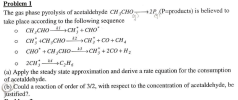 Problem 1 The gas phase pyrolysis of acetaldehyde CH3CHO- take place according to the following sequence →2P (P-products) is believed to *k4 2136 (a) Apply the steady state approximation and derive a rate equation for the consumption of acetaldehyde. ((b) Could a reaction of order of 3/2, with respect to the concentration of acetaldehyde, be justified?.
Acetaldehyde (CH3CHO) decomposes at high temperature to methane and carbon monoxide. A container was filled with...
Acetaldehyde (CH3CHO) decomposes at high temperature to methane and carbon monoxide. A container was filled with acetaldehyde to a pressure of 0.22 atmospheres and then the CO partial pressure was monitored as a function of time. Time (s) CO Partial Pressure (Atm) 0 0.0000 1733 0.1100 3466 0.1650 5199 0.1925 Determine the order of the reaction and then the rate constant? The answer is First Order, with a rate constant of 4.0x10^-4 s^-1
Acetaldehyde decomposes to methane and carbon monoxide according to the following balanced equation: CH3CHO → CH4...
Acetaldehyde decomposes to methane and carbon monoxide according to the following balanced equation: CH3CHO → CH4 + CO In a particular experiment, the following kinetic data for the decomposition of acetaldehyde were obtained: Time(s) 0 1000 2000 3000 4000 [CH3CHO] (M) 0.4940 0.1533 0.0907 0.0644 0.0499 What is the value of the rate constant at the temperature of this experiment? Give an answer with concentration units of molarity and time units of seconds.
The following data were obtained for the decomposition of acetaldehyde CH3CHO → CH4 + CO Initial...
 The following data were obtained for the decomposition of acetaldehyde CH3CHO → CH4 + CO Initial Rate (mol L min-1) [CH3CHO] (mol L-4) 0.20 1.00 0.56 2.00 Which one of the following statements is correct? O A. The reaction is second order. O O B. The rate constant is 0.693 mol L-4 min-?. O C. The rate constant is 0.20 mol-1/2 L 1/2 min-?. O O O D. The reaction is first order. O E. The rate constant is 0.20...
Discuss the hybridization and sketch a bonding scheme for acetaldehyde (CH3CHO). The Lewis structure is given...
Discuss the hybridization and sketch a bonding scheme for acetaldehyde (CH3CHO). The Lewis structure is given below.
6. [20pt] The Rice-Herzfeld mechanism for the thermal decomposition of acetaldehyde (CH:CНO) is k1 CH3CHO CH3...
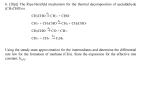 6. [20pt] The Rice-Herzfeld mechanism for the thermal decomposition of acetaldehyde (CH:CНO) is k1 CH3CHO CH3 CHO k2 CH3:: + CH3CНО $ СН4 + CH-CHO- k3 CH2CHO CO CH3 k4 СH3: + CH3. $ C2Н6 Using the steady-state approximation for the intermediates and determine the differential rate law for the formation of methane (CH4). State the expression for the effective rate constant, keff
acetaldehyde (CH3CHU) in aqueous For the reaction between hydrocyanic acid (HCN) and solution, HCN(A) + CH3CHO(B)...
 acetaldehyde (CH3CHU) in aqueous For the reaction between hydrocyanic acid (HCN) and solution, HCN(A) + CH3CHO(B) - CH2CH(OH)CN the rate law at 25°C and a certain pH is(-ra)=KACACB, where ka=0.210 L mol"min" (see problem 4-6). If the reaction is carried out at steady-state at 25°C in a CSTR, how large a reactor (V/L) is required for 75% conversion of HCN, if the feed concentration is 0.04 mol L-l for each reactant, and the feed rate is 2 L min!?
The gas phase decomposition of ethanol to acetaldehyde CH3CH2OH(g) → CH3CHO(g) + H2(g) occurs at 200...
The gas phase decomposition of ethanol to acetaldehyde CH3CH2OH(g) → CH3CHO(g) + H2(g) occurs at 200 degrees C through a first order reaction with a rate constant of 0.028 min−1. If a container at 200oC is filled with 3.4 Atm of CH3CH2OH(g). What is the TOTAL pressure in the container after 30 minutes?
 Sav The thermal decomposition of acetaldehyde, CH3CHO -- CH4 + Co, is a second-order reaction with a rate constant of 6.67 x 10⁻² M1s1 Starting with 1.00 M acetaldehyde, what is the half-life of this reaction? a. 7.0 5 b. 0.033s c. 0.067 s d. 1.0 x 10's e. 155 What is the boiling point of a solution containing 0.852 g naphthalene (C10H8, Molar Mass 128.2 g/mol) a nonvolatile, nonelectrolyte dissolved in 14.0 g benzene (Molar Mass = 78.1 g/mol)?...
 The mechanism of the pyrolysis of acetaldehyde corresponding to the chemical reaction CH3CHO(8) CH4(8) +CO(g) at 520 °C and 0.2 bar is kị kg CHCH0g) CH3 g) + CH0g) CH3(g) + CH3CHO(g) = CH4(g) + CH3COg) CH3CO(g) = CO(g) + CH3(g) CH3(g) + CH3(g) = C2H6() Is this reaction a chain reaction? If so, identify the initiation, propagation, inhibition, and termination step(s). Using the steady state approximation for intermediate species CH3(g) and CH3CO(g), derive the rate law 1/2 kz [CH2CHO]3/2
 Problem 1 The gas phase pyrolysis of acetaldehyde CH3CHO- take place according to the following sequence →2P (P-products) is believed to *k4 2136 (a) Apply the steady state approximation and derive a rate equation for the consumption of acetaldehyde. ((b) Could a reaction of order of 3/2, with respect to the concentration of acetaldehyde, be justified?.
 The following data were obtained for the decomposition of acetaldehyde CH3CHO → CH4 + CO Initial Rate (mol L min-1) [CH3CHO] (mol L-4) 0.20 1.00 0.56 2.00 Which one of the following statements is correct? O A. The reaction is second order. O O B. The rate constant is 0.693 mol L-4 min-?. O C. The rate constant is 0.20 mol-1/2 L 1/2 min-?. O O O D. The reaction is first order. O E. The rate constant is 0.20...
 6. [20pt] The Rice-Herzfeld mechanism for the thermal decomposition of acetaldehyde (CH:CНO) is k1 CH3CHO CH3 CHO k2 CH3:: + CH3CНО $ СН4 + CH-CHO- k3 CH2CHO CO CH3 k4 СH3: + CH3. $ C2Н6 Using the steady-state approximation for the intermediates and determine the differential rate law for the formation of methane (CH4). State the expression for the effective rate constant, keff
 acetaldehyde (CH3CHU) in aqueous For the reaction between hydrocyanic acid (HCN) and solution, HCN(A) + CH3CHO(B) - CH2CH(OH)CN the rate law at 25°C and a certain pH is(-ra)=KACACB, where ka=0.210 L mol"min" (see problem 4-6). If the reaction is carried out at steady-state at 25°C in a CSTR, how large a reactor (V/L) is required for 75% conversion of HCN, if the feed concentration is 0.04 mol L-l for each reactant, and the feed rate is 2 L min!?
Most questions answered within 3 hours.
-
Where is the error in this code sequence?
String s1 = "Hello";
String s2 = "ello";...
asked 11 months ago -
Financial data for Joel de Paris, Inc., for last year
follow:
Joel de Paris, Inc.
Balance...
asked 11 months ago -
Consider this reaction:
Al2(SO4)3 (aq)+ BaCl3
(aq) Al2Cl6 (aq)- +
3BaSO4(s) . What is the...
asked 11 months ago -
Suppose that Savneet is considering increasing her
recent random sample from 20 car rentals to 40...
asked 11 months ago -
Trucks arrive at an unloading terminal at an average rate of 120
per hour.
Trucks arrive...
asked 11 months ago -
Why are methanol and ethanol completely soluble in water while
octanol is not very little soluble....
asked 11 months ago -
A facilities manager at a university reads in a research report
that the mean amount of...
asked 11 months ago -
When the CuSO4 is rehydrated by adding water to the anhydrous
compound, is this an endothermic...
asked 11 months ago -
A ray of sunlight is passing from diamond into crown glass; the
angle of incidence is...
asked 11 months ago -
A block of mass 0.249 kg is placed on top of a light, vertical
spring of...
asked 11 months ago -
how do the kidneys compensate in the presences of acidosis
a) trigger hyperventilate
b) reserve acid...
asked 11 months ago -
Question 501 pts
The rental rate of capital to the firm increases. Which of the
following...
asked 11 months ago