Consider the unbalanced chemical reaction shown below: Cu(s)+HNO3(aq)→Cu(NO3)2(aq)+NO(g)+H2O(l) The oxidation state of Cu in Cu(s)Cu(s) =...
Consider the unbalanced chemical reaction shown below:
Cu(s)+HNO3(aq)→Cu(NO3)2(aq)+NO(g)+H2O(l)
The oxidation state of Cu in Cu(s)Cu(s) =
The oxidation state of Cu in Cu(NO_3)_2(aq)Cu(NO3)2(aq) =
The oxidation state of N in HNO_3(aq)HNO3(aq) =
The oxidation state of N in NO(g)NO(g) =
The total number of electrons transferred in this reaction is =
The sum of the coefficients in the balanced chemical reaction =
Homework Answers
In the image uploaded below, the oxidation of Cu and N are written with the balanced chemical equation.
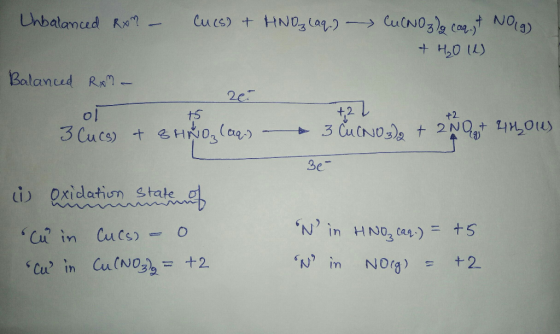
The total number of electrons transferred by each Cu atom is 2 electrons and by each N atom is 3 electrons.
The sum of coefficients in the balanced chemical reaction is= 3+ 8 + 3+ 2+ 4 = 20
Add Answer to:
Consider the unbalanced chemical reaction shown below:
Cu(s)+HNO3(aq)→Cu(NO3)2(aq)+NO(g)+H2O(l)
The oxidation state of Cu in Cu(s)Cu(s) =...
C2 T13HW Question 2 Homework - Unanswered Fill in the Blanks Consider the unbalanced chemical reaction...
 C2 T13HW Question 2 Homework - Unanswered Fill in the Blanks Consider the unbalanced chemical reaction shown below: _Cu[s] + _HNO3(aq) + Cu(NO3)2(aq) +_NO(g) + _H2O(L) The oxidation state of Cu in Cus) The oxidation state of Cu in Cu(NO3)2(aq) = The oxidation state of Nin HNO3(aq) - The oxidation state of Nin NO 9) The total number of electrons transferred in this reaction is The sum of the coefficients in the balanced chemical reaction -
1. For the oxidation-reduction reaction Zn(s) + 2HNO3 (aq) → H2(g) + Zn(NO3)2 (aq) Hint: HNO3...
 1. For the oxidation-reduction reaction Zn(s) + 2HNO3 (aq) → H2(g) + Zn(NO3)2 (aq) Hint: HNO3 a) provide equation for the oxidation half-reaction: b) provide equation for the reduction half-reaction: In the given equation above or in your answers to a) and b): c) label the substance which is oxidizing agent, d) label the substance which is reducing agent.
94. The net ionic equation for the reaction, Cu(s) + 2HNO3(aq) - H2(g) + Cu(NO3)(aq) A)...
 94. The net ionic equation for the reaction, Cu(s) + 2HNO3(aq) - H2(g) + Cu(NO3)(aq) A) Cu(s) + H(aq) → H2(aq) +Cu? (aq) B) Cu(s) +2H(aq) → H2(g) +Cu2+ (aq) C) Cu(s) +2H (aq) H2(g) + Cu(aq) D) Cu(s) + H(aq) H2(g) + Cu(aq) X Question 13 of 100 Meme 51. Which of the following is TRUE? A) Hydrogen atom to hydrogen ion (H+)is reduction B) Oxygen atom to oxide ion(O2-) is reduction. C) tin atom to tin(IV) ion is...
What is the oxidation state of nitrogen the following redox reaction? Cu(s) + HNO3(aq) → Cu2+(aq)...
What is the oxidation state of nitrogen the following redox reaction? Cu(s) + HNO3(aq) → Cu2+(aq) + NO(g)
3. Consider the unbalanced reaction NO3- (aq) + Sn2+ (aq) +Snº+(aq) + NO(g) a. Atom In...
 3. Consider the unbalanced reaction NO3- (aq) + Sn2+ (aq) +Snº+(aq) + NO(g) a. Atom In the following table, identify which atom is oxidized, which atom is reduced, and their oxidation states in the reactants and products. (12 points) Oxidation State in Oxidation State in Reactant Product Oxidized Reduced b. Balance the reaction under BASIC conditions. (15 points) NO3- (aq) + Sn2+ (aq) Sn"+ (aq) + NO(g)
Consider the following UNBALANCED reaction IN ACIDIC SOLUTION: Cu(s) + NO3(aq) - -Cu2+ (aq) + NO()...
 Consider the following UNBALANCED reaction IN ACIDIC SOLUTION: Cu(s) + NO3(aq) - -Cu2+ (aq) + NO() Provide the following information with the requested information. Make sure to show any work that is required for full credit. You may use the Eºcell potential table found here. a. (5) Species that is oxidized (be specific - i.e.identify which atom and if there are multiple atoms with different charges, identify the correct one) b. (5) Species that is reduced (same instructions as above)...
Consider the unbalanced half reaction shown below: (MnO4)-(aq) → MnO2(s) When this half reaction is balanced...
Consider the unbalanced half reaction shown below: (MnO4)-(aq) → MnO2(s) When this half reaction is balanced with the lowest possible whole number coefficients how many electrons will there be in the balanced half reaction?
HNO3 (aq) + Cu (s) + H2(g) + CuNO3 (aq) •Identify what type of reaction it...
 HNO3 (aq) + Cu (s) + H2(g) + CuNO3 (aq) •Identify what type of reaction it is: precipitation, redox or acid-base. •Balance the above equation. •Write the balanced net ionic equation. d. Indicate the element that has been oxidized and the one that has been reduced. You should also identify the oxidation number (ox #) of each before and after the process. Identify the reducing agent and the oxidizing agent. Element Oxidized: Ox # Reactant: Ox # Product: Element Reduced:...
Again consider the following unbalanced oxidation - reduction reaction: Ba(OH)2(aq) + H2O2(aq) + CIO2(aq) + Ba(CIO2)2(s)...
 Again consider the following unbalanced oxidation - reduction reaction: Ba(OH)2(aq) + H2O2(aq) + CIO2(aq) + Ba(CIO2)2(s) + O2(g) Balance this reaction for basic conditions. Once both half reactions are ready to add to give the overall balanced reaction, the number of electrons lost ( = the number of electrons gained) is O 2 O 3 O 1 O none of these
The reaction Cu(s) + 2 AgNO_3(aq) rightarrow Cu(NO_3)_2 (aq) + 2Ag(s) is best classified as a(n)...
 The reaction Cu(s) + 2 AgNO_3(aq) rightarrow Cu(NO_3)_2 (aq) + 2Ag(s) is best classified as a(n) acid-base neutralization reaction. double replacement reaction. oxidation-reduction reaction. precipitation reaction. What is the concentration of sodium ions in 0.350 M Na_3PO_4 solution? 0.117 M 0.350 M 1.05 M 1.40 M What is the molecular geometry of BrF_4^-? seesaw square planar square pyramidal tetrahedral in the reaction the spectator ions are Ag^+ and NO_3^- Ag^+ and I^- H^+ and I^- H^+ and NO_3^-
 C2 T13HW Question 2 Homework - Unanswered Fill in the Blanks Consider the unbalanced chemical reaction shown below: _Cu[s] + _HNO3(aq) + Cu(NO3)2(aq) +_NO(g) + _H2O(L) The oxidation state of Cu in Cus) The oxidation state of Cu in Cu(NO3)2(aq) = The oxidation state of Nin HNO3(aq) - The oxidation state of Nin NO 9) The total number of electrons transferred in this reaction is The sum of the coefficients in the balanced chemical reaction -
 1. For the oxidation-reduction reaction Zn(s) + 2HNO3 (aq) → H2(g) + Zn(NO3)2 (aq) Hint: HNO3 a) provide equation for the oxidation half-reaction: b) provide equation for the reduction half-reaction: In the given equation above or in your answers to a) and b): c) label the substance which is oxidizing agent, d) label the substance which is reducing agent.
 94. The net ionic equation for the reaction, Cu(s) + 2HNO3(aq) - H2(g) + Cu(NO3)(aq) A) Cu(s) + H(aq) → H2(aq) +Cu? (aq) B) Cu(s) +2H(aq) → H2(g) +Cu2+ (aq) C) Cu(s) +2H (aq) H2(g) + Cu(aq) D) Cu(s) + H(aq) H2(g) + Cu(aq) X Question 13 of 100 Meme 51. Which of the following is TRUE? A) Hydrogen atom to hydrogen ion (H+)is reduction B) Oxygen atom to oxide ion(O2-) is reduction. C) tin atom to tin(IV) ion is...
 3. Consider the unbalanced reaction NO3- (aq) + Sn2+ (aq) +Snº+(aq) + NO(g) a. Atom In the following table, identify which atom is oxidized, which atom is reduced, and their oxidation states in the reactants and products. (12 points) Oxidation State in Oxidation State in Reactant Product Oxidized Reduced b. Balance the reaction under BASIC conditions. (15 points) NO3- (aq) + Sn2+ (aq) Sn"+ (aq) + NO(g)
 Consider the following UNBALANCED reaction IN ACIDIC SOLUTION: Cu(s) + NO3(aq) - -Cu2+ (aq) + NO() Provide the following information with the requested information. Make sure to show any work that is required for full credit. You may use the Eºcell potential table found here. a. (5) Species that is oxidized (be specific - i.e.identify which atom and if there are multiple atoms with different charges, identify the correct one) b. (5) Species that is reduced (same instructions as above)...
 HNO3 (aq) + Cu (s) + H2(g) + CuNO3 (aq) •Identify what type of reaction it is: precipitation, redox or acid-base. •Balance the above equation. •Write the balanced net ionic equation. d. Indicate the element that has been oxidized and the one that has been reduced. You should also identify the oxidation number (ox #) of each before and after the process. Identify the reducing agent and the oxidizing agent. Element Oxidized: Ox # Reactant: Ox # Product: Element Reduced:...
 Again consider the following unbalanced oxidation - reduction reaction: Ba(OH)2(aq) + H2O2(aq) + CIO2(aq) + Ba(CIO2)2(s) + O2(g) Balance this reaction for basic conditions. Once both half reactions are ready to add to give the overall balanced reaction, the number of electrons lost ( = the number of electrons gained) is O 2 O 3 O 1 O none of these
 The reaction Cu(s) + 2 AgNO_3(aq) rightarrow Cu(NO_3)_2 (aq) + 2Ag(s) is best classified as a(n) acid-base neutralization reaction. double replacement reaction. oxidation-reduction reaction. precipitation reaction. What is the concentration of sodium ions in 0.350 M Na_3PO_4 solution? 0.117 M 0.350 M 1.05 M 1.40 M What is the molecular geometry of BrF_4^-? seesaw square planar square pyramidal tetrahedral in the reaction the spectator ions are Ag^+ and NO_3^- Ag^+ and I^- H^+ and I^- H^+ and NO_3^-
Most questions answered within 3 hours.
-
Where is the error in this code sequence?
String s1 = "Hello";
String s2 = "ello";...
asked 10 months ago -
Financial data for Joel de Paris, Inc., for last year
follow:
Joel de Paris, Inc.
Balance...
asked 10 months ago -
Consider this reaction:
Al2(SO4)3 (aq)+ BaCl3
(aq) Al2Cl6 (aq)- +
3BaSO4(s) . What is the...
asked 10 months ago -
Suppose that Savneet is considering increasing her
recent random sample from 20 car rentals to 40...
asked 10 months ago -
Trucks arrive at an unloading terminal at an average rate of 120
per hour.
Trucks arrive...
asked 10 months ago -
Why are methanol and ethanol completely soluble in water while
octanol is not very little soluble....
asked 10 months ago -
A facilities manager at a university reads in a research report
that the mean amount of...
asked 10 months ago -
When the CuSO4 is rehydrated by adding water to the anhydrous
compound, is this an endothermic...
asked 10 months ago -
A ray of sunlight is passing from diamond into crown glass; the
angle of incidence is...
asked 10 months ago -
A block of mass 0.249 kg is placed on top of a light, vertical
spring of...
asked 10 months ago -
how do the kidneys compensate in the presences of acidosis
a) trigger hyperventilate
b) reserve acid...
asked 10 months ago -
Question 501 pts
The rental rate of capital to the firm increases. Which of the
following...
asked 10 months ago