Explain how output (GDP) is determined according to the classical model and how it is distributed...
Explain how output (GDP) is determined according to the classical model and how it is distributed among the factors of production according to the neoclassical model
Homework Answers
In classical model the equilibrium GDP is equal yobthe potential orvthe full employment level and the AS curve is vertical at this full emoloyment level. Thus according to the classical model, the GDP is determined from the supply side and there is no relevance and importance given to the demand side for determining the Equilibrium level of GDP or income in the economy. This is because the classical model has foundation in a few assumptions that make demand irrelevant altogether in determining the Equilibrium GDP. These are:
1) Says law: which says that supply creates its own demand and the sellers are able to sell all that they produce and there is no dearth of demand. Thus changes in demand will have no influence on production decision and patterns.
2) the prices are flexible such that any changes in the money supply leads to an equivalent change in the price level thus maintaining the Equilibrium. This is money neutrality phenomenon.
3) the equilibrium GDP is determined by the full employment level. That is there is full employment of the resources and no extra shifts or no factor of production is left unused and thus equilibrium GDP will be at the potential level or the full employment level.
The distribution of income or GDP is determined by the Marginal productivity rule of the neoclassical model. This imply that the factors are paid according and equal to the Marginal value that they produce. Marginal value of their produce is equivalent to the price of output time the Marginal product of that factor. Thus the factor of production share equals GDP/value of Marginal product of the total factor employed. For the Cobb Douglas or a typical neoclassical production function determining the GDP of an economy such as; Y=K^aL^b
The share of capital in total GDP Y = a = Y/ pMPK
Where p is the price of output produced and MPL is the Marginal product of capital. Thus pMPk is the value of the total product produced by capital.
Add Answer to:
Explain how output (GDP) is determined according to the
classical model and how it is distributed...
Explain why the equilibrium level of output (GDP) in the Keynesian system can be determined at...
Explain why the equilibrium level of output (GDP) in the Keynesian system can be determined at the level of output that is below the full-employment level output whereas the equilibrium level of output in the classical system is determined at the full-employment level of output?
Explain and compare how income is determined in the ‘Classical’ model as opposed to Keynes. Discuss...
Explain and compare how income is determined in the ‘Classical’ model as opposed to Keynes. Discuss how each of the two theories can explain the existence of unemployment.
In the Classical model of economics, the level of saving is determined most directly by the...
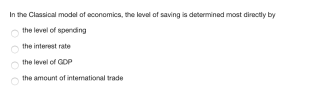 In the Classical model of economics, the level of saving is determined most directly by the level of spending the interest rate the level of GDP the amount of international trade
According to the classical model, an increase in the money supply causes a. output to increase...
According to the classical model, an increase in the money supply causes a. output to increase in the long run. b. the unemployment rate to fall in the long run. c. prices to rise in the long run. d. interest rates to fall in the long run.
According to classical economics: both real GDP and price level are determined by aggregate supply. both...
According to classical economics: both real GDP and price level are determined by aggregate supply. both real GDP and price level are determined by aggregate demand. real GDP is determined by aggregate demand, while the equilibrium price level is determined by aggregate supply. real GDP is determined by aggregate supply, while the equilibrium price level is determined by aggregate demand. price level cannot be changed as prices and wages are perfectly rigid. All members of the Federal Board of Governors...
According to the Classical model, what happens when there is a recessionary GDP gap? (check all...
According to the Classical model, what happens when there is a recessionary GDP gap? (check all that apply) a.The economy self-adjusts back to potential GDP b.The economy stays in recession unless the government acts to increase aggregate demand c.An excess supply of labor causes wage rates to fall d.The price level rises e.An excess demand for labor causes wage rates to rise What are the implications of wages being "sticky downward"? (check all that apply) a.Employers will lay off workers...
Assume the economy is in long-run equilibrium and AD decreases. According to the Classical Model, what...
 Assume the economy is in long-run equilibrium and AD decreases. According to the Classical Model, what will happen to the equilibrium level of GDP and the Price Level?
Consider a closed economy operating according to the Classical model. The production function is: Y =...
 Consider a closed economy operating according to the Classical
model. The production function is: Y = 40K^0:75L^0:25
Problem 1- Use the following information o answer questions 24 29 Consider a closed economy operating acoording to the Classical model. The production function is: 40K0.75し0.25 where K and L are the capital and labor used in the production of output Y The consumption and investment functions are: C 100 +0.8(Y-T) 1 = 1,450-20r where T is the amount of taxes and r...
Consider a closed economy operating according to the Classical
model. The production function is: Y = 40K^0:75L^0:25
Problem 1- Use the following information o answer questions 24 29 Consider a closed economy operating acoording to the Classical model. The production function is: 40K0.75し0.25 where K and L are the capital and labor used in the production of output Y The consumption and investment functions are: C 100 +0.8(Y-T) 1 = 1,450-20r where T is the amount of taxes and r...
queation 4&5 QUESTION 4 The classical model indicates that at the equilibrium interest rate, Saving is less than...
 queation 4&5
QUESTION 4 The classical model indicates that at the equilibrium interest rate, Saving is less than investment. unnecessary for investment. equal to investment, greater than investment. QUESTIONS Which of the following is a TRUE statement? Classical economists believed real GDP adjusted more than prices when aggregate demand fell, while Keynes argued that prices adjusted more than output. Classical economists believed price adjusted more than output when aggregate demand fell, while Keynes argued real GDP adjusted more than prices...
queation 4&5
QUESTION 4 The classical model indicates that at the equilibrium interest rate, Saving is less than investment. unnecessary for investment. equal to investment, greater than investment. QUESTIONS Which of the following is a TRUE statement? Classical economists believed real GDP adjusted more than prices when aggregate demand fell, while Keynes argued that prices adjusted more than output. Classical economists believed price adjusted more than output when aggregate demand fell, while Keynes argued real GDP adjusted more than prices...
According to the Classical model, if government suddenly spends more for space travel programs, this will...
 According to the Classical model, if government suddenly spends more for space travel programs, this will cause Aggregate Demand to fall, causing prices to fall, but no change in long-run GDP Aggregate Demand to rise, causing prices to increase, but no change in long-run GDP. Aggregate Demand to fall, causing prices to fall and long-run GDP to fall Aggregate Demand to rise, causing prices to rise and long-run GDP to rise.
 In the Classical model of economics, the level of saving is determined most directly by the level of spending the interest rate the level of GDP the amount of international trade
 Assume the economy is in long-run equilibrium and AD decreases. According to the Classical Model, what will happen to the equilibrium level of GDP and the Price Level?
 Consider a closed economy operating according to the Classical
model. The production function is: Y = 40K^0:75L^0:25
Problem 1- Use the following information o answer questions 24 29 Consider a closed economy operating acoording to the Classical model. The production function is: 40K0.75し0.25 where K and L are the capital and labor used in the production of output Y The consumption and investment functions are: C 100 +0.8(Y-T) 1 = 1,450-20r where T is the amount of taxes and r...
Consider a closed economy operating according to the Classical
model. The production function is: Y = 40K^0:75L^0:25
Problem 1- Use the following information o answer questions 24 29 Consider a closed economy operating acoording to the Classical model. The production function is: 40K0.75し0.25 where K and L are the capital and labor used in the production of output Y The consumption and investment functions are: C 100 +0.8(Y-T) 1 = 1,450-20r where T is the amount of taxes and r...
 queation 4&5
QUESTION 4 The classical model indicates that at the equilibrium interest rate, Saving is less than investment. unnecessary for investment. equal to investment, greater than investment. QUESTIONS Which of the following is a TRUE statement? Classical economists believed real GDP adjusted more than prices when aggregate demand fell, while Keynes argued that prices adjusted more than output. Classical economists believed price adjusted more than output when aggregate demand fell, while Keynes argued real GDP adjusted more than prices...
queation 4&5
QUESTION 4 The classical model indicates that at the equilibrium interest rate, Saving is less than investment. unnecessary for investment. equal to investment, greater than investment. QUESTIONS Which of the following is a TRUE statement? Classical economists believed real GDP adjusted more than prices when aggregate demand fell, while Keynes argued that prices adjusted more than output. Classical economists believed price adjusted more than output when aggregate demand fell, while Keynes argued real GDP adjusted more than prices...
 According to the Classical model, if government suddenly spends more for space travel programs, this will cause Aggregate Demand to fall, causing prices to fall, but no change in long-run GDP Aggregate Demand to rise, causing prices to increase, but no change in long-run GDP. Aggregate Demand to fall, causing prices to fall and long-run GDP to fall Aggregate Demand to rise, causing prices to rise and long-run GDP to rise.
Most questions answered within 3 hours.
-
Where is the error in this code sequence?
String s1 = "Hello";
String s2 = "ello";...
asked 10 months ago -
Financial data for Joel de Paris, Inc., for last year
follow:
Joel de Paris, Inc.
Balance...
asked 10 months ago -
Consider this reaction:
Al2(SO4)3 (aq)+ BaCl3
(aq) Al2Cl6 (aq)- +
3BaSO4(s) . What is the...
asked 10 months ago -
Suppose that Savneet is considering increasing her
recent random sample from 20 car rentals to 40...
asked 10 months ago -
Trucks arrive at an unloading terminal at an average rate of 120
per hour.
Trucks arrive...
asked 10 months ago -
Why are methanol and ethanol completely soluble in water while
octanol is not very little soluble....
asked 10 months ago -
A facilities manager at a university reads in a research report
that the mean amount of...
asked 10 months ago -
When the CuSO4 is rehydrated by adding water to the anhydrous
compound, is this an endothermic...
asked 10 months ago -
A ray of sunlight is passing from diamond into crown glass; the
angle of incidence is...
asked 10 months ago -
A block of mass 0.249 kg is placed on top of a light, vertical
spring of...
asked 10 months ago -
how do the kidneys compensate in the presences of acidosis
a) trigger hyperventilate
b) reserve acid...
asked 10 months ago -
Question 501 pts
The rental rate of capital to the firm increases. Which of the
following...
asked 10 months ago