The moment arm for a muscle force (motive in this case) is 0.025 m, and the...
- The moment arm for a muscle force (motive in this case) is 0.025 m, and the moment arm for the resistive force is 0.50 m. Calculate the mechanical advantage.
Homework Answers
Mechanical advantage is defined as the ratio of the force produced by a machine to the force applied to it.
Here, Mechanical advantage is = 0.025/0.50=0.05 .
Add Answer to:
The moment arm for a muscle force (motive in this case) is
0.025 m, and the...
The triceps muscle in the back of the upper arm extends the forearm. This muscle in...
 The triceps muscle in the back of the upper arm extends the forearm. This muscle in a professional boxer exerts a force of 2967 N with an effective perpendicular lever arm of 3.70 cm, producing an angular acceleration of the forearm of 110.0 rad /s'. What is the moment of inertia of the boxer's forearm? moment of inertia: kg-m? Question Credit: OpenStax College Physics
Dan's biceps muscle has a moment arm about the elbow joint of 0.011 m when the...
Dan's biceps muscle has a moment arm about the elbow joint of 0.011 m when the joint is held at a joint angle of 90 degrees and can produce a force of 526 N. His forearm is 0.24 m from the elbow joint center to the center of his hand where he grips a handle. His forearm has a mass of 1.2 kg and the center of mass is located directly above the elbow joint. How much force can he...
The triceps muscle in the back of the upper arm extends the forearm. This muscle in...
The triceps muscle in the back of the upper arm extends the forearm. This muscle in a professional boxer exerts a force of 2.00 ✕ 103 N with an effective perpendicular lever arm of 4.00 cm, producing an angular acceleration of the forearm of 135 rad/s2. What is the moment of inertia of the boxer's forearm? _kg·m2
The triceps muscle in the back of the upper arm extends the forearm. This muscle in...
The triceps muscle in the back of the upper arm extends the forearm. This muscle in a professional boxer exerts a force of 2.00 ✕ 103 N with an effective perpendicular lever arm of 5.00 cm, producing an angular acceleration of the forearm of 105 rad/s2. What is the moment of inertia (in kg·m2) of the boxer's forearm? kg·m2
Help! Thanks! The triceps muscle in the back of the upper arm extends the forearm. This...
 Help! Thanks!
The triceps muscle in the back of the upper arm extends the forearm. This muscle in a professional boxer exerts a force of 2007 N with an effective perpendicular lever arm of 2.05 cm, producing an angular acceleration of the forearm of 115.0 rad/s^2. What is the moment of inertia of the boxer's forearm?
Help! Thanks!
The triceps muscle in the back of the upper arm extends the forearm. This muscle in a professional boxer exerts a force of 2007 N with an effective perpendicular lever arm of 2.05 cm, producing an angular acceleration of the forearm of 115.0 rad/s^2. What is the moment of inertia of the boxer's forearm?
this is actuallu biomechanics. Activity 1: Moment arm and torque (6 pts) 1. What force is...
 this is actuallu biomechanics.
Activity 1: Moment arm and torque (6 pts) 1. What force is required to balance the seesaw in the following figure? 2. What force is required to balance the following seesaw? 80N 6.15k 12NM 5m -1500NM 15cm T: fx D 488- Fr 1 1.3s00 3m SM 1-297e Nm 500N 3. A force of 250 N is applied to a door 0.5 m from the hinge at an angle of 30° as shown, (1) What is the...
this is actuallu biomechanics.
Activity 1: Moment arm and torque (6 pts) 1. What force is required to balance the seesaw in the following figure? 2. What force is required to balance the following seesaw? 80N 6.15k 12NM 5m -1500NM 15cm T: fx D 488- Fr 1 1.3s00 3m SM 1-297e Nm 500N 3. A force of 250 N is applied to a door 0.5 m from the hinge at an angle of 30° as shown, (1) What is the...
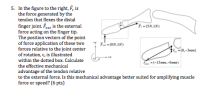
BPK201 In the figure to the right, ? is " the force generated by the tendon...
 BPK201
In the figure to the right, ? is "
the force generated by the tendon that flexes the distal
finger joint. ? is the external #$"
force acting on the finger tip.
The position vectors of the point
of force application of these two
forces relative to the joint center
of rotation, c, is illustrated
within the dotted box. Calculate
the effective mechanical
advantage of the tendon relative
to the external force. Is this mechanical advantage better suited
for...
BPK201
In the figure to the right, ? is "
the force generated by the tendon that flexes the distal
finger joint. ? is the external #$"
force acting on the finger tip.
The position vectors of the point
of force application of these two
forces relative to the joint center
of rotation, c, is illustrated
within the dotted box. Calculate
the effective mechanical
advantage of the tendon relative
to the external force. Is this mechanical advantage better suited
for...
When you hold your arm outstretched, it's supported primarily by the deltoid muscle.
When you hold your arm outstretched, it's supported primarily by the deltoid muscle. The given figure shows a case in which the deltoid exerts a 67 N force at 15 degrees to the horizontal. If the force-application point is 18 cm horizontally from the shoulder joint, what torque does the deltoid exert about the shoulder?
Find the elbow joint reaction force (magnitude and direction) and the elbow flexor muscle force for...
Find the elbow joint reaction force (magnitude and direction) and the elbow flexor muscle force for the instant described below. Assume the forearm, hand, and ball to be a single rigid body. This rigid body has a mass of 3 kg; it has a mass moment of inertia about its center of mass of 0.018 kg*m2 ; its center of mass is 19 cm from the center of the elbow joint. The rigid body has an angular acceleration (α) of...
#1 The elbow joint is flexed using the biceps brachii muscle, which remains essentially vertical as...
 #1 The elbow joint is flexed using the biceps brachii muscle, which remains essentially vertical as the arm moves in the vertical plane. If this muscle is located a distance a from the pivot point A on the humerus, determine the variation of the moment capacity about A if the constant force developed by the muscle is F. Plot these results of M vs. θ for-60 < θ < 80
 The triceps muscle in the back of the upper arm extends the forearm. This muscle in a professional boxer exerts a force of 2967 N with an effective perpendicular lever arm of 3.70 cm, producing an angular acceleration of the forearm of 110.0 rad /s'. What is the moment of inertia of the boxer's forearm? moment of inertia: kg-m? Question Credit: OpenStax College Physics
 Help! Thanks!
The triceps muscle in the back of the upper arm extends the forearm. This muscle in a professional boxer exerts a force of 2007 N with an effective perpendicular lever arm of 2.05 cm, producing an angular acceleration of the forearm of 115.0 rad/s^2. What is the moment of inertia of the boxer's forearm?
Help! Thanks!
The triceps muscle in the back of the upper arm extends the forearm. This muscle in a professional boxer exerts a force of 2007 N with an effective perpendicular lever arm of 2.05 cm, producing an angular acceleration of the forearm of 115.0 rad/s^2. What is the moment of inertia of the boxer's forearm?
 this is actuallu biomechanics.
Activity 1: Moment arm and torque (6 pts) 1. What force is required to balance the seesaw in the following figure? 2. What force is required to balance the following seesaw? 80N 6.15k 12NM 5m -1500NM 15cm T: fx D 488- Fr 1 1.3s00 3m SM 1-297e Nm 500N 3. A force of 250 N is applied to a door 0.5 m from the hinge at an angle of 30° as shown, (1) What is the...
this is actuallu biomechanics.
Activity 1: Moment arm and torque (6 pts) 1. What force is required to balance the seesaw in the following figure? 2. What force is required to balance the following seesaw? 80N 6.15k 12NM 5m -1500NM 15cm T: fx D 488- Fr 1 1.3s00 3m SM 1-297e Nm 500N 3. A force of 250 N is applied to a door 0.5 m from the hinge at an angle of 30° as shown, (1) What is the...
 BPK201
In the figure to the right, ? is "
the force generated by the tendon that flexes the distal
finger joint. ? is the external #$"
force acting on the finger tip.
The position vectors of the point
of force application of these two
forces relative to the joint center
of rotation, c, is illustrated
within the dotted box. Calculate
the effective mechanical
advantage of the tendon relative
to the external force. Is this mechanical advantage better suited
for...
BPK201
In the figure to the right, ? is "
the force generated by the tendon that flexes the distal
finger joint. ? is the external #$"
force acting on the finger tip.
The position vectors of the point
of force application of these two
forces relative to the joint center
of rotation, c, is illustrated
within the dotted box. Calculate
the effective mechanical
advantage of the tendon relative
to the external force. Is this mechanical advantage better suited
for...
 #1 The elbow joint is flexed using the biceps brachii muscle, which remains essentially vertical as the arm moves in the vertical plane. If this muscle is located a distance a from the pivot point A on the humerus, determine the variation of the moment capacity about A if the constant force developed by the muscle is F. Plot these results of M vs. θ for-60 < θ < 80
Most questions answered within 3 hours.
-
Where is the error in this code sequence?
String s1 = "Hello";
String s2 = "ello";...
asked 11 months ago -
Financial data for Joel de Paris, Inc., for last year
follow:
Joel de Paris, Inc.
Balance...
asked 11 months ago -
Consider this reaction:
Al2(SO4)3 (aq)+ BaCl3
(aq) Al2Cl6 (aq)- +
3BaSO4(s) . What is the...
asked 11 months ago -
Suppose that Savneet is considering increasing her
recent random sample from 20 car rentals to 40...
asked 11 months ago -
Trucks arrive at an unloading terminal at an average rate of 120
per hour.
Trucks arrive...
asked 11 months ago -
Why are methanol and ethanol completely soluble in water while
octanol is not very little soluble....
asked 11 months ago -
A facilities manager at a university reads in a research report
that the mean amount of...
asked 11 months ago -
When the CuSO4 is rehydrated by adding water to the anhydrous
compound, is this an endothermic...
asked 11 months ago -
A ray of sunlight is passing from diamond into crown glass; the
angle of incidence is...
asked 11 months ago -
A block of mass 0.249 kg is placed on top of a light, vertical
spring of...
asked 11 months ago -
how do the kidneys compensate in the presences of acidosis
a) trigger hyperventilate
b) reserve acid...
asked 11 months ago -
Question 501 pts
The rental rate of capital to the firm increases. Which of the
following...
asked 11 months ago