Can some help me solve these? I am confused on where to start. I know in...
Can some help me solve these? I am confused on where to start. I know in some cases, since there are no arguments, I can use *.
Function 3: In this function you must both return a value and
modify in-place the input
parameter (when needed). The only functions you are allowed to use
are range(), len(),
append(), insert(), remove(), pop() and the del keyword.
• Examples:
return value argument value after return
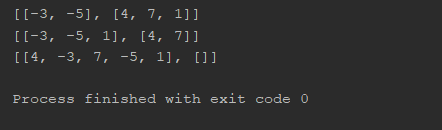
◦ func3([4,-3,7,-5,1]) → [-3,-5] [4,7,1]
◦ func3([4,-3,7,-5,1], 4) → [-3,-5,1] [4,7]
◦ func3([4,-3,7,-5,1], 10) → [4,-3,7,-5,1] [ ]
Homework Answers
def func3(numbers, t=0):
    less, high = [], []
    for num in numbers:
        if num < t:
            less.append(num)
        else:
            high.append(num)
    return [less, high]


print(func3([4, -3, 7, -5, 1]))
print(func3([4, -3, 7, -5, 1], 4))
print(func3([4, -3, 7, -5, 1], 10))
Add Answer to:
Can some help me solve these? I am confused on where to start. I
know in...
Can someone help me solve this? I need to return a single list. Not 2 separate...
Can someone help me solve this? I need to return a single list. Not 2 separate lists. I also need to modify a list of numbers. Function 3: In this function you must both return a value and modify in-place the input parameter (when needed). The only functions you are allowed to use are range(), len(), append(), insert(), remove(), pop() and the del keyword. • Examples: return value argument value after return ◦ func3([4,-3,7,-5,1]) → [-3,-5] [4,7,1] ◦ func3([4,-3,7,-5,1], 4)...
Based on the following examples of function calls and the respective return values, guess what are...
Based on the following examples of function calls and the respective return values, guess what are the signatures of the functions and then implement them. You are not allowed to use: a) modules, b) slicing, c) aliases, d) the list comprehension syntax (if you don’t know what that is then you can’t use it either). Function 3: In this function you must both return a value and modify in-place the input parameter (when needed). The only functions you are allowed...
Can someone solve these for me using only len(), range(), append(), and del keyword when needed...
Can someone solve these for me using only len(), range(), append(), and del keyword when needed as the directions state? No list comprehension, slicing, or importing modules. No chr or index(i) functions. def reduce_matrix(mat) • Reduces the size of matrix mat in half, in both dimensions, by merging adjacent elements • The new values of the matrix are the average of the respective merged elements • Return value is None. Variable mat is directly modified in memory • mat is...
hi i dont know and understand what this assignment wants me to do can some please...
hi i dont know and understand what this assignment wants me to do can some please explain it to me thank you Modify the print_face function to have a third parameter mouth and use it in the final print statement. def print_face(eye, face_char): print(' ', eye, ' ', eye) # Print eyes print(' ', face_char) # Print nose print(' ', face_char*5) # Print mouth return print_face('o', 'x')
I am confused, can you help me solve? Thank you Based on the traditional criterion (p...
I am confused, can you help me solve? Thank you Based on the traditional criterion (p < .05). Would p-value of 0.4 be considered statistically significant?
can some help me why it is erroring. I cannot find the mistake in the code....
can some help me why it is erroring. I cannot find the mistake in the code. It is to implment a circular double linked list. please and thank you ////////////////////////////////////////////////////////////////////////// HEADER FILE //////////////////////////////////////////////////////////////////////// #pragma once #include <cstdlib> template <typename T> class Node { public: T val; Node<T> *next; Node(T v) { val = v; next = NULL; } }; /////////////////////////////////////////////////////////////////////////////////// STACK.CPP FILE /////////////////////////////////////////////////////////////////////////////////// #include "Stack.h" template <typename T> class Stack {...
i am very confused with these questions. can someone help me solve? and can you explain...
 i am very confused with these questions. can someone help me
solve? and can you explain neatly and clearly? will rate, thank
you.
1. In this experiment, you will be generating time measurements that have both random uncertainty (Stran) and systematic uncertainty (dtsys). Using Eq. 4 as a starting point, write down an equation that will allow you to calculate &t from Stran and otsys 2. The acceleration due to gravity is related to the time, t, it takes the...
i am very confused with these questions. can someone help me
solve? and can you explain neatly and clearly? will rate, thank
you.
1. In this experiment, you will be generating time measurements that have both random uncertainty (Stran) and systematic uncertainty (dtsys). Using Eq. 4 as a starting point, write down an equation that will allow you to calculate &t from Stran and otsys 2. The acceleration due to gravity is related to the time, t, it takes the...
when i run it is still be "false" i don't know why. could you help me...
 when i run it is still be "false" i don't know why. could you
help me fix it and tell me which part is wrong??? specific answer
is better thanks!!!
Problem 6: (4 pts): Write a function that takes as an input parameter a string. It should return a Boolean value indicating whether the string is a palindrome or not. INPUT: “mom"->true “palindrome”->false “amanaplanpanama"->true 3 #include <iostream> #include <string.h> I using namespace std; string function(string str); int main() { function("palindrome");...
when i run it is still be "false" i don't know why. could you
help me fix it and tell me which part is wrong??? specific answer
is better thanks!!!
Problem 6: (4 pts): Write a function that takes as an input parameter a string. It should return a Boolean value indicating whether the string is a palindrome or not. INPUT: “mom"->true “palindrome”->false “amanaplanpanama"->true 3 #include <iostream> #include <string.h> I using namespace std; string function(string str); int main() { function("palindrome");...
Please help, I am very confused. I do not know where to start. Please show work...
 Please help, I am very confused. I do not know where to start.
Please show work and explain. THANK YOU SO MUCH
For a charge +25 uC: a. Rank the electric energy between Q and q for a charge q = +10 μC placed at points A-E Largest- 1._2_ 4 6.-Smallest b. Rank the electric energy between Q and q for a charge q +3 uC placed at points A-F _456.Smallest c. Rank the electric energy between Q and q...
Please help, I am very confused. I do not know where to start.
Please show work and explain. THANK YOU SO MUCH
For a charge +25 uC: a. Rank the electric energy between Q and q for a charge q = +10 μC placed at points A-E Largest- 1._2_ 4 6.-Smallest b. Rank the electric energy between Q and q for a charge q +3 uC placed at points A-F _456.Smallest c. Rank the electric energy between Q and q...
Can someone let me know what to do for this? In C Programming. HERE ARE INSTRUCTIONS:...
 Can someone let me know what to do for this? In C
Programming.
HERE ARE INSTRUCTIONS:
it is for a yahtzee game program.
Write function sumChance to do the following a. Return type int b. Parameter list array of dice c. Declare int variable sum d. Declare int variable die e. Loop through the dice array adding the value of each die to the variable sum f. Return variable sum Write function checkLgStraight to do the following a. Return type...
Can someone let me know what to do for this? In C
Programming.
HERE ARE INSTRUCTIONS:
it is for a yahtzee game program.
Write function sumChance to do the following a. Return type int b. Parameter list array of dice c. Declare int variable sum d. Declare int variable die e. Loop through the dice array adding the value of each die to the variable sum f. Return variable sum Write function checkLgStraight to do the following a. Return type...
 i am very confused with these questions. can someone help me
solve? and can you explain neatly and clearly? will rate, thank
you.
1. In this experiment, you will be generating time measurements that have both random uncertainty (Stran) and systematic uncertainty (dtsys). Using Eq. 4 as a starting point, write down an equation that will allow you to calculate &t from Stran and otsys 2. The acceleration due to gravity is related to the time, t, it takes the...
i am very confused with these questions. can someone help me
solve? and can you explain neatly and clearly? will rate, thank
you.
1. In this experiment, you will be generating time measurements that have both random uncertainty (Stran) and systematic uncertainty (dtsys). Using Eq. 4 as a starting point, write down an equation that will allow you to calculate &t from Stran and otsys 2. The acceleration due to gravity is related to the time, t, it takes the...
 when i run it is still be "false" i don't know why. could you
help me fix it and tell me which part is wrong??? specific answer
is better thanks!!!
Problem 6: (4 pts): Write a function that takes as an input parameter a string. It should return a Boolean value indicating whether the string is a palindrome or not. INPUT: “mom"->true “palindrome”->false “amanaplanpanama"->true 3 #include <iostream> #include <string.h> I using namespace std; string function(string str); int main() { function("palindrome");...
when i run it is still be "false" i don't know why. could you
help me fix it and tell me which part is wrong??? specific answer
is better thanks!!!
Problem 6: (4 pts): Write a function that takes as an input parameter a string. It should return a Boolean value indicating whether the string is a palindrome or not. INPUT: “mom"->true “palindrome”->false “amanaplanpanama"->true 3 #include <iostream> #include <string.h> I using namespace std; string function(string str); int main() { function("palindrome");...
 Please help, I am very confused. I do not know where to start.
Please show work and explain. THANK YOU SO MUCH
For a charge +25 uC: a. Rank the electric energy between Q and q for a charge q = +10 μC placed at points A-E Largest- 1._2_ 4 6.-Smallest b. Rank the electric energy between Q and q for a charge q +3 uC placed at points A-F _456.Smallest c. Rank the electric energy between Q and q...
Please help, I am very confused. I do not know where to start.
Please show work and explain. THANK YOU SO MUCH
For a charge +25 uC: a. Rank the electric energy between Q and q for a charge q = +10 μC placed at points A-E Largest- 1._2_ 4 6.-Smallest b. Rank the electric energy between Q and q for a charge q +3 uC placed at points A-F _456.Smallest c. Rank the electric energy between Q and q...
 Can someone let me know what to do for this? In C
Programming.
HERE ARE INSTRUCTIONS:
it is for a yahtzee game program.
Write function sumChance to do the following a. Return type int b. Parameter list array of dice c. Declare int variable sum d. Declare int variable die e. Loop through the dice array adding the value of each die to the variable sum f. Return variable sum Write function checkLgStraight to do the following a. Return type...
Can someone let me know what to do for this? In C
Programming.
HERE ARE INSTRUCTIONS:
it is for a yahtzee game program.
Write function sumChance to do the following a. Return type int b. Parameter list array of dice c. Declare int variable sum d. Declare int variable die e. Loop through the dice array adding the value of each die to the variable sum f. Return variable sum Write function checkLgStraight to do the following a. Return type...
Most questions answered within 3 hours.
-
Where is the error in this code sequence?
String s1 = "Hello";
String s2 = "ello";...
asked 10 months ago -
Financial data for Joel de Paris, Inc., for last year
follow:
Joel de Paris, Inc.
Balance...
asked 10 months ago -
Consider this reaction:
Al2(SO4)3 (aq)+ BaCl3
(aq) Al2Cl6 (aq)- +
3BaSO4(s) . What is the...
asked 10 months ago -
Suppose that Savneet is considering increasing her
recent random sample from 20 car rentals to 40...
asked 10 months ago -
Trucks arrive at an unloading terminal at an average rate of 120
per hour.
Trucks arrive...
asked 10 months ago -
Why are methanol and ethanol completely soluble in water while
octanol is not very little soluble....
asked 10 months ago -
A facilities manager at a university reads in a research report
that the mean amount of...
asked 10 months ago -
When the CuSO4 is rehydrated by adding water to the anhydrous
compound, is this an endothermic...
asked 10 months ago -
A ray of sunlight is passing from diamond into crown glass; the
angle of incidence is...
asked 10 months ago -
A block of mass 0.249 kg is placed on top of a light, vertical
spring of...
asked 10 months ago -
how do the kidneys compensate in the presences of acidosis
a) trigger hyperventilate
b) reserve acid...
asked 10 months ago -
Question 501 pts
The rental rate of capital to the firm increases. Which of the
following...
asked 10 months ago