A beam of 13.1eV electrons collides with a gas of H atoms knocking some of the...
A beam of 13.1eV electrons collides with a gas of H atoms knocking some of the atoms into excited energy states. Find the longest wavelength emitted when these atoms decay into lower energy states.
Homework Answers
 if any inquires please
comment
if any inquires please
commentAdd Answer to:
A beam of 13.1eV electrons collides with a gas of H atoms
knocking some of the...
Photons can be emitted from atoms by heating them up, where electrons are excited to higher...
Photons can be emitted from atoms by heating them up, where electrons are excited to higher energy states by thermal excitations and they subsequently decay to lower states releasing photons. Would it be possible to use the same method in practice in order to obtain photons as a result of the nuclear transitions? Explain how and why. Which temperature would be needed for that?
Electrons accelerated by a potential difference of 12.60 V pass through a gas of hydrogen atoms...
Electrons accelerated by a potential difference of 12.60 V pass through a gas of hydrogen atoms at room temperature. Calculate the wavelength of light emitted with the longest possible wavelength. Show work please!
Electrons with energy 13.0eV are fired at Hydrogen atoms in a gas discharge tube. (a) How...
Electrons with energy 13.0eV are fired at Hydrogen atoms in a gas discharge tube. (a) How many different spectral lines could be emitted by the Hydrogen atoms? (b) Determine the minimum wavelength spectral line that can be emitted from the Hydrogen atoms. (c) What are the energies of the photons produced in the transition in part (b)?
1. Luminescence is because of Photons emitted while excited electrons drop down I Knocking out of...
 1. Luminescence is because of Photons emitted while excited electrons drop down I Knocking out of electrons by photons Photons stimulated by photons O All 2. Internal conversion is where... The spin of an excited electron reverses, changing the state of the molecule (from singlet state to triplet state or vice versa) A molecule converts its excess energy to light, and emits a photon A molecule converts excess electronic energy to vibrational energy 3. Fluorescence typically occurs within 1055 10-5...
For the Bohr's quantization I need the solution for the whole question but for the second...
 For the Bohr's quantization I need the solution for the whole
question but for the second question I just need part (iii) but I
posted the whole question because it is all connected.
(c) Bohr's quantization conditions for the allowed state of an electron in the hy- drogen atom are given by h Ln=mvaIn= "2T where n 1,2, 3.. Consider a ten-fold ionized sodium ion, Na10+, which is obtained by removing ten electrons from a Na atom (Z = 11)....
For the Bohr's quantization I need the solution for the whole
question but for the second question I just need part (iii) but I
posted the whole question because it is all connected.
(c) Bohr's quantization conditions for the allowed state of an electron in the hy- drogen atom are given by h Ln=mvaIn= "2T where n 1,2, 3.. Consider a ten-fold ionized sodium ion, Na10+, which is obtained by removing ten electrons from a Na atom (Z = 11)....
The intensity (I(v)) of emitted light, at some v, for atoms or molecules moving at non-relativistic...
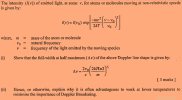 The intensity (I(v)) of emitted light, at some v, for atoms or molecules moving at non-relativistic speeds is given by: 169=160) ve where, m = Vo = V = mass of the atom or molecule natural frequency frequency of the light emitted by the moving species (i) Show that the full-width at half maximum (Av) of the above Doppler line shape is given by: Ar=2 (212) [3 marks ] Hence, or otherwise, explain why it is often advantagcous to work...
The stimulated emission of photons from the excited atoms in a gas laser is prompted by...
 The stimulated emission of photons from the excited atoms in a gas laser is prompted by which of the following? a. nearby presence of photons of same wavelength as those emitted b. high flux of electrons c. high voltage d. high temperature
In interstellar space near a star there is a region called H II in which highly excited H atoms can be produced in...
 In interstellar space near a star there is a region called H II in which highly excited H atoms can be produced in the process e + H = H (highly excited). When a highly excited hydrogen atom makes a transition from n = 109 to n= 108 a photon is emitted. Calculate The wavenumber, in cm and wavelength, in nm, of this radiation. The frequency, in sl, of this radiation. The energy, in Joules, of a single photon of...
What is the wavelength of light emitted by hydrogen atoms with electrons in the 5 level...
 What is the wavelength of light emitted by hydrogen atoms with
electrons in the 5 level going down to the 1 level? Give to the
nearest whole number.
Incorrect Question 1 0/4 pts The wavelength of light given off by electrons on their way down in hydrogen is given by: 1.0974 x 10⁷ ng where nf is the final (lower) level. What is the wavelength of light emitted by hydrogen atoms with electrons in the 5 level going down to...
What is the wavelength of light emitted by hydrogen atoms with
electrons in the 5 level going down to the 1 level? Give to the
nearest whole number.
Incorrect Question 1 0/4 pts The wavelength of light given off by electrons on their way down in hydrogen is given by: 1.0974 x 10⁷ ng where nf is the final (lower) level. What is the wavelength of light emitted by hydrogen atoms with electrons in the 5 level going down to...
Bohr Model - Line Spectra 2 -0.07.ww Bohr's Model - Line Spectrum in eV:E, --13.6.1-1.2.3.4. SE-EE...
 Bohr Model - Line Spectra 2 -0.07.ww Bohr's Model - Line Spectrum in eV:E, --13.6.1-1.2.3.4. SE-EE Emitted lines Electrons in hydrogen atoms are in the n = 7 state (orbit). They can jump up to higher orbits or down to lower orbits. Emitted Spectral lines: When electrons in the higher orbits (with higher energies) jump DOWN to Lower orbits (with lower energies), energies are emitted in the form of emitted photons (light). The electrons jump from n = 7 state...
 1. Luminescence is because of Photons emitted while excited electrons drop down I Knocking out of electrons by photons Photons stimulated by photons O All 2. Internal conversion is where... The spin of an excited electron reverses, changing the state of the molecule (from singlet state to triplet state or vice versa) A molecule converts its excess energy to light, and emits a photon A molecule converts excess electronic energy to vibrational energy 3. Fluorescence typically occurs within 1055 10-5...
 For the Bohr's quantization I need the solution for the whole
question but for the second question I just need part (iii) but I
posted the whole question because it is all connected.
(c) Bohr's quantization conditions for the allowed state of an electron in the hy- drogen atom are given by h Ln=mvaIn= "2T where n 1,2, 3.. Consider a ten-fold ionized sodium ion, Na10+, which is obtained by removing ten electrons from a Na atom (Z = 11)....
For the Bohr's quantization I need the solution for the whole
question but for the second question I just need part (iii) but I
posted the whole question because it is all connected.
(c) Bohr's quantization conditions for the allowed state of an electron in the hy- drogen atom are given by h Ln=mvaIn= "2T where n 1,2, 3.. Consider a ten-fold ionized sodium ion, Na10+, which is obtained by removing ten electrons from a Na atom (Z = 11)....
 The intensity (I(v)) of emitted light, at some v, for atoms or molecules moving at non-relativistic speeds is given by: 169=160) ve where, m = Vo = V = mass of the atom or molecule natural frequency frequency of the light emitted by the moving species (i) Show that the full-width at half maximum (Av) of the above Doppler line shape is given by: Ar=2 (212) [3 marks ] Hence, or otherwise, explain why it is often advantagcous to work...
 The stimulated emission of photons from the excited atoms in a gas laser is prompted by which of the following? a. nearby presence of photons of same wavelength as those emitted b. high flux of electrons c. high voltage d. high temperature
 In interstellar space near a star there is a region called H II in which highly excited H atoms can be produced in the process e + H = H (highly excited). When a highly excited hydrogen atom makes a transition from n = 109 to n= 108 a photon is emitted. Calculate The wavenumber, in cm and wavelength, in nm, of this radiation. The frequency, in sl, of this radiation. The energy, in Joules, of a single photon of...
 What is the wavelength of light emitted by hydrogen atoms with
electrons in the 5 level going down to the 1 level? Give to the
nearest whole number.
Incorrect Question 1 0/4 pts The wavelength of light given off by electrons on their way down in hydrogen is given by: 1.0974 x 10⁷ ng where nf is the final (lower) level. What is the wavelength of light emitted by hydrogen atoms with electrons in the 5 level going down to...
What is the wavelength of light emitted by hydrogen atoms with
electrons in the 5 level going down to the 1 level? Give to the
nearest whole number.
Incorrect Question 1 0/4 pts The wavelength of light given off by electrons on their way down in hydrogen is given by: 1.0974 x 10⁷ ng where nf is the final (lower) level. What is the wavelength of light emitted by hydrogen atoms with electrons in the 5 level going down to...
 Bohr Model - Line Spectra 2 -0.07.ww Bohr's Model - Line Spectrum in eV:E, --13.6.1-1.2.3.4. SE-EE Emitted lines Electrons in hydrogen atoms are in the n = 7 state (orbit). They can jump up to higher orbits or down to lower orbits. Emitted Spectral lines: When electrons in the higher orbits (with higher energies) jump DOWN to Lower orbits (with lower energies), energies are emitted in the form of emitted photons (light). The electrons jump from n = 7 state...
Most questions answered within 3 hours.
-
Where is the error in this code sequence?
String s1 = "Hello";
String s2 = "ello";...
asked 11 months ago -
Financial data for Joel de Paris, Inc., for last year
follow:
Joel de Paris, Inc.
Balance...
asked 11 months ago -
Consider this reaction:
Al2(SO4)3 (aq)+ BaCl3
(aq) Al2Cl6 (aq)- +
3BaSO4(s) . What is the...
asked 11 months ago -
Suppose that Savneet is considering increasing her
recent random sample from 20 car rentals to 40...
asked 11 months ago -
Trucks arrive at an unloading terminal at an average rate of 120
per hour.
Trucks arrive...
asked 11 months ago -
Why are methanol and ethanol completely soluble in water while
octanol is not very little soluble....
asked 11 months ago -
A facilities manager at a university reads in a research report
that the mean amount of...
asked 11 months ago -
When the CuSO4 is rehydrated by adding water to the anhydrous
compound, is this an endothermic...
asked 11 months ago -
A ray of sunlight is passing from diamond into crown glass; the
angle of incidence is...
asked 11 months ago -
A block of mass 0.249 kg is placed on top of a light, vertical
spring of...
asked 11 months ago -
how do the kidneys compensate in the presences of acidosis
a) trigger hyperventilate
b) reserve acid...
asked 11 months ago -
Question 501 pts
The rental rate of capital to the firm increases. Which of the
following...
asked 11 months ago