4. A space probe is orbiting Planet A. It is then moved into an orbit around...
Homework Answers
Gravitational constant = G
Mass of planet A = M1
Mass of planet B = M2 = 3M1
Mass of the probe = m
Radius of the orbit around planet A = R1
Radius of the orbit around planet B = R2 = 2R1
Orbital speed of the space probe around planet A = V1
Orbital speed of the space probe around planet B = V2
Period of orbit around planet A = T1
Period of orbit around planet B = T2
For planet A,
V1T1 = 2 R1
R1

The gravitational force between planet A and the space probe provides the required centripetal force for the circular motion of the probe.


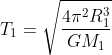
Similarly for planet B,
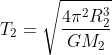

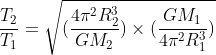

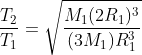


Ratio of the orbital period around planet B to that around planet A = 1.6
Add Answer to:
4. A space probe is orbiting Planet A. It is then moved into
an orbit around...
Question 1 3 pts Planet A and Planet B orbit a star in circular orbits. The...
 Question 1 3 pts Planet A and Planet B orbit a star in circular orbits. The orbital radius (distance from the star) of Planet B is twice the orbital radius of Planet A, and Planet B is eight times as massive as Planet A. How does the escape velocity of Planet B compare to that of Planet B? Find vB.esc/VAesc 2.0 sqrt(2.0) 3.2 0.25 0.063 0.50 0.33 4.0 Not enough information to know
A satellite is orbiting around a planet in a circular orbit. The radius of the orbit,...
A satellite is orbiting around a planet in a circular orbit. The radius of the orbit, measured from the center of the planet is R = 1.7 × 10⁷ m. The mass of the planet is M = 10 × 1024 kg. A) Express the magnitude of the gravitational force F in terms of M, R, the gravitational constant G, and the mass m of the satellite. B) Express the magnitude of the centripetal acceleration ac of the satellite in terms...
5) A satellite in a circular orbit of radius R around planet X has an orbital...
5) A satellite in a circular orbit of radius R around planet X has an orbital period T. If Planet X had one-fourth as much mass, the orbital period of this satellite in an orbit of the same radius would be: A) 2T B) T square root(2) C) T/4 D) T/2 E) 4
In 2017 astronomers discovered a planet orbiting the star HATS-43. The orbit of the planet around...
In 2017 astronomers discovered a planet orbiting the star HATS-43. The orbit of the planet around HATS-43 has semi-major axis 7.41×10⁹m, eccentricity 0.173, and period 4.39 days. Find the mass of HATS-43.
Satellite A has twice the mass of satellite B, and circles in the same orbit. Compare the two satellite's speeds. The s...
 Satellite A has twice the mass of satellite B, and circles in the same orbit. Compare the two satellite's speeds. The speed of B is twice the speed of A. The speed of Bis half the speed of A. A. The speed of Bis one-fourth the speed of A. The speed of B is equal to the speed of A. The speed of Halley's Comet, while traveling in its elliptical orbit around the Sun, O is constant increases as it...
Astronomers discover an exoplanet, a planet orbiting a star other than the Sun, that has an...
Astronomers discover an exoplanet, a planet orbiting a star other than the Sun, that has an orbital period of 4.01 Earth years in a circular orbit around its star, which has a measured mass of 3.97X10^30. Find the radius of the exoplanet's orbit.
planet X travels in a circular motion orbit around the Sun. The radius of Planet X...
planet X travels in a circular motion orbit around the Sun. The radius of Planet X is twice that of Earth. The year on Planet X is 540 Earth years. The mass of Planet X is half that of Earth. The mass of the sun is 1.99*10^30 kg. The Earth's orbital distance from the Sun is 1.50*10^11 m.
Two planets are orbiting around the same star. Planet A has four times the mass of...
 Two planets are orbiting around the same star. Planet A has four times the mass of planet B. Planet A is located twice further from the star than planet B. When comparing the force of gravity affecting both planets, what is the value of the following ratio: FG on A FG on B O A) 4 B) 2 C) 1 D) 1/2 O E) 1/4
A planet of mass ?=8.45×1024 kg is orbiting in a circular path a star of mass...
A planet of mass ?=8.45×1024 kg is orbiting in a circular path a star of mass ?=3.85×1029 kg . The radius of the orbit is ?=3.85×10⁷ km . What is the orbital period (in Earth days) of the planet ?planet ? ?planet=
2. A new Earth-like planet is found orbiting a distant star with a circular orbit. The...
 2. A new Earth-like planet is found orbiting a distant star with a circular orbit. The it takes 1.3 Earth years for the planet to make a full circle around it's star. The star has a radius 5 x 10¹¹m. The altitude of the planet's orbit is 8 x 10⁵ km. Find the mass of the star that the new planet is orbiting.
 Question 1 3 pts Planet A and Planet B orbit a star in circular orbits. The orbital radius (distance from the star) of Planet B is twice the orbital radius of Planet A, and Planet B is eight times as massive as Planet A. How does the escape velocity of Planet B compare to that of Planet B? Find vB.esc/VAesc 2.0 sqrt(2.0) 3.2 0.25 0.063 0.50 0.33 4.0 Not enough information to know
 Satellite A has twice the mass of satellite B, and circles in the same orbit. Compare the two satellite's speeds. The speed of B is twice the speed of A. The speed of Bis half the speed of A. A. The speed of Bis one-fourth the speed of A. The speed of B is equal to the speed of A. The speed of Halley's Comet, while traveling in its elliptical orbit around the Sun, O is constant increases as it...
 Two planets are orbiting around the same star. Planet A has four times the mass of planet B. Planet A is located twice further from the star than planet B. When comparing the force of gravity affecting both planets, what is the value of the following ratio: FG on A FG on B O A) 4 B) 2 C) 1 D) 1/2 O E) 1/4
 2. A new Earth-like planet is found orbiting a distant star with a circular orbit. The it takes 1.3 Earth years for the planet to make a full circle around it's star. The star has a radius 5 x 10¹¹m. The altitude of the planet's orbit is 8 x 10⁵ km. Find the mass of the star that the new planet is orbiting.
Most questions answered within 3 hours.
-
Where is the error in this code sequence?
String s1 = "Hello";
String s2 = "ello";...
asked 10 months ago -
Financial data for Joel de Paris, Inc., for last year
follow:
Joel de Paris, Inc.
Balance...
asked 10 months ago -
Consider this reaction:
Al2(SO4)3 (aq)+ BaCl3
(aq) Al2Cl6 (aq)- +
3BaSO4(s) . What is the...
asked 10 months ago -
Suppose that Savneet is considering increasing her
recent random sample from 20 car rentals to 40...
asked 10 months ago -
Trucks arrive at an unloading terminal at an average rate of 120
per hour.
Trucks arrive...
asked 10 months ago -
Why are methanol and ethanol completely soluble in water while
octanol is not very little soluble....
asked 10 months ago -
A facilities manager at a university reads in a research report
that the mean amount of...
asked 10 months ago -
When the CuSO4 is rehydrated by adding water to the anhydrous
compound, is this an endothermic...
asked 10 months ago -
A ray of sunlight is passing from diamond into crown glass; the
angle of incidence is...
asked 10 months ago -
A block of mass 0.249 kg is placed on top of a light, vertical
spring of...
asked 10 months ago -
how do the kidneys compensate in the presences of acidosis
a) trigger hyperventilate
b) reserve acid...
asked 10 months ago -
Question 501 pts
The rental rate of capital to the firm increases. Which of the
following...
asked 10 months ago