Describe each category of middleware and provide examples of when and how each category of middleware...
Describe each category of middleware and provide examples of when and how each category of middleware is used (among clients, servers, databases, and applications)
- Explain the relationship that each middleware category has with both the client and the server.
- Provide current examples of middleware.
Homework Answers
1.
- RPCs (Remote Procedure Call) Middleware
RPC exists since the 1970s and are the oldest type of middleware
and it is client/server based. One client can request a service
from a program located in another computer in a network without
having to understand network details. RPCs are synchronous; they
are labelled as “blocking middleware” because the requesting
program is suspended until the results of the remote procedure are
returned. As the RPC’s use a point-to-point communication, they are
not scalable and consume a vast amount of resources during they
processing. Despite the simplicity, the complexity of their
maintenance and performance issues, make this middleware not a
viable solution in scenarios where there are many applications
requiring integration.
- MOM (Message Oriented Middleware)
MOM is a type of middleware that uses messages as the method of integration. In MOM the applications are decoupled. Sender and receivers are never aware of each other; instead they send and receive the messages from the messaging system. It is the responsibility of the MOM to get the messages to their destinations. The messaging system uses channels that the applications can recognize and the messages can be sent and received asynchronously. The asynchronous paradigm allows the application to continue functioning after sending a request, so if the message is taking too much time it is possible to process other messages while is waiting, they can deal with down connections and queue messages until it’s viable to deliver them. One established standard is the JMS (Java Message Service), which provides an API and a set of rules that govern message delivery.
- Distributed Objects
Distributed objects are small applications that use standard interfaces and protocols to communicate with one another. Because they are built over standards, two compliant objects should be able to exchange information and carry out application functions by invoking each other methods. Two important distributed objects specifications exist, CORBA (Common Object Request Broker Architecture) and DCOM (Distributed Component Object Model). CORBA is an architecture and specification for creating, distributing, and managing distributed objects in a network. It allows different objects at different locations to communicate through an interface broker. CORBA uses the ORB (Object Request Broker). ORB allows an object to request services from other object without having to learn his location in a distributed network using the CORBA Interface repository to locate and communicate with a requested object. To enable interoperability between different ORBs, the GIOP (General Inter-ORB Protocol) and for the Internet, the IIOP Internet Inter-ORB Protocol) were implemented, both over TCP/IP. DCOM (Distributed Component Object Model) is the Microsoft equivalent to CORBA. It is based on the DOM (Component Object Model) and provides a set of concepts and interfaces that allows client objects request services from server objects in a network. DCOM allows bridging with CORBA, mapping COM objects to appear as CORBA objects.
- Database Middleware
Database middleware allows communications with a database from an application or between databases. It is used to extract information from either local or remote databases. It works with two database types, CLIs (Call level interfaces) and at-native database middleware. CLIs provide access to any number of relational databases through a common interface. On the other way, native database middleware uses the features and functions of a particular data base, using only native mechanisms. Although only communicate with one database, it has as advantages, improved performance and access to all low features of a particular type of database.
- Transaction Processing Monitors
They are a type of middleware that preserves the integrity of a transaction. TP Monitors support features such rollback, failover, auto restart, error logging and replication to eliminate single points of failure. They provide a location for application logic in addition to communication between two or more applications.
- Message Brokers
Message Brokers allow the information flow between applications. They can, regardless the type of application, join them using common rules and routing engines
NOTE: As per Chegg policy, I am allowed to answer only 1 long question (including sub-parts) on a single post. Kindly post the remaining questions separately and I will try to answer them. Sorry for the inconvenience caused.
Add Answer to:
Describe each category of middleware and provide examples of
when and how each category of middleware...
Client server Computing
1)Explain differences in Delivery Systems - Thick –v- Thin Client Programming a. Browser based –v- Desktop Executable applications b. Software distribution issues (pluses and minuses) for each2) Provide Illustrations and explanations of the Architectures.3)Explain: a) The history of Computer programming. b) The Hardware architecture used by modern computers (Von Neumann Architecture) c) Structured Programming – How it works/ Why we use it d) Compiler –v- interpreter –v- Hybrid (Just in time)4)Explain in detail the history and overview of the Client-Server Architecture a) Client-Server b) 3 Tier Systems c)...
Describe the components of an ICS and a SCADA system. Provide examples of how each are...
Describe the components of an ICS and a SCADA system. Provide examples of how each are configured and used in the industry.
Describe the difference between respiratory alteration related ventilation versus perfusion. Provide two examples of each alteration....
Describe the difference between respiratory alteration related ventilation versus perfusion. Provide two examples of each alteration. Explain the relationship between fluid balance and electrolyte levels. Pick an electrolyte and provide an example of how a change in fluid levels will affect that electrolyte. Compare and contrast acute renal failure (ARF) with chronic kidney disease (CKD). Provide at least three similarities and three differences. Discuss at least three different types of urinary incontinence, focusing on the underlying causes and possible treatments.
Provide examples of when each of the four business-level cooperative strategies and the three corporate-level...
Provide examples of when each of the four business-level cooperative strategies and the three corporate-level strategies might be used to expand a firm's operations and develop competitive advantage. Discuss how the Fed's balance sheet has changed over time since the crisis of 2007. Briefly explain some of the asset and liability changes
provide in 100 words describe some examples of both ethical and legal circumstances where you can...
provide in 100 words describe some examples of both ethical and legal circumstances where you can apply the concepts of beneficence and nonmaleficence. Explain how these concepts work within your examples to provide protection to both the organizations and the patients?
Describe a relationship you have with a service business. Provide specific examples. 2. Describe a relationship...
Describe a relationship you have with a service business. Provide specific examples. 2. Describe a relationship you have with a merchandising business. Be specific - discuss a real-world example. 3. Describe a relationship you have with a manufacturing business. Again, provide specifics. 4. Discuss the similarities and differences between proprietorships, partnerships, corporations, and LLC's. Provide examples that are unique from your classmates in your discussion. 5. Why do businesses need to follow accounting principles? What is accounting's role and what...
Explain what is a charismatic and transformation leader? Give examples of each and describe how they...
Explain what is a charismatic and transformation leader? Give examples of each and describe how they are different. Is the current Georgia State president a charismatic leader or a transformation leader? Why?
1. Discuss the difference between inheritance and composition. What are the advantages and disadvantages of each?...
1. Discuss the difference between inheritance and composition. What are the advantages and disadvantages of each? Can you implement one with the other? 2.How is a class similar to a database table? How is it different? How do these similarities and differences justify the need for class models and for data models? Or do they? 3.Discuss the difference between association and composition. What are the advantages and disadvantages of each? 4.When would you apply inheritance? When would you not? Provide...
Life is "organized". Complete the enclosed chart of biological organization and provide 2 examples of each....
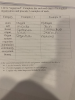 Life is "organized". Complete the enclosed chart of biological organization and provide 2 examples of each. Category Example # 1 Example #2 Oxygen muscle Epithiua Hydrogen Sken Connectul Stomach nenud Digestue atom cell tissue organ Organ system organism population community ecosystem biome At the successful completion of this assignment. students will be able to: . List the hierarchy terms in order • Provide examples of organisms in each category • Explain why some stages are included in others
Discuss the three types of restructuring strategies and provide real-word examples of instances when each has...
Discuss the three types of restructuring strategies and provide real-word examples of instances when each has been used. Cite any sources used to support your answer.
 Life is "organized". Complete the enclosed chart of biological organization and provide 2 examples of each. Category Example # 1 Example #2 Oxygen muscle Epithiua Hydrogen Sken Connectul Stomach nenud Digestue atom cell tissue organ Organ system organism population community ecosystem biome At the successful completion of this assignment. students will be able to: . List the hierarchy terms in order • Provide examples of organisms in each category • Explain why some stages are included in others
Most questions answered within 3 hours.
-
Where is the error in this code sequence?
String s1 = "Hello";
String s2 = "ello";...
asked 10 months ago -
Financial data for Joel de Paris, Inc., for last year
follow:
Joel de Paris, Inc.
Balance...
asked 10 months ago -
Consider this reaction:
Al2(SO4)3 (aq)+ BaCl3
(aq) Al2Cl6 (aq)- +
3BaSO4(s) . What is the...
asked 10 months ago -
Suppose that Savneet is considering increasing her
recent random sample from 20 car rentals to 40...
asked 10 months ago -
Trucks arrive at an unloading terminal at an average rate of 120
per hour.
Trucks arrive...
asked 10 months ago -
Why are methanol and ethanol completely soluble in water while
octanol is not very little soluble....
asked 10 months ago -
A facilities manager at a university reads in a research report
that the mean amount of...
asked 10 months ago -
When the CuSO4 is rehydrated by adding water to the anhydrous
compound, is this an endothermic...
asked 10 months ago -
A ray of sunlight is passing from diamond into crown glass; the
angle of incidence is...
asked 10 months ago -
A block of mass 0.249 kg is placed on top of a light, vertical
spring of...
asked 10 months ago -
how do the kidneys compensate in the presences of acidosis
a) trigger hyperventilate
b) reserve acid...
asked 10 months ago -
Question 501 pts
The rental rate of capital to the firm increases. Which of the
following...
asked 10 months ago