Why does [M(H2O)6]+2 exhibit an Orange color while [M(dmg)6] exhibits a blue color ?
Why does [M(H2O)6]+2 exhibit an Orange color while [M(dmg)6] exhibits a blue color ?
Homework Answers
H2O is a weak field ligand and (DMG) is a strong- field ligand. When both bind to the same metal,M the difference in energy between the higher and lower energy orbitals are different.
The relationship between the Δ0 and the energy of the
photons is given by E=h =hc/
=hc/ =Δo
=Δo
Since H2O is a weak field ligand , a lower difference is seen between the higher and lower energy level orbitals.Thus, the wavelength of the absorbed light will be high and the complementary wavelength will be low. Since, [M(H2O)6] absorbs a light of higher wavelength, it emits a light of lower wavelength thus, it appears orange.
Similarly , since DMG is a strong field ligand,a higher difference is seen between the higher and lower energy level orbitals.Thus, the wavelength of the absorbed light will be low and the complementary wavelength will be high Since, [M(H2O)6] absorbs a light of lower wavelength, it emits a light of higher wavelength thus, it appears blue.
Add Answer to:
Why does [M(H2O)6]+2 exhibit an
Orange color while [M(dmg)6] exhibits a blue color ?
250 Experiments 2. A solution causes a yellow color with thymol blue, an orange color with methyl orange, a color w...
 250 Experiments 2. A solution causes a yellow color with thymol blue, an orange color with methyl orange, a color with methyl red, and a yellow color with bromthymol blue. The pH must le between and The estimated pH is_ b. A solution causes a yellow color with thymol blue, yellow colors with both methylona and methyl red, and a green color with bromthymol blue. The pH must lie between and The estimated pH is
3. (6) The directed graph below with node 1, 2, 3 in orange color and directed edges in blue color. (Note, there is an...
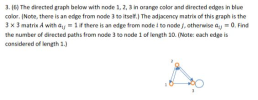 3. (6) The directed graph below with node 1, 2, 3 in orange color and directed edges in blue color. (Note, there is an edge from node 3 to itself.) The adjacency matrix of this graph is the 1 if there is an edge from node i to node j, otherwise ay 0. Find 3 x 3 matrix A with ay the number of directed paths from node 3 to node 1 of length 10. (Note: each edge is considered...
Why does the original color of the object turn into orange when temperature increases above room...
Why does the original color of the object turn into orange when temperature increases above room temperature?
10.9 The manufacturer of M&M's claims the following color breakdown: 24% blue, 20% orange, 16% green,...
 10.9 The manufacturer of M&M's claims the following color breakdown: 24% blue, 20% orange, 16% green, 14% yellow, 13% red, and 13% brown. A randomly selected bag of M&M's had 103 candies and yielded the following colors.
why bail blue of [Cu(H2O)6]^2+ can turn dark blue when ammonia solution is added?
why bail blue of [Cu(H2O)6]^2+ can turn dark blue when ammonia solution is added?
What Carbohydrates, other than Ketose, produce a reddish-orange solid with Benedict's reagent and a red color...
What Carbohydrates, other than Ketose, produce a reddish-orange solid with Benedict's reagent and a red color with Seliwanoff's reagent, and why? Why does starch produce no color change with Benedict's or Seliwanoff's reagent, but turns a blue-black color with Iodine reagent?
Which of the following best explains the fact that H2S boils at -60 Celsius while H2O...
Which of the following best explains the fact that H2S boils at -60 Celsius while H2O boils at 100 Celsius at normal atmospheric pressure? H2O has a larger net dipole moment than H2S. H2O has a smaller mass than H2S H2O exhibits hydrogen bonding interactions while H2S does not. H2O has London dispersion forces while H2S does not. Both H2O and H2S exhibit London dispersion forces, but the dispersion forces are stronger in H2O
Plain M&M's come in 6 different colors (Blue, Orange, Green, Yellow, Red, Brown) and are produced...
Plain M&M's come in 6 different colors (Blue, Orange, Green, Yellow, Red, Brown) and are produced at two different plants. M&M's that come from a plant in Tennessee are supposed to have the following distribution of colors: 20.7% Blue; 20.5% Orange; 19.8% Green; 13.5% Yellow; 13.1% Red and 12.4% Brown. Quality control at the plant is concerned the machine is not working correctly and that it is producing a different distribution of colors. They take a random sample of 940...
Can someone help with a Pareto Chart from this data? M&M Color FREQUENCY Red 13 Orange...
Can someone help with a Pareto Chart from this data? M&M Color FREQUENCY Red 13 Orange 25 Yellow 8 Brown 8 Blue 27 Green 19
2 Homework 1 1. In an experiment to investigate the effect of color of paper (blue,...
 2 Homework 1 1. In an experiment to investigate the effect of color of paper (blue, green, orange) on response rates for questionnaires distributed by the "wind shield method" in supermarket parking lots, 15 representative super- market parking lots were chosen in a metropolitan area and each color was assigmed at random to five of the lots. The response rates (in per- cent) are recorded in CH16PRO8.txt. The first column contains the response. In the second column, "1", "", and...
 250 Experiments 2. A solution causes a yellow color with thymol blue, an orange color with methyl orange, a color with methyl red, and a yellow color with bromthymol blue. The pH must le between and The estimated pH is_ b. A solution causes a yellow color with thymol blue, yellow colors with both methylona and methyl red, and a green color with bromthymol blue. The pH must lie between and The estimated pH is
 3. (6) The directed graph below with node 1, 2, 3 in orange color and directed edges in blue color. (Note, there is an edge from node 3 to itself.) The adjacency matrix of this graph is the 1 if there is an edge from node i to node j, otherwise ay 0. Find 3 x 3 matrix A with ay the number of directed paths from node 3 to node 1 of length 10. (Note: each edge is considered...
 10.9 The manufacturer of M&M's claims the following color breakdown: 24% blue, 20% orange, 16% green, 14% yellow, 13% red, and 13% brown. A randomly selected bag of M&M's had 103 candies and yielded the following colors.
 2 Homework 1 1. In an experiment to investigate the effect of color of paper (blue, green, orange) on response rates for questionnaires distributed by the "wind shield method" in supermarket parking lots, 15 representative super- market parking lots were chosen in a metropolitan area and each color was assigmed at random to five of the lots. The response rates (in per- cent) are recorded in CH16PRO8.txt. The first column contains the response. In the second column, "1", "", and...
Most questions answered within 3 hours.
-
Where is the error in this code sequence?
String s1 = "Hello";
String s2 = "ello";...
asked 10 months ago -
Financial data for Joel de Paris, Inc., for last year
follow:
Joel de Paris, Inc.
Balance...
asked 10 months ago -
Consider this reaction:
Al2(SO4)3 (aq)+ BaCl3
(aq) Al2Cl6 (aq)- +
3BaSO4(s) . What is the...
asked 10 months ago -
Suppose that Savneet is considering increasing her
recent random sample from 20 car rentals to 40...
asked 10 months ago -
Trucks arrive at an unloading terminal at an average rate of 120
per hour.
Trucks arrive...
asked 10 months ago -
Why are methanol and ethanol completely soluble in water while
octanol is not very little soluble....
asked 10 months ago -
A facilities manager at a university reads in a research report
that the mean amount of...
asked 10 months ago -
When the CuSO4 is rehydrated by adding water to the anhydrous
compound, is this an endothermic...
asked 10 months ago -
A ray of sunlight is passing from diamond into crown glass; the
angle of incidence is...
asked 10 months ago -
A block of mass 0.249 kg is placed on top of a light, vertical
spring of...
asked 10 months ago -
how do the kidneys compensate in the presences of acidosis
a) trigger hyperventilate
b) reserve acid...
asked 10 months ago -
Question 501 pts
The rental rate of capital to the firm increases. Which of the
following...
asked 10 months ago