Questions 1: A firm has the marginal private costs MPC = 2 + q. The aggregate...
Questions 1: A firm has the marginal private costs MPC = 2 + q. The aggregate demand for q is AD = 10 -q. What is the market equilibrium for q?
Question 2: Producing a unit of q has the marginal external costs of 2 in addition to the private costs described in question 1. For the demand function given in question 1, what is the socially efficient q?
Question 3: Assume that protecting a threatened species would produce non-use benefits of 1 million per year. For a discount rate of 5 %, what is the present value of these benefits?
Question 4: Assume that protecting the species would reduce land values by 10 millions because of use restriction (land conversion etc.). How much does the protection reduce the annual (yearly) profits from using the land if the interest rate is 5 % and there is a constant stream of benefits from using the land?
Homework Answers
Q1) at market eqm
Market demand is Marginal Benefit curve
So at eqm, AD = PMC
10-q = 2+q
8 = 2q
q* = 4
Q2) MEC = 2
SMC = sovial marginal cost
SMC = PMC + MEC
= 2+q + 2
= 4+q
At eqm, MB = SMC
10-q = 4+q
6 = 2q
q" = 3, socially efficient
C) Present value = 1/(1+ .05)
= 1/1.05
= .9524 $ million
its mandatory to answer only first question
Add Answer to:
Questions 1: A firm has the marginal private
costs MPC = 2 + q. The aggregate...
There is a paper plant facing the following marginal private cost of producing paper: MPC =...
There is a paper plant facing the following marginal private cost of producing paper: MPC = $100 + 4Q where Q = amount of paper produced This paper plant can freely dump waste into the river. This waste inflicts the following marginal externality cost to a downstream resort: MEC = $20 + 2Q where Q = amount of paper produced If the market demand for paper is: Demand = $400 - Q a. Without regulation, how much paper would be...
Question 6 (1 point) The following equations represent the MWTP (demand) function and the private MC...
 Question 6 (1 point) The following equations represent the MWTP (demand) function and the private MC functions in the market for some good where a negative externality (such as pollution) results in damages of $12 per unit of the good produced. MWTP 400 QD MPC 55+0.5QS The market equilibrium level of output will be equal to units. Question 7 (1 point) The following equations represent the MWTP function and the private MC function in the market for some good where...
1.2.3.4. 1.With an upward sloping marginal damage cost curve that starts at the origin, total damages...
 1.2.3.4.
1.With an upward sloping marginal damage cost curve that starts
at the origin, total damages for 20 units of emissions are equal to
the marginal damage cost of the 20th unit times 20.
A.True
B .False
In the following figure, social MWTP equals private MWTP plus external benefits from production. In this market, the socially efficient level of output is P MSC MPC Social MWTP Private MWTP none of the choices are correct Q3 In the following figure, the...
1.2.3.4.
1.With an upward sloping marginal damage cost curve that starts
at the origin, total damages for 20 units of emissions are equal to
the marginal damage cost of the 20th unit times 20.
A.True
B .False
In the following figure, social MWTP equals private MWTP plus external benefits from production. In this market, the socially efficient level of output is P MSC MPC Social MWTP Private MWTP none of the choices are correct Q3 In the following figure, the...
3. Suppose the marginal benefits (social and private) and costs (social and pri vate) per gallon...
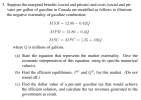 3. Suppose the marginal benefits (social and private) and costs (social and pri vate) per gallon of gasoline in Canada are modelled as follows to illustrate the negative externality of gasoline combustion: MSB- 12.80 0.42Q MPB- 12.80- 0.4Q MSC- MPC 1.25 +.02Q where Q is millions of gallons (a) State the equation that represents the market externality. Give the economic interpretation of this equation, using its specific numerical value(s) round off.) the efficient solution, and calculate the tax revenues generated...
Assume the marginal propensity to consume (MPC) is 0.75 and the economy is in recession with real GDP $1 trillion below...
Assume the marginal propensity to consume (MPC) is 0.75 and the economy is in recession with real GDP $1 trillion below full-employment real GDP. To achieve full employment, aggregate demand (AD) must be increased $2 trillion. Following discretionary fiscal policy, government spending should be increased:
The aggregate demand for a product is Q = 400 – 20P. The product has a...
The aggregate demand for a product is Q = 400 – 20P. The product has a marginal cost of production equal to (1/16)*Q + 2, i.e. the inverse-supply curve is P=(1/16)*Q + 2. a) Calculate the static efficient market price and quantity for this product. b) Calculate the net benefits (economic surplus) associated with this allocation and draw a graph explaining the outcome.
The market below exists for electricity produced by coal at a power plant in Tennessee. The...
 The market below exists for electricity produced by coal at a
power plant in Tennessee. The marginal private cost (MPC) curve
represents the private costs of the power plant to produce
electricity from coal. Coal-fired electricity generation, however,
also produces an externality. Production creates emissions that can
harm human health, contribute to greenhouse gas emissions, and
degrade ecosystems. The marginal social cost (MSC) curve represents
the cost of coal-fired electricity production in Tennessee,
including the costs borne by society. Use...
The market below exists for electricity produced by coal at a
power plant in Tennessee. The marginal private cost (MPC) curve
represents the private costs of the power plant to produce
electricity from coal. Coal-fired electricity generation, however,
also produces an externality. Production creates emissions that can
harm human health, contribute to greenhouse gas emissions, and
degrade ecosystems. The marginal social cost (MSC) curve represents
the cost of coal-fired electricity production in Tennessee,
including the costs borne by society. Use...
A firm producing plastic bags is polluting the air of the neighborhood. In the following table the marginal private cos...
A firm producing plastic bags is polluting the air of the neighborhood. In the following table the marginal private costs (MPC) of the firm for different quantities of plastic bags are reported together with the inverse demand for plastics bags. 2.4 Quantity 2.4 MPC (£) 2.4 Selling price (£) 2.4 1 2.4 11 2.4 28 2.4 2 2.4 12 2.4 26 2.4 3 2.4 13 2.4 24 2.4 4 2.4 14 2.4 22 2.4 5 2.4 15 2.4 20 2.4...
3. Assume that a mining company that produces ore sells its product for $40 per ton....
3. Assume that a mining company that produces ore sells its product for $40 per ton. Also assume that the $40/ton price represents both the private and social benefit per ton. In producing ore, the mining company incurs costs, represented by MPC. Furthermore, the pollution the company generates travels down stream to impose additional “external” costs on society, represented by MEC. Both the private costs to the firm and external costs are as follows. Ore Mined (tons) MPC to firm...
Depicted in the below figure 2. Firm 1 has marginal abatement cost "Firm 1 MAC 1" and Firm 2 has ...
 depicted in the below figure 2. Firm 1 has marginal abatement cost "Firm 1 MAC 1" and Firm 2 has marginal abatement cost "Firm 2 MAC 1" depicted in figure 1. The industry aggregate marginal abatement cost curve "Aggregate MAC 1 is given in figure 2. a. What is the optimal emissions tax? 0.5 points b. Given the optimal emissions tax what is the total cost of abatement and the total damages of pollution? 0.5 points] c. Suppose that Firm...
 Question 6 (1 point) The following equations represent the MWTP (demand) function and the private MC functions in the market for some good where a negative externality (such as pollution) results in damages of $12 per unit of the good produced. MWTP 400 QD MPC 55+0.5QS The market equilibrium level of output will be equal to units. Question 7 (1 point) The following equations represent the MWTP function and the private MC function in the market for some good where...
 1.2.3.4.
1.With an upward sloping marginal damage cost curve that starts
at the origin, total damages for 20 units of emissions are equal to
the marginal damage cost of the 20th unit times 20.
A.True
B .False
In the following figure, social MWTP equals private MWTP plus external benefits from production. In this market, the socially efficient level of output is P MSC MPC Social MWTP Private MWTP none of the choices are correct Q3 In the following figure, the...
1.2.3.4.
1.With an upward sloping marginal damage cost curve that starts
at the origin, total damages for 20 units of emissions are equal to
the marginal damage cost of the 20th unit times 20.
A.True
B .False
In the following figure, social MWTP equals private MWTP plus external benefits from production. In this market, the socially efficient level of output is P MSC MPC Social MWTP Private MWTP none of the choices are correct Q3 In the following figure, the...
 3. Suppose the marginal benefits (social and private) and costs (social and pri vate) per gallon of gasoline in Canada are modelled as follows to illustrate the negative externality of gasoline combustion: MSB- 12.80 0.42Q MPB- 12.80- 0.4Q MSC- MPC 1.25 +.02Q where Q is millions of gallons (a) State the equation that represents the market externality. Give the economic interpretation of this equation, using its specific numerical value(s) round off.) the efficient solution, and calculate the tax revenues generated...
 The market below exists for electricity produced by coal at a
power plant in Tennessee. The marginal private cost (MPC) curve
represents the private costs of the power plant to produce
electricity from coal. Coal-fired electricity generation, however,
also produces an externality. Production creates emissions that can
harm human health, contribute to greenhouse gas emissions, and
degrade ecosystems. The marginal social cost (MSC) curve represents
the cost of coal-fired electricity production in Tennessee,
including the costs borne by society. Use...
The market below exists for electricity produced by coal at a
power plant in Tennessee. The marginal private cost (MPC) curve
represents the private costs of the power plant to produce
electricity from coal. Coal-fired electricity generation, however,
also produces an externality. Production creates emissions that can
harm human health, contribute to greenhouse gas emissions, and
degrade ecosystems. The marginal social cost (MSC) curve represents
the cost of coal-fired electricity production in Tennessee,
including the costs borne by society. Use...
 depicted in the below figure 2. Firm 1 has marginal abatement cost "Firm 1 MAC 1" and Firm 2 has marginal abatement cost "Firm 2 MAC 1" depicted in figure 1. The industry aggregate marginal abatement cost curve "Aggregate MAC 1 is given in figure 2. a. What is the optimal emissions tax? 0.5 points b. Given the optimal emissions tax what is the total cost of abatement and the total damages of pollution? 0.5 points] c. Suppose that Firm...
Most questions answered within 3 hours.
-
Where is the error in this code sequence?
String s1 = "Hello";
String s2 = "ello";...
asked 11 months ago -
Financial data for Joel de Paris, Inc., for last year
follow:
Joel de Paris, Inc.
Balance...
asked 11 months ago -
Consider this reaction:
Al2(SO4)3 (aq)+ BaCl3
(aq) Al2Cl6 (aq)- +
3BaSO4(s) . What is the...
asked 11 months ago -
Suppose that Savneet is considering increasing her
recent random sample from 20 car rentals to 40...
asked 11 months ago -
Trucks arrive at an unloading terminal at an average rate of 120
per hour.
Trucks arrive...
asked 11 months ago -
Why are methanol and ethanol completely soluble in water while
octanol is not very little soluble....
asked 11 months ago -
A facilities manager at a university reads in a research report
that the mean amount of...
asked 11 months ago -
When the CuSO4 is rehydrated by adding water to the anhydrous
compound, is this an endothermic...
asked 11 months ago -
A ray of sunlight is passing from diamond into crown glass; the
angle of incidence is...
asked 11 months ago -
A block of mass 0.249 kg is placed on top of a light, vertical
spring of...
asked 11 months ago -
how do the kidneys compensate in the presences of acidosis
a) trigger hyperventilate
b) reserve acid...
asked 11 months ago -
Question 501 pts
The rental rate of capital to the firm increases. Which of the
following...
asked 11 months ago