I'm trying to model the velocity over time of a given time interval in python, but...
I'm trying to model the velocity over time of a given time interval in python, but my code won't work. I need to solve the problem using the Euler method.
import numpy as np
from matplotlib import pyplot as plt


def car(x0, v0, Cd, p, A, m, facc, T, dt):
    n = 0
    t = np.arange(0, T, dt)
    x = np.array([x0])
    v = np.array([v0])

    while x[n] > 0:
        x = np.append(x, x[n]+v[n]*dt)
        v = np.append(v, v[n]+(facc/m-(1/(2*m))*Cd*A*p*v[n])*dt)
        t = np.append(t, t[n]+dt)
        n += 0
return x, v, tHomework Answers
`Hey,
Note: Brother in case of any queries, just comment in box I would be very happy to assist all your queries
Note: Brother sometimes while uploading on HomeworkLib the indentations change. So, I request you to verify it with screenshot once. This is the link where I have saved the code too
https://onlinegdb.com/r1jFFqC9V
import numpy as np
def car(x0, v0, Cd, p, A, m, facc, T, dt):
n = 0
t = np.arange(0, T, dt)
x = np.array([x0])
v = np.array([v0])
while x[n] > 0:
x = np.append(x, x[n]-v[n]*dt)
v = np.append(v, v[n]+(facc/m-(1/(2*m))*Cd*A*p*v[n])*dt)
t = np.append(t, t[n]+dt)
n += 1
return x, v, t
car(1,12,0.8,5,10,5,76,7,0.01)
Kindly revert for any queries
Thanks.
Add Answer to:
I'm trying to model the velocity over time of a given time
interval in python, but...
IN PYTHON 3 GIVING THIS CODE %matplotlib inline import numpy as np import matplotlib.pyplot as plt...
IN PYTHON 3 GIVING THIS CODE %matplotlib inline import numpy as np import matplotlib.pyplot as plt from sklearn import datasets N_samples = 2000 X = np.array(datasets.make_circles(n_samples=N_samples, noise=0.05, factor=0.3)[0]) plt.scatter(X[:,0], X[:,1], alpha=0.8, s=64, edgecolors='white'); Use Spectral Clustering to cluster the points and visualize your result
Python, I need help with glob. I have a lot of data text files and want...
Python, I need help with glob. I have a lot of data text files and want to order them. However glob makes it in the wrong order. Have: data00120.txt data00022.txt data00045.txt etc Want: data00000.txt data00001.txt data00002.txt etc Code piece: def last_9chars(x): return(x[-9:]) files = sorted(glob.glob('data*.txt'),key = last_9chars) whole code: import numpy as np import matplotlib.pyplot as plt import glob import sys import re from prettytable import PrettyTable def last_9chars(x): return(x[-9:]) files = sorted(glob.glob('data*.txt'),key = last_9chars) x = PrettyTable() x.field_names =...
This is a python matplotlib question. So it would be great if you could show me...
 This is a python matplotlib question. So it would be
great if you could show me in python method.
I have this loadtxt that asked to plot histogram of
wind gusts(column 3) that lie in direction angle(column 2) from min
angle to max angle inclusively. I don't know how to include
min_angle and max_angle into my codes.
Histogram of wind gust speeds As before the file akaroawindgusts.txt contains hourly maximum wind gusts speeds at the Akaroa Electronic weather station (EW)...
This is a python matplotlib question. So it would be
great if you could show me in python method.
I have this loadtxt that asked to plot histogram of
wind gusts(column 3) that lie in direction angle(column 2) from min
angle to max angle inclusively. I don't know how to include
min_angle and max_angle into my codes.
Histogram of wind gust speeds As before the file akaroawindgusts.txt contains hourly maximum wind gusts speeds at the Akaroa Electronic weather station (EW)...
Python, given a code in class i just need help with the third bullet point ; using a and n (defin...
 Python, given a code in class i just need help with the third
bullet point ; using a and n (defined in the second picture of
python code) find the first digit for k! for k =1,...,n. you dont
have to type in all this code just help me write the code in the
first picture where it says: def benford(a):
b = [0 for d in range(1,10)]
#Do everthything in here
return b
2.2 Generating data In this assignment...
Python, given a code in class i just need help with the third
bullet point ; using a and n (defined in the second picture of
python code) find the first digit for k! for k =1,...,n. you dont
have to type in all this code just help me write the code in the
first picture where it says: def benford(a):
b = [0 for d in range(1,10)]
#Do everthything in here
return b
2.2 Generating data In this assignment...
I'm trying to use the odeint function or the quad function to integrate my integrand in my calc_H...
 I'm trying to use the odeint function or the quad
function to integrate my integrand in my calc_Hmatrix function.
however I am not sure what my y0 or my t would need to be in order
to get the code to run properly. please help, if more information
is needed I can update this post
Project1(1) (1) (1) x S ㄨ scipyintegrate.odeint--Sc | + jupyter Project1(1) ()(1r File Edit View Insert Cell Kernel Widgets Help +x4r,수+H.CCode Trusted Python 3 O...
I'm trying to use the odeint function or the quad
function to integrate my integrand in my calc_Hmatrix function.
however I am not sure what my y0 or my t would need to be in order
to get the code to run properly. please help, if more information
is needed I can update this post
Project1(1) (1) (1) x S ㄨ scipyintegrate.odeint--Sc | + jupyter Project1(1) ()(1r File Edit View Insert Cell Kernel Widgets Help +x4r,수+H.CCode Trusted Python 3 O...
Python 1 import matplotlib.pyplot as plt 2 import numpy as np 3 4 abscissa = np.arange(20) 5 plt....
 python
1
import matplotlib.pyplot as plt
2
import numpy as np
3
4
abscissa = np.arange(20)
5
plt.gca().set_prop_cycle(
’
color
’
, [
’
red
’
,
’
green
’
,
’
blue
’
,
’
black
’
])
6
7
class MyLine:
8
9
def __init__(self,
*
args,
**
options):
10
#TO DO: IMPLEMENT FUNCTION
11
pass
12
13
def draw(self):
14
plt.plot(abscissa,self.line(abscissa))
15
16
def get_line(self):
17
return "y = {0:.2f}x + {1:.2f}".format(self.slope,
self.intercept)
18
19
def __str__(self):...
python
1
import matplotlib.pyplot as plt
2
import numpy as np
3
4
abscissa = np.arange(20)
5
plt.gca().set_prop_cycle(
’
color
’
, [
’
red
’
,
’
green
’
,
’
blue
’
,
’
black
’
])
6
7
class MyLine:
8
9
def __init__(self,
*
args,
**
options):
10
#TO DO: IMPLEMENT FUNCTION
11
pass
12
13
def draw(self):
14
plt.plot(abscissa,self.line(abscissa))
15
16
def get_line(self):
17
return "y = {0:.2f}x + {1:.2f}".format(self.slope,
self.intercept)
18
19
def __str__(self):...
UPDATED: Hi, I have a problem in PYTHON I've been trying to solve. I'm given two csv files containing data in th...
 UPDATED:
Hi, I have a problem in PYTHON I've been trying to solve. I'm given
two csv files containing data in the following format of a micro
car that moves around:
Action, time, speed. (e.g. N,t,s= Move North for t seconds with
speed s meters per second)
One list is the expected results, the second list is the actual
(recorded) results.
The car can move N,S,E,W. The data entry will look like this:
(CSV files)
Expected: Actual:
I am trying...
UPDATED:
Hi, I have a problem in PYTHON I've been trying to solve. I'm given
two csv files containing data in the following format of a micro
car that moves around:
Action, time, speed. (e.g. N,t,s= Move North for t seconds with
speed s meters per second)
One list is the expected results, the second list is the actual
(recorded) results.
The car can move N,S,E,W. The data entry will look like this:
(CSV files)
Expected: Actual:
I am trying...
I'm trying to sort a list of students from a text file in python(3.7) with three separate sorting functions (Bubble, selection, insert) I'm not sure to why as its not working I'm going to...
I'm trying to sort a list of students from a text file in python(3.7) with three separate sorting functions (Bubble, selection, insert) I'm not sure to why as its not working I'm going to guess its because I'm not using the swap function I built. Every time I run it though I get an error that says the following Traceback (most recent call last): File "C:/Users/tkoto/Desktop/SearchAndSortLab.py", line 146, in <module> main() File "C:/Users/tkoto/Desktop/SearchAndSortLab.py", line 122, in main studentArray.gpaSort() File "C:/Users/tkoto/Desktop/SearchAndSortLab.py",...
python / visual studio Problem 1: Random Walk A random walk is a stochastic process. A...
 python / visual studio
Problem 1: Random Walk A random walk is a stochastic process. A stochastic process is a series of values that are not determined functionally, but probabilistically. The random walk is supposed to describe an inebriated person who, starting from the bar, intends to walk home, but because of intoxication instead randomly takes single steps either forward or backward, left or right. The person has no memory of any steps taken, so theoretically, the person shouldn't move...
python / visual studio
Problem 1: Random Walk A random walk is a stochastic process. A stochastic process is a series of values that are not determined functionally, but probabilistically. The random walk is supposed to describe an inebriated person who, starting from the bar, intends to walk home, but because of intoxication instead randomly takes single steps either forward or backward, left or right. The person has no memory of any steps taken, so theoretically, the person shouldn't move...
Python PageRank-Nibble Parallel PageRank-Nibble is described in in Section 3.3 of [1]. At a high level,...
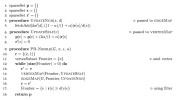 Python PageRank-Nibble
Parallel PageRank-Nibble is described in in Section 3.3 of [1].
At a high level, the algorithm works as follows:
each node i in the graph gets two new quantities, p[i] and
r[i]. p values will indicate the PageRank score, and r
holds a "residual"
add 1 unit of "mass" to r[seed]
iteratively, for each node i with "enough residual" r[i]
transfer some proportion of the mass in residual r[i] to
PageRank value p[i]
distribute some proportion of the remaining...
Python PageRank-Nibble
Parallel PageRank-Nibble is described in in Section 3.3 of [1].
At a high level, the algorithm works as follows:
each node i in the graph gets two new quantities, p[i] and
r[i]. p values will indicate the PageRank score, and r
holds a "residual"
add 1 unit of "mass" to r[seed]
iteratively, for each node i with "enough residual" r[i]
transfer some proportion of the mass in residual r[i] to
PageRank value p[i]
distribute some proportion of the remaining...
 This is a python matplotlib question. So it would be
great if you could show me in python method.
I have this loadtxt that asked to plot histogram of
wind gusts(column 3) that lie in direction angle(column 2) from min
angle to max angle inclusively. I don't know how to include
min_angle and max_angle into my codes.
Histogram of wind gust speeds As before the file akaroawindgusts.txt contains hourly maximum wind gusts speeds at the Akaroa Electronic weather station (EW)...
This is a python matplotlib question. So it would be
great if you could show me in python method.
I have this loadtxt that asked to plot histogram of
wind gusts(column 3) that lie in direction angle(column 2) from min
angle to max angle inclusively. I don't know how to include
min_angle and max_angle into my codes.
Histogram of wind gust speeds As before the file akaroawindgusts.txt contains hourly maximum wind gusts speeds at the Akaroa Electronic weather station (EW)...
 Python, given a code in class i just need help with the third
bullet point ; using a and n (defined in the second picture of
python code) find the first digit for k! for k =1,...,n. you dont
have to type in all this code just help me write the code in the
first picture where it says: def benford(a):
b = [0 for d in range(1,10)]
#Do everthything in here
return b
2.2 Generating data In this assignment...
Python, given a code in class i just need help with the third
bullet point ; using a and n (defined in the second picture of
python code) find the first digit for k! for k =1,...,n. you dont
have to type in all this code just help me write the code in the
first picture where it says: def benford(a):
b = [0 for d in range(1,10)]
#Do everthything in here
return b
2.2 Generating data In this assignment...
 I'm trying to use the odeint function or the quad
function to integrate my integrand in my calc_Hmatrix function.
however I am not sure what my y0 or my t would need to be in order
to get the code to run properly. please help, if more information
is needed I can update this post
Project1(1) (1) (1) x S ㄨ scipyintegrate.odeint--Sc | + jupyter Project1(1) ()(1r File Edit View Insert Cell Kernel Widgets Help +x4r,수+H.CCode Trusted Python 3 O...
I'm trying to use the odeint function or the quad
function to integrate my integrand in my calc_Hmatrix function.
however I am not sure what my y0 or my t would need to be in order
to get the code to run properly. please help, if more information
is needed I can update this post
Project1(1) (1) (1) x S ㄨ scipyintegrate.odeint--Sc | + jupyter Project1(1) ()(1r File Edit View Insert Cell Kernel Widgets Help +x4r,수+H.CCode Trusted Python 3 O...
 python
1
import matplotlib.pyplot as plt
2
import numpy as np
3
4
abscissa = np.arange(20)
5
plt.gca().set_prop_cycle(
’
color
’
, [
’
red
’
,
’
green
’
,
’
blue
’
,
’
black
’
])
6
7
class MyLine:
8
9
def __init__(self,
*
args,
**
options):
10
#TO DO: IMPLEMENT FUNCTION
11
pass
12
13
def draw(self):
14
plt.plot(abscissa,self.line(abscissa))
15
16
def get_line(self):
17
return "y = {0:.2f}x + {1:.2f}".format(self.slope,
self.intercept)
18
19
def __str__(self):...
python
1
import matplotlib.pyplot as plt
2
import numpy as np
3
4
abscissa = np.arange(20)
5
plt.gca().set_prop_cycle(
’
color
’
, [
’
red
’
,
’
green
’
,
’
blue
’
,
’
black
’
])
6
7
class MyLine:
8
9
def __init__(self,
*
args,
**
options):
10
#TO DO: IMPLEMENT FUNCTION
11
pass
12
13
def draw(self):
14
plt.plot(abscissa,self.line(abscissa))
15
16
def get_line(self):
17
return "y = {0:.2f}x + {1:.2f}".format(self.slope,
self.intercept)
18
19
def __str__(self):...
 UPDATED:
Hi, I have a problem in PYTHON I've been trying to solve. I'm given
two csv files containing data in the following format of a micro
car that moves around:
Action, time, speed. (e.g. N,t,s= Move North for t seconds with
speed s meters per second)
One list is the expected results, the second list is the actual
(recorded) results.
The car can move N,S,E,W. The data entry will look like this:
(CSV files)
Expected: Actual:
I am trying...
UPDATED:
Hi, I have a problem in PYTHON I've been trying to solve. I'm given
two csv files containing data in the following format of a micro
car that moves around:
Action, time, speed. (e.g. N,t,s= Move North for t seconds with
speed s meters per second)
One list is the expected results, the second list is the actual
(recorded) results.
The car can move N,S,E,W. The data entry will look like this:
(CSV files)
Expected: Actual:
I am trying...
 python / visual studio
Problem 1: Random Walk A random walk is a stochastic process. A stochastic process is a series of values that are not determined functionally, but probabilistically. The random walk is supposed to describe an inebriated person who, starting from the bar, intends to walk home, but because of intoxication instead randomly takes single steps either forward or backward, left or right. The person has no memory of any steps taken, so theoretically, the person shouldn't move...
python / visual studio
Problem 1: Random Walk A random walk is a stochastic process. A stochastic process is a series of values that are not determined functionally, but probabilistically. The random walk is supposed to describe an inebriated person who, starting from the bar, intends to walk home, but because of intoxication instead randomly takes single steps either forward or backward, left or right. The person has no memory of any steps taken, so theoretically, the person shouldn't move...
 Python PageRank-Nibble
Parallel PageRank-Nibble is described in in Section 3.3 of [1].
At a high level, the algorithm works as follows:
each node i in the graph gets two new quantities, p[i] and
r[i]. p values will indicate the PageRank score, and r
holds a "residual"
add 1 unit of "mass" to r[seed]
iteratively, for each node i with "enough residual" r[i]
transfer some proportion of the mass in residual r[i] to
PageRank value p[i]
distribute some proportion of the remaining...
Python PageRank-Nibble
Parallel PageRank-Nibble is described in in Section 3.3 of [1].
At a high level, the algorithm works as follows:
each node i in the graph gets two new quantities, p[i] and
r[i]. p values will indicate the PageRank score, and r
holds a "residual"
add 1 unit of "mass" to r[seed]
iteratively, for each node i with "enough residual" r[i]
transfer some proportion of the mass in residual r[i] to
PageRank value p[i]
distribute some proportion of the remaining...
Most questions answered within 3 hours.
-
Where is the error in this code sequence?
String s1 = "Hello";
String s2 = "ello";...
asked 11 months ago -
Financial data for Joel de Paris, Inc., for last year
follow:
Joel de Paris, Inc.
Balance...
asked 11 months ago -
Consider this reaction:
Al2(SO4)3 (aq)+ BaCl3
(aq) Al2Cl6 (aq)- +
3BaSO4(s) . What is the...
asked 11 months ago -
Suppose that Savneet is considering increasing her
recent random sample from 20 car rentals to 40...
asked 11 months ago -
Trucks arrive at an unloading terminal at an average rate of 120
per hour.
Trucks arrive...
asked 11 months ago -
Why are methanol and ethanol completely soluble in water while
octanol is not very little soluble....
asked 11 months ago -
A facilities manager at a university reads in a research report
that the mean amount of...
asked 11 months ago -
When the CuSO4 is rehydrated by adding water to the anhydrous
compound, is this an endothermic...
asked 11 months ago -
A ray of sunlight is passing from diamond into crown glass; the
angle of incidence is...
asked 11 months ago -
A block of mass 0.249 kg is placed on top of a light, vertical
spring of...
asked 11 months ago -
how do the kidneys compensate in the presences of acidosis
a) trigger hyperventilate
b) reserve acid...
asked 11 months ago -
Question 501 pts
The rental rate of capital to the firm increases. Which of the
following...
asked 11 months ago