Question 1 (20 marks) As an International Economics student, discuss the challenges that South Africa will...
Question 1 (20 marks)
As an International Economics student, discuss the challenges that South Africa will face or is facing in implementing free higher education in the presence of rising international debt.
Homework Answers
Requests for free higher education and other social services such as Africa's health and basic education date back to the 1960s. These requirements were prevalent across different ideologically oriented nations – from socialist Mozambique and Tanzania to capitalist Kenya and Uganda.
One of the unintended implications is that free higher education has created gross inequities. It reproduced and strengthened colonial and post-colonial inequities in the allocation of universities and privileges, and hence of free greater education beneficiaries.
As is well recognized, in most African nations, the distribution of (excellent quality) schools in both colonial and post-colonial periods has been and remains uneven. It was the kids of the new political and company elite that gained access to free education mostly.
Over the previous two years, universities in South Africa have experienced unprecedented student revolts. It started as demonstrations against an increase in tuition fees and asking for the removal of apartheid symbols from the past. It gained momentum quickly and became a domestic student uprising with requests for free access and higher education decolonization.
Student protests are a significant expression of South Africa's greater education transformation weaknesses and failures. They also arose as an illustration of growing frustration with South Africa's government, its extreme inequalities, its rampant poverty, and its enormous youth unemployment. For many years, social protests and community actions have been a characteristic of South African politics, but student protests have been the first significant national protest wave.
The South African government and the Treasury have the economic resources at their disposal, but it may not be a useful answer to abolish charges in an exceptionally unequal culture. In fact, it can help to increase inequalities. There is a substantial minority of learners with more than 600 000 parents who can afford tuition. Indeed, some of them have their private high school schooling with greater charges than the most costly universities in South Africa. In addition, graduation from an organization of higher education paves the way for well-paid employment in the government or private sector
Lastly, the problems facing South African greater education are related to the broader problems facing South Africa: bad financial growth, elevated youth unemployment, and the paralyzing impact of the ANC management and government political crisis. The protests of the students couldn't really transform themselves into a force for political change. In the larger South African political image, it plays a much more restricted role than maybe initially anticipated. It suffers from the lack of any clear management or approach to move forward. In this sense, the student protests have become a symptom of South Africa's many ills and failures rather than a force for change.
Add Answer to:
Question 1 (20 marks)
As an International Economics student, discuss the challenges
that South Africa will...
Question 1 (10 marks) Themba is a natural person who is a resident of South Africa....
 Question 1 (10 marks) Themba is a natural person who is a resident of South Africa. He runs his own business which makes him a sole proprietor. Thembas VAT registration is based on the payment basis of VAT. Thembas bank statement for the period of June was inclusive of the following items: | Cash receipts 68 400 Cash sales made in the republic of South Africa Consulting fees 50 000 Cash payments Bank charges Fuel Entertainment expenses Rentals paid Interest...
QUESTION 1 (20 Marks) 1.1 Discuss some of the features prevalent in the South African economy,...
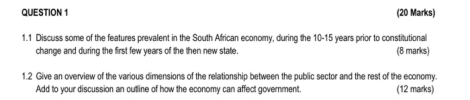 QUESTION 1 (20 Marks) 1.1 Discuss some of the features prevalent in the South African economy, during the 10-15 years prior to constitutional change and during the first few years of the then new state. (8 marks) 1.2 Give an overview of the various dimensions of the relationship between the public sector and the rest of the economy. Add to your discussion an outline of how the economy can affect government. (12 marks)
Question 2 (1 point) Figure: A Tariff on Oranges in South Africa Price of oranges Domestic...
 Question 2 (1 point) Figure: A Tariff on Oranges in South Africa Price of oranges Domestic supply Domestic domand O, O, G C Quantity of oranges Rolerance 20 (Figure: A Tariff on Oranges in South Africa) Look at the figure A Tariff on Oranges in South Africa. When the government imposes a tariff on imported oranges, the price of oranges in South Africa rises from Pw to Prand the volume of imports falls to: Oa) - Q Ob) Ca -...
I need help with this question please! - 4 marks) In economics, a population's Lorenz curve...
 I need help with this question
please!
- 4 marks) In economics, a population's Lorenz curve L(2) gives the percentage (as a decimal) of the country's distribution of wealth among the lowest earning percentage 2 (as a decimal between 0 and 1; e.g., 35% means x = 0.35) of the population. As an example, if L(0.4) = 0.1, then this means that the lowest earning 40% of households have only 10% of the entire economy's wealth. The line y =...
I need help with this question
please!
- 4 marks) In economics, a population's Lorenz curve L(2) gives the percentage (as a decimal) of the country's distribution of wealth among the lowest earning percentage 2 (as a decimal between 0 and 1; e.g., 35% means x = 0.35) of the population. As an example, if L(0.4) = 0.1, then this means that the lowest earning 40% of households have only 10% of the entire economy's wealth. The line y =...
business and society QUESTION 5 (20 Marks) 5.1 Critically discuss the principles of ethical decision making (10 mark...
 business and society
QUESTION 5 (20 Marks) 5.1 Critically discuss the principles of ethical decision making (10 marks) 5.2 Propose some practical suggestions for making ethical decisions. (5 marks) 5.3 Indicate why ethical decision making can be difficult (5 marks) QUESTION 6 (20 Marks) There are SEVEN (7) key environments that affect businesses today. Discuss these in the light of forces pushing towards more freedom (free markets) and those pushing towards more state control
QUESTION 5 (20 Marks) 5.1 Critically...
business and society
QUESTION 5 (20 Marks) 5.1 Critically discuss the principles of ethical decision making (10 marks) 5.2 Propose some practical suggestions for making ethical decisions. (5 marks) 5.3 Indicate why ethical decision making can be difficult (5 marks) QUESTION 6 (20 Marks) There are SEVEN (7) key environments that affect businesses today. Discuss these in the light of forces pushing towards more freedom (free markets) and those pushing towards more state control
QUESTION 5 (20 Marks) 5.1 Critically...
Question 1 The international financial reporting standards (IFRS) are playing an increasingly important role in global...
 Question 1 The international financial reporting standards (IFRS) are playing an increasingly important role in global financial reporting. What are the benefits and challenges of adopting IFRS in Malaysia? Explain. (20 marks)
Question 3 (20 marks) Consider the optimization problem faced by a Monash University administrator who has the task...
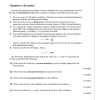 Question 3 (20 marks) Consider the optimization problem faced by a Monash University administrator who has the task of maximizing revenue from student fees subject to the following constraints: 1. There is a total of 1000 places available at Monash which must be distributed between domestic students and international students 2、 The University receives a fixed grant of SG from the Government to cover its operations, and may charge international students whatever it likes. (Sound familiar!) 3. Letxdenote the number...
QUESTION 1 The International Financial Reporting Standards (IFRS) are playing an increasingly important role in global...
 QUESTION 1 The International Financial Reporting Standards (IFRS) are playing an increasingly important role in global financial reporting. What are the benefits and challenges of adopting IFRS to your country? Explain. (20 marks)
ignore the image. 1 Discuss the five macroeconomic goals of south africa and why they are...
 ignore the image.
1 Discuss the five macroeconomic goals of south africa and why
they are important.
2. Distinguish between gross donestic product and gross
national product
QUESTION 3 BANK RECONCILIATION (20 MARKS) 3.1 The following information was extracted from the accounting records of Swanky Traders. REQUIRED Prepare the Bank account in the Ledger of Swanky Traders for March 2019 showing the entries from the information below that would have been made in the Cash Journals. Show clearly the contra...
ignore the image.
1 Discuss the five macroeconomic goals of south africa and why
they are important.
2. Distinguish between gross donestic product and gross
national product
QUESTION 3 BANK RECONCILIATION (20 MARKS) 3.1 The following information was extracted from the accounting records of Swanky Traders. REQUIRED Prepare the Bank account in the Ledger of Swanky Traders for March 2019 showing the entries from the information below that would have been made in the Cash Journals. Show clearly the contra...
SECTION A [40 MARKS] Answer ALL questions in this section. QUESTION 1 (20 Marks) Choose the...
 SECTION A [40 MARKS] Answer ALL questions in this section. QUESTION 1 (20 Marks) Choose the most appropriate answer. Write down numbers 1.1 to 1.10 in your answer book and next to each number write the letter that represents the correct answer. E.g. 1.11 a 1.1 Which one of the following statements is incorrect? a) b) c) The three major flows in the economy are total production, total income and total spending There are two sets of markets in a...
 Question 1 (10 marks) Themba is a natural person who is a resident of South Africa. He runs his own business which makes him a sole proprietor. Thembas VAT registration is based on the payment basis of VAT. Thembas bank statement for the period of June was inclusive of the following items: | Cash receipts 68 400 Cash sales made in the republic of South Africa Consulting fees 50 000 Cash payments Bank charges Fuel Entertainment expenses Rentals paid Interest...
 QUESTION 1 (20 Marks) 1.1 Discuss some of the features prevalent in the South African economy, during the 10-15 years prior to constitutional change and during the first few years of the then new state. (8 marks) 1.2 Give an overview of the various dimensions of the relationship between the public sector and the rest of the economy. Add to your discussion an outline of how the economy can affect government. (12 marks)
 Question 2 (1 point) Figure: A Tariff on Oranges in South Africa Price of oranges Domestic supply Domestic domand O, O, G C Quantity of oranges Rolerance 20 (Figure: A Tariff on Oranges in South Africa) Look at the figure A Tariff on Oranges in South Africa. When the government imposes a tariff on imported oranges, the price of oranges in South Africa rises from Pw to Prand the volume of imports falls to: Oa) - Q Ob) Ca -...
 I need help with this question
please!
- 4 marks) In economics, a population's Lorenz curve L(2) gives the percentage (as a decimal) of the country's distribution of wealth among the lowest earning percentage 2 (as a decimal between 0 and 1; e.g., 35% means x = 0.35) of the population. As an example, if L(0.4) = 0.1, then this means that the lowest earning 40% of households have only 10% of the entire economy's wealth. The line y =...
I need help with this question
please!
- 4 marks) In economics, a population's Lorenz curve L(2) gives the percentage (as a decimal) of the country's distribution of wealth among the lowest earning percentage 2 (as a decimal between 0 and 1; e.g., 35% means x = 0.35) of the population. As an example, if L(0.4) = 0.1, then this means that the lowest earning 40% of households have only 10% of the entire economy's wealth. The line y =...
 business and society
QUESTION 5 (20 Marks) 5.1 Critically discuss the principles of ethical decision making (10 marks) 5.2 Propose some practical suggestions for making ethical decisions. (5 marks) 5.3 Indicate why ethical decision making can be difficult (5 marks) QUESTION 6 (20 Marks) There are SEVEN (7) key environments that affect businesses today. Discuss these in the light of forces pushing towards more freedom (free markets) and those pushing towards more state control
QUESTION 5 (20 Marks) 5.1 Critically...
business and society
QUESTION 5 (20 Marks) 5.1 Critically discuss the principles of ethical decision making (10 marks) 5.2 Propose some practical suggestions for making ethical decisions. (5 marks) 5.3 Indicate why ethical decision making can be difficult (5 marks) QUESTION 6 (20 Marks) There are SEVEN (7) key environments that affect businesses today. Discuss these in the light of forces pushing towards more freedom (free markets) and those pushing towards more state control
QUESTION 5 (20 Marks) 5.1 Critically...
 Question 1 The international financial reporting standards (IFRS) are playing an increasingly important role in global financial reporting. What are the benefits and challenges of adopting IFRS in Malaysia? Explain. (20 marks)
 Question 3 (20 marks) Consider the optimization problem faced by a Monash University administrator who has the task of maximizing revenue from student fees subject to the following constraints: 1. There is a total of 1000 places available at Monash which must be distributed between domestic students and international students 2、 The University receives a fixed grant of SG from the Government to cover its operations, and may charge international students whatever it likes. (Sound familiar!) 3. Letxdenote the number...
 QUESTION 1 The International Financial Reporting Standards (IFRS) are playing an increasingly important role in global financial reporting. What are the benefits and challenges of adopting IFRS to your country? Explain. (20 marks)
 ignore the image.
1 Discuss the five macroeconomic goals of south africa and why
they are important.
2. Distinguish between gross donestic product and gross
national product
QUESTION 3 BANK RECONCILIATION (20 MARKS) 3.1 The following information was extracted from the accounting records of Swanky Traders. REQUIRED Prepare the Bank account in the Ledger of Swanky Traders for March 2019 showing the entries from the information below that would have been made in the Cash Journals. Show clearly the contra...
ignore the image.
1 Discuss the five macroeconomic goals of south africa and why
they are important.
2. Distinguish between gross donestic product and gross
national product
QUESTION 3 BANK RECONCILIATION (20 MARKS) 3.1 The following information was extracted from the accounting records of Swanky Traders. REQUIRED Prepare the Bank account in the Ledger of Swanky Traders for March 2019 showing the entries from the information below that would have been made in the Cash Journals. Show clearly the contra...
 SECTION A [40 MARKS] Answer ALL questions in this section. QUESTION 1 (20 Marks) Choose the most appropriate answer. Write down numbers 1.1 to 1.10 in your answer book and next to each number write the letter that represents the correct answer. E.g. 1.11 a 1.1 Which one of the following statements is incorrect? a) b) c) The three major flows in the economy are total production, total income and total spending There are two sets of markets in a...
Most questions answered within 3 hours.
-
Where is the error in this code sequence?
String s1 = "Hello";
String s2 = "ello";...
asked 10 months ago -
Financial data for Joel de Paris, Inc., for last year
follow:
Joel de Paris, Inc.
Balance...
asked 10 months ago -
Consider this reaction:
Al2(SO4)3 (aq)+ BaCl3
(aq) Al2Cl6 (aq)- +
3BaSO4(s) . What is the...
asked 10 months ago -
Suppose that Savneet is considering increasing her
recent random sample from 20 car rentals to 40...
asked 10 months ago -
Trucks arrive at an unloading terminal at an average rate of 120
per hour.
Trucks arrive...
asked 10 months ago -
Why are methanol and ethanol completely soluble in water while
octanol is not very little soluble....
asked 10 months ago -
A facilities manager at a university reads in a research report
that the mean amount of...
asked 10 months ago -
When the CuSO4 is rehydrated by adding water to the anhydrous
compound, is this an endothermic...
asked 10 months ago -
A ray of sunlight is passing from diamond into crown glass; the
angle of incidence is...
asked 10 months ago -
A block of mass 0.249 kg is placed on top of a light, vertical
spring of...
asked 10 months ago -
how do the kidneys compensate in the presences of acidosis
a) trigger hyperventilate
b) reserve acid...
asked 10 months ago -
Question 501 pts
The rental rate of capital to the firm increases. Which of the
following...
asked 10 months ago