Determine the basic operation(s) in the following algorithm and then analyze its performance for i =...
Determine the basic operation(s) in the following algorithm and then analyze its performance
     for i = 1 to n do
     {
}
for j = i to n do
     x++;
for j = 1 to i do
     y++;
Homework Answers
Number of times each line runs in the code
for i = 1 to n do   -> (n+1)
{                   -> 1
}                   -> 1

for j = i to n do   -> (n+1)
     x++;           -> (n)
for j = 1 to i do   -> n(n+1)
     y++;           -> n(n)


Total time complexity
= (n+1)+1+1+(n+1)+n+n(n+1)+n(n)
= 2(n+1)+2+n+n(n+1+n)
= 2(n+1)+2+n+n(2n+1)
= 2n+2+2+n+2n^2+n
= 4n+4+2n^2
= O(n^2)
Add Answer to:
Determine the basic operation(s) in the following algorithm and
then analyze its performance
for i =...
Analyze the running time of the following algorithms asymptotically. (a) Algorithm for-loop(n): P = 1 for...
 Analyze the running time of the following algorithms asymptotically. (a) Algorithm for-loop(n): P = 1 for i = 1 to 5n^2 do p = p times i return p (b) Algorithm for-loop(n): s = 0 for i = 1 to n do for j = I to n do s = s + i return s (c) Algorithm WhileLoop(n): x = 0; j = 2; while (j = n){x = x+ 1; j =j times 2;}
Algorithm performance Give the order of magnitude Theta () for the following algorithm. Explain why your...
 Algorithm performance Give the order of magnitude Theta () for the following algorithm. Explain why your answer is correct. GET VALUES for A_1, A_2, .. ., A_n, and B_1, B_2, .. ., B_n Get value of n i = 1/* set i equal to 1 */DO WHILE (i lessthanorequalto n)/* for each of the n values in A */j = 1/* set j equal to 1 */DO WHILE (j lessthanorequalto n)/* Do n times *1 IF Ai = Bj THEN...
1. Implement the merge-sort algorithm a. Determine the correct basic operation 2. Test your algorithm on...
1. Implement the merge-sort algorithm a. Determine the correct basic operation 2. Test your algorithm on inputs of size 2^10, 2^11 ... 2^20. If this is too slow then just run it on any set of powers of two. 3. Show the running time of each of these inputs Choose a basic operation Count the total number times that this basic operation is done for each power of 2. Display this count in a table
Explain the code and analyze the performance of algorithm #include<stdio.h> #include<string.h> #define NUM 1...
Explain the code and analyze the performance of algorithm #include<stdio.h> #include<string.h> #define NUM 100 #define maxint 10000 void dijkstra(int n,int v,int dist[],int prev[],int c[][NUM]) { int i,j; bool s[NUM]; for(i=1; i<=n; i++) { dist[i] = c[v][i]; s[i] = false; if (dist[i]>maxint) prev[i] = 0; else prev[i] = v; } dist[v] = 0; s[v] = true; for(i=1; i<n; i++) { int tmp = maxint; int u = v; for(j=1; j<=n; j++) if(!(s[j]) && (dist[j]<tmp)) { u = j; tmp = dist[j]; ...
ALGORITHM X(A[0..n - 1]) // Input: A contains n real numbers for it 0 to n...
 ALGORITHM X(A[0..n - 1]) // Input: A contains n real numbers for it 0 to n - 2 do for jt i +1 to n - 1 do if Aj] > A[i] swap A[i] and A[j] 1. What does this algorithm compute? 2. What is the basic operation? 3. How many times is the basic operation executed? 4. What is the efficiency class of this algorithm?
Perform the following to the algorithm below: - - Express T(n) as a function of n...
 Perform the following to the algorithm below: - - Express T(n) as a function of n Find a best approximation for the Big O function for T(n) Perform a time complexity analysis Define the basic operation of the algorithm Correctness Efficiency - - Procedure maxMin (n, A, I, h) integer h, I, A (1:n), n integer j j-2 IA (1) hS (1) while (i <=n) do if (Ali) < 1) then TEA (0) if(Ali) >h) then h A() j+į+1 repeat...
Below is an algorithm using C++ language Question : Analyze the algorithm and provide in terms...
Below is an algorithm using C++ language Question : Analyze the algorithm and provide in terms of exact number of steps A(n) or the algorithm. A(n) = Given your analysis provide an upper bound in terms of Big-O for Algorithm . O(n) = #include <iostream> #include <cstdlib> #include <cmath> using namespace std; int random_value(int range, long seed) { srand(seed); float generator = (float) rand() / (float) RAND_MAX; float random = floor(range * generator); return random; }...
Analyze the time complexity of the following algorithm. You may assume that the floor function in...
 Analyze the time complexity of the following algorithm. You may assume that the floor function in line 2 takes Theta (1) time. Please show your work. Input: data: array of integers Input: n: size of data Output: median of data 1 Algorithm: MedianSelect 2 lim = [n/2] + 1 3 min = - infinity 4 for i = 1 to lim do 5 prev = min 6 min = infinity 7 for j = 1 to n do 8 if...
1. Analyze the running time of the following algorithm and write it using ( notation. You...
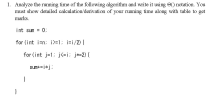 1. Analyze the running time of the following algorithm and write it using ( notation. You must show detailed calculation/derivation of your running time along with table to get marks. int sum = 0; for (int i=n; i)=1; i=i/2) { for (int j=1; j<=i; j*=2) { sum+=i*j; } }
By concentrating on the dominating step(s) and also assuming that all basic operations are having...
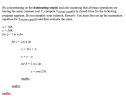 Please explain your thought process as your complete this
problem
By concentrating on the dominating step(s) and also assuming that all basic operations are having the same constant cost C, compute Tworst-case(n) in closed-form for the following program segment. Do not simplify your solution. Remark: You must first set up the summation equation for Tworst-case(n) and then evaluate the sums. x = 168; y-268; for i-1 to n do for J-to n do y=x-y; for k-1 to i do y...
Please explain your thought process as your complete this
problem
By concentrating on the dominating step(s) and also assuming that all basic operations are having the same constant cost C, compute Tworst-case(n) in closed-form for the following program segment. Do not simplify your solution. Remark: You must first set up the summation equation for Tworst-case(n) and then evaluate the sums. x = 168; y-268; for i-1 to n do for J-to n do y=x-y; for k-1 to i do y...
 Analyze the running time of the following algorithms asymptotically. (a) Algorithm for-loop(n): P = 1 for i = 1 to 5n^2 do p = p times i return p (b) Algorithm for-loop(n): s = 0 for i = 1 to n do for j = I to n do s = s + i return s (c) Algorithm WhileLoop(n): x = 0; j = 2; while (j = n){x = x+ 1; j =j times 2;}
 Algorithm performance Give the order of magnitude Theta () for the following algorithm. Explain why your answer is correct. GET VALUES for A_1, A_2, .. ., A_n, and B_1, B_2, .. ., B_n Get value of n i = 1/* set i equal to 1 */DO WHILE (i lessthanorequalto n)/* for each of the n values in A */j = 1/* set j equal to 1 */DO WHILE (j lessthanorequalto n)/* Do n times *1 IF Ai = Bj THEN...
 ALGORITHM X(A[0..n - 1]) // Input: A contains n real numbers for it 0 to n - 2 do for jt i +1 to n - 1 do if Aj] > A[i] swap A[i] and A[j] 1. What does this algorithm compute? 2. What is the basic operation? 3. How many times is the basic operation executed? 4. What is the efficiency class of this algorithm?
 Perform the following to the algorithm below: - - Express T(n) as a function of n Find a best approximation for the Big O function for T(n) Perform a time complexity analysis Define the basic operation of the algorithm Correctness Efficiency - - Procedure maxMin (n, A, I, h) integer h, I, A (1:n), n integer j j-2 IA (1) hS (1) while (i <=n) do if (Ali) < 1) then TEA (0) if(Ali) >h) then h A() j+į+1 repeat...
 Analyze the time complexity of the following algorithm. You may assume that the floor function in line 2 takes Theta (1) time. Please show your work. Input: data: array of integers Input: n: size of data Output: median of data 1 Algorithm: MedianSelect 2 lim = [n/2] + 1 3 min = - infinity 4 for i = 1 to lim do 5 prev = min 6 min = infinity 7 for j = 1 to n do 8 if...
 1. Analyze the running time of the following algorithm and write it using ( notation. You must show detailed calculation/derivation of your running time along with table to get marks. int sum = 0; for (int i=n; i)=1; i=i/2) { for (int j=1; j<=i; j*=2) { sum+=i*j; } }
 Please explain your thought process as your complete this
problem
By concentrating on the dominating step(s) and also assuming that all basic operations are having the same constant cost C, compute Tworst-case(n) in closed-form for the following program segment. Do not simplify your solution. Remark: You must first set up the summation equation for Tworst-case(n) and then evaluate the sums. x = 168; y-268; for i-1 to n do for J-to n do y=x-y; for k-1 to i do y...
Please explain your thought process as your complete this
problem
By concentrating on the dominating step(s) and also assuming that all basic operations are having the same constant cost C, compute Tworst-case(n) in closed-form for the following program segment. Do not simplify your solution. Remark: You must first set up the summation equation for Tworst-case(n) and then evaluate the sums. x = 168; y-268; for i-1 to n do for J-to n do y=x-y; for k-1 to i do y...
Most questions answered within 3 hours.
-
Where is the error in this code sequence?
String s1 = "Hello";
String s2 = "ello";...
asked 10 months ago -
Financial data for Joel de Paris, Inc., for last year
follow:
Joel de Paris, Inc.
Balance...
asked 10 months ago -
Consider this reaction:
Al2(SO4)3 (aq)+ BaCl3
(aq) Al2Cl6 (aq)- +
3BaSO4(s) . What is the...
asked 10 months ago -
Suppose that Savneet is considering increasing her
recent random sample from 20 car rentals to 40...
asked 10 months ago -
Trucks arrive at an unloading terminal at an average rate of 120
per hour.
Trucks arrive...
asked 10 months ago -
Why are methanol and ethanol completely soluble in water while
octanol is not very little soluble....
asked 10 months ago -
A facilities manager at a university reads in a research report
that the mean amount of...
asked 10 months ago -
When the CuSO4 is rehydrated by adding water to the anhydrous
compound, is this an endothermic...
asked 10 months ago -
A ray of sunlight is passing from diamond into crown glass; the
angle of incidence is...
asked 10 months ago -
A block of mass 0.249 kg is placed on top of a light, vertical
spring of...
asked 10 months ago -
how do the kidneys compensate in the presences of acidosis
a) trigger hyperventilate
b) reserve acid...
asked 10 months ago -
Question 501 pts
The rental rate of capital to the firm increases. Which of the
following...
asked 10 months ago