You intend to conduct an ANOVA with 42 subjects, which will be divided into 7 treatment...
You intend to conduct an ANOVA with 42 subjects, which will be
divided into 7 treatment groups.
What are the degrees of freedom for the numerator?
d.f.(treatment) =
What are the degrees of freedom for the denominator?
d.f.(error) =
Homework Answers

Add Answer to:
You intend to conduct an ANOVA with 42 subjects, which will be
divided into 7 treatment...
You intend to conduct an ANOVA with 7 groups in which each group will have the...
You intend to conduct an ANOVA with 7 groups in which each group will have the same number of subjects: n=6n=6. (This is referred to as a "balanced" single-factor ANOVA.) What are the degrees of freedom for the numerator? d.f.(treatment) = What are the degrees of freedom for the denominator? d.f.(error) =
You intend to conduct an ANOVA with 4 groups in which each group will have the...
You intend to conduct an ANOVA with 4 groups in which each group will have the same number of subjects: n=16n=16. (This is referred to as a "balanced" single-factor ANOVA.) What are the degrees of freedom for the numerator? d.f.(treatment) = What are the degrees of freedom for the denominator? d.f.(error) =
Analysis of variance compares the means of a response variable for several groups. ANOVA compares the...
 Analysis of variance compares the means of a response variable for several groups. ANOVA compares the variation within each group to the variation of the mean of each group. The ratio of these two is the F statistic from an F distribution with (number of groups - 1) as the numerator degrees of freedom and (number of observations - number of groups) as the denominator degrees of freedom. You intend to conduct an ANOVA with 4 groups in which each...
Analysis of variance compares the means of a response variable for several groups. ANOVA compares the...
 Analysis of variance compares the means of a response variable for several groups. ANOVA compares the variation within each group to the variation of the mean of each group. The ratio of these two is the F statistic from an F distribution with (number of groups - 1) as the numerator degrees of freedom and (number of observations - number of groups) as the denominator degrees of freedom. You intend to conduct an ANOVA with 4 groups in which each...
Analysis of variance compares the means of a response variable for several groups. ANOVA compares the...
 Analysis of variance compares the means of a response variable for several groups. ANOVA compares the variation within each group to the variation of the mean of each group. The ratio of these two is the F statistic from an F distribution with (number of groups - 1) as the numerator degrees of freedom and (number of observations - number of groups) as the denominator degrees of freedom. You intend to conduct an ANOVA with 4 groups in which each...
You intend to conduct a goodness-of-fit test for a multinomial distribution with 4 categories. You collect...
You intend to conduct a goodness-of-fit test for a multinomial distribution with 4 categories. You collect data from 87 subjects. What are the degrees of freedom for the χ2χ2 distribution for this test? d.f. =
You intend to conduct a test of independence for a contingency table with 8 categories in...
You intend to conduct a test of independence for a contingency table with 8 categories in the column variable and 2 categories in the row variable. You collect data from 349 subjects. What are the degrees of freedom for the ? 2 distribution for this test? d.f. =
Suppose you perform an ANOVA on 18 subjects divided evenly into three groups according to age....
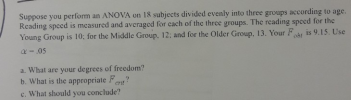 Suppose you perform an ANOVA on 18 subjects divided evenly into three groups according to age. Reading speed is measured and averaged for cach of the three groups. The reading speed for the Young Group is 10; for the Middle Group, 12; and for the Older Group, 13. Your F is 9.15. Use obf a=05 a. What are your degrees of freedom? b. What is the appropriate P? crit c. What should you conclude?
11.2 You intend to conduct a goodness-of-fit test for a multinomial distribution with 7 categories. You...
 11.2
You intend to conduct a goodness-of-fit test for a multinomial distribution with 7 categories. You collect data from 74 subjects. What are the degrees of freedom for the x2 distribution for this test? d.f. = Submit License Question 1. Points possible: 1 Unlimited attempts. You are conducting a multinomial Chi-Square Goodness of Fit hypothesis test for the claim that the 4 categories occur with the following frequencies: Ho:PA = 0.2; PB = 0.3; pc = 0.3; PD = 0.2...
11.2
You intend to conduct a goodness-of-fit test for a multinomial distribution with 7 categories. You collect data from 74 subjects. What are the degrees of freedom for the x2 distribution for this test? d.f. = Submit License Question 1. Points possible: 1 Unlimited attempts. You are conducting a multinomial Chi-Square Goodness of Fit hypothesis test for the claim that the 4 categories occur with the following frequencies: Ho:PA = 0.2; PB = 0.3; pc = 0.3; PD = 0.2...
You intend to conduct a goodness-of-fit test for a multinomial distribution with 4 categories. You collect...
You intend to conduct a goodness-of-fit test for a multinomial distribution with 4 categories. You collect data from 63 subjects. What are the degrees of freedom for the χ 2 distribution for this test?
 Analysis of variance compares the means of a response variable for several groups. ANOVA compares the variation within each group to the variation of the mean of each group. The ratio of these two is the F statistic from an F distribution with (number of groups - 1) as the numerator degrees of freedom and (number of observations - number of groups) as the denominator degrees of freedom. You intend to conduct an ANOVA with 4 groups in which each...
 Analysis of variance compares the means of a response variable for several groups. ANOVA compares the variation within each group to the variation of the mean of each group. The ratio of these two is the F statistic from an F distribution with (number of groups - 1) as the numerator degrees of freedom and (number of observations - number of groups) as the denominator degrees of freedom. You intend to conduct an ANOVA with 4 groups in which each...
 Analysis of variance compares the means of a response variable for several groups. ANOVA compares the variation within each group to the variation of the mean of each group. The ratio of these two is the F statistic from an F distribution with (number of groups - 1) as the numerator degrees of freedom and (number of observations - number of groups) as the denominator degrees of freedom. You intend to conduct an ANOVA with 4 groups in which each...
 Suppose you perform an ANOVA on 18 subjects divided evenly into three groups according to age. Reading speed is measured and averaged for cach of the three groups. The reading speed for the Young Group is 10; for the Middle Group, 12; and for the Older Group, 13. Your F is 9.15. Use obf a=05 a. What are your degrees of freedom? b. What is the appropriate P? crit c. What should you conclude?
 11.2
You intend to conduct a goodness-of-fit test for a multinomial distribution with 7 categories. You collect data from 74 subjects. What are the degrees of freedom for the x2 distribution for this test? d.f. = Submit License Question 1. Points possible: 1 Unlimited attempts. You are conducting a multinomial Chi-Square Goodness of Fit hypothesis test for the claim that the 4 categories occur with the following frequencies: Ho:PA = 0.2; PB = 0.3; pc = 0.3; PD = 0.2...
11.2
You intend to conduct a goodness-of-fit test for a multinomial distribution with 7 categories. You collect data from 74 subjects. What are the degrees of freedom for the x2 distribution for this test? d.f. = Submit License Question 1. Points possible: 1 Unlimited attempts. You are conducting a multinomial Chi-Square Goodness of Fit hypothesis test for the claim that the 4 categories occur with the following frequencies: Ho:PA = 0.2; PB = 0.3; pc = 0.3; PD = 0.2...
Most questions answered within 3 hours.
-
Where is the error in this code sequence?
String s1 = "Hello";
String s2 = "ello";...
asked 11 months ago -
Financial data for Joel de Paris, Inc., for last year
follow:
Joel de Paris, Inc.
Balance...
asked 11 months ago -
Consider this reaction:
Al2(SO4)3 (aq)+ BaCl3
(aq) Al2Cl6 (aq)- +
3BaSO4(s) . What is the...
asked 11 months ago -
Suppose that Savneet is considering increasing her
recent random sample from 20 car rentals to 40...
asked 11 months ago -
Trucks arrive at an unloading terminal at an average rate of 120
per hour.
Trucks arrive...
asked 11 months ago -
Why are methanol and ethanol completely soluble in water while
octanol is not very little soluble....
asked 11 months ago -
A facilities manager at a university reads in a research report
that the mean amount of...
asked 11 months ago -
When the CuSO4 is rehydrated by adding water to the anhydrous
compound, is this an endothermic...
asked 11 months ago -
A ray of sunlight is passing from diamond into crown glass; the
angle of incidence is...
asked 11 months ago -
A block of mass 0.249 kg is placed on top of a light, vertical
spring of...
asked 11 months ago -
how do the kidneys compensate in the presences of acidosis
a) trigger hyperventilate
b) reserve acid...
asked 11 months ago -
Question 501 pts
The rental rate of capital to the firm increases. Which of the
following...
asked 11 months ago