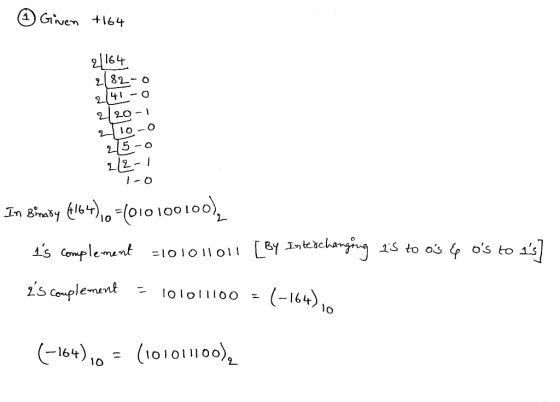
1. Convert the decimal number +164 and -164 to 9-bit binary numbers according to Sign magnitude,...
1. Convert the decimal number +164 and -164 to 9-bit binary numbers according to Sign magnitude, One’s complement, and Two’s complement
2. Convert the binary number 111011010 to base 10 decimal form (our regular number system) treating it as each of the following representations: Sign magnitude, One’s complement, and Two’s complement
Homework Answers
2) Given 1 1101 1010
In Sign magnitude the
The sign "1" means negative
11011010 = (1 × 2⁸) + (1 × 2⁷) + (0 × 2⁶) + (1 × 2⁵) + (1 × 2⁴) + (0 × 2³) + (1 × 2²) + (0 × 2¹) + (-16 × 2⁰) = 218
The magnitude is 218
In One’s complement
111011010 = (1 × 2⁸) + (1 × 2⁷) + (1 × 2⁶) + (0 × 2⁵) + (1 × 2⁴) + (1 × 2³) + (0 × 2²) + (1 × 2¹) + (0 × 2⁰) = 474
In Two’s complement
111011010 = -38
Add Answer to:
1. Convert the decimal number +164 and -164 to 9-bit binary
numbers according to Sign magnitude,...
3.8) Convert the hexadecimal number 0x15 to a decimal number. 3.9) Convert the hexadecimal number 0x19...
3.8) Convert the hexadecimal number 0x15 to a decimal number. 3.9) Convert the hexadecimal number 0x19 to a decimal number. 3.10) Convert the decimal number -35 to an 8-bit two’s complement binary number. 3.11) Convert the decimal number -32 to an 8-bit two’s complement binary number. 3.12) Assuming the use of the two’s complement number system find the equivalent decimal values for the following 8-bit binary numbers: a)10000001 b)11111111 c)01010000 d)11100000 e)10000011 3.13) Convert the base 8 number 204 to...
(1) Convert this Hexadecimal to Binary, Octal and Decimal : ABCDEF (2) how the representation of...
(1) Convert this Hexadecimal to Binary, Octal and Decimal : ABCDEF (2) how the representation of each of these numbers in both two’s complement and sign magnitude formats. Use the following assumptions: ● Assume that the sign magnitude number should be represented in the fewest number of bits possible. ● Assume that the sign bit for negative sign magnitude numbers should be a 1. ● Assume that the two’s complement numbers should be 8 bit numbers. 1. 108 2. -65
For problems 8, 9 and 10, convert the following decimal numbers into 8‑bit binary numbers as...
For problems 8, 9 and 10, convert the following decimal numbers into 8‑bit binary numbers as required for 2's complement math, and perform the indicated operations. Circle or bold your binary answer and show your work. Notes: Remember that positive numbers are represented in sign-magnitude format in 2's complement math 8. +26 +15 = 9. +26 - 15 = 10. - 26 +15 =
1. What decimal number is represented by the following excess 8 notation? 2. Convert 1111 from...
1. What decimal number is represented by the following excess 8 notation? 2. Convert 1111 from excess eight representation to its equivalent base ten binary form 3. With two's complement signed binary representation, what is the range of numbers as written in binary and in decimal for an eight-bit cell? (lowest to highest) 4. Convert -7 from decimal to binary, assuming seven-bit two’s complement binary representation 5. Convert 111 1010 from binary to decimal assuming seven bit two's complement binary...
Convert the following numbers from binary to decimal, assuming nine-bit two’s complement binary representation: 1 0110...
Convert the following numbers from binary to decimal, assuming nine-bit two’s complement binary representation: 1 0110 1010
Convert the decimal numbers A and B to 5-bit binary numbers. Using two’s complement representation, show...
Convert the decimal numbers A and B to 5-bit binary numbers. Using two’s complement representation, show (i) how to subtract the two 5-bit binary numbers (A−B); (ii) how to translate the binary result back to decimal
Exercise 1.25 Convert the following decimal numbers to unsigned binary numbers Exercise 1.31 Repeat Exercise 1.29,...
 Exercise 1.25 Convert the following decimal numbers to unsigned binary numbers Exercise 1.31 Repeat Exercise 1.29, but convert to 8-bit sign/magnitude numbers KExercise 1.32 Repeat Exercise 1.30, but convert to 8-bit sign/magnitude numbers (a) 4210 (b) 6310 Exercise 1.33 Convert the following 4-bit two's complement numbers to 8-bit two's complement numbers. (c) 22910 (d) 84510 (a) 0101 b) 1010 XExercise 1.26 Convert the following decimal numbers to unsigned binary numbers. Exercise 1.34 Convert the following 4-bit two's complement numbers to...
101b= 2610, what is b? How the following numbers will be represented in 4-bit (a) sign-magnitude...
101b= 2610, what is b? How the following numbers will be represented in 4-bit (a) sign-magnitude (b) two’s complement and (c) unsigned representations. Indicate if not possible. 2, 5, 7, 8 How the following negative numbers will be represented in 4-bit (a) sign-magnitude and b) two’s complement representations. Indicate if not possible. -2, -5, -7, -8 Consider the following java program snippet (hint: byte is represented as 8-bit 2’s complement number in java- run the program in java to check it). What will be printed? Explain....
Convert the following signed binary integers to the THREE signed binary representations: (i) sign-and-magnitude, (ii) one's...
Convert the following signed binary integers to the THREE signed binary representations: (i) sign-and-magnitude, (ii) one's complement (OC), and (iii) two's complement (TC) expressions, respectively (use the 6-bit system): a. - 0b001101 b. + 0b010011 2. We have learned before that we can express real numbers using fixed point expression. Convert the follownig numbers into Q3.4 representation: a. A1 = 0.5 b. A2 = 2.25 c. A3 = 6.725 d. A4 = -4.5
1. Convert the binary number 10101102 to octal, decimal, and hexadecimal numbers. 2. Convert the decimal...
 1. Convert the binary number 10101102 to octal, decimal, and hexadecimal numbers. 2. Convert the decimal number 236.7510 to binary,octal, and hexadecimal numbers. 3. Add the following two binary numbers: 100111102 and 011110112. Remember to show any carries that are generated along the way. 4. Repeat the previous question, but this time subtract the second binary number from the first. Remember to show any borrows that are required along the way. 5. Determine the encoding of the decimal number 28610...
 Exercise 1.25 Convert the following decimal numbers to unsigned binary numbers Exercise 1.31 Repeat Exercise 1.29, but convert to 8-bit sign/magnitude numbers KExercise 1.32 Repeat Exercise 1.30, but convert to 8-bit sign/magnitude numbers (a) 4210 (b) 6310 Exercise 1.33 Convert the following 4-bit two's complement numbers to 8-bit two's complement numbers. (c) 22910 (d) 84510 (a) 0101 b) 1010 XExercise 1.26 Convert the following decimal numbers to unsigned binary numbers. Exercise 1.34 Convert the following 4-bit two's complement numbers to...
 1. Convert the binary number 10101102 to octal, decimal, and hexadecimal numbers. 2. Convert the decimal number 236.7510 to binary,octal, and hexadecimal numbers. 3. Add the following two binary numbers: 100111102 and 011110112. Remember to show any carries that are generated along the way. 4. Repeat the previous question, but this time subtract the second binary number from the first. Remember to show any borrows that are required along the way. 5. Determine the encoding of the decimal number 28610...
Most questions answered within 3 hours.
-
Where is the error in this code sequence?
String s1 = "Hello";
String s2 = "ello";...
asked 10 months ago -
Financial data for Joel de Paris, Inc., for last year
follow:
Joel de Paris, Inc.
Balance...
asked 10 months ago -
Consider this reaction:
Al2(SO4)3 (aq)+ BaCl3
(aq) Al2Cl6 (aq)- +
3BaSO4(s) . What is the...
asked 10 months ago -
Suppose that Savneet is considering increasing her
recent random sample from 20 car rentals to 40...
asked 10 months ago -
Trucks arrive at an unloading terminal at an average rate of 120
per hour.
Trucks arrive...
asked 10 months ago -
Why are methanol and ethanol completely soluble in water while
octanol is not very little soluble....
asked 10 months ago -
A facilities manager at a university reads in a research report
that the mean amount of...
asked 10 months ago -
When the CuSO4 is rehydrated by adding water to the anhydrous
compound, is this an endothermic...
asked 10 months ago -
A ray of sunlight is passing from diamond into crown glass; the
angle of incidence is...
asked 10 months ago -
A block of mass 0.249 kg is placed on top of a light, vertical
spring of...
asked 10 months ago -
how do the kidneys compensate in the presences of acidosis
a) trigger hyperventilate
b) reserve acid...
asked 10 months ago -
Question 501 pts
The rental rate of capital to the firm increases. Which of the
following...
asked 10 months ago