Now consider firms that produce new scientific discoveries (not shirts!) that generate a positive externality because...
Now consider firms that produce new scientific discoveries (not shirts!) that generate a positive externality because other firms can build on their findings.
a. Draw supply and demand curves when firms treat future scientific advances as an externality and show how they would change if firms were to instead consider the externality as part of their benefits.
b. How does failing to consider the externality affect the equilibrium price and quantity of scientific discoveries, relative to the case where firms consider the externality?
Homework Answers
a)
This is an example of positive production externality. Positive externalities are side effects of production which are not taken into account by the market system. These positive effects reduce the cost of production of other firms. Hence, the supply curve will shift right.
Firm must increase its output level if it consider the external effects or if these effects internalized.
following is the diagram:
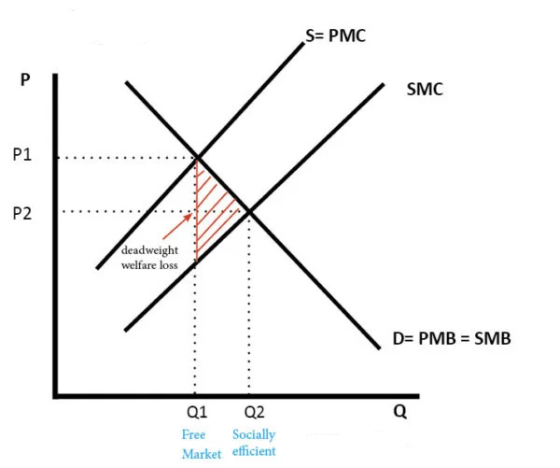
In the above diagram, the output level rises from Q1 to Q2 if these external effects are considered. it would be beneficial for society as a whole.
b)
Other firms would find that their costs are high enough to restrict the output level. Hence, when externalities are not realized fully, there would be a high level of price and low level of output.
In the case of an individual firm that creates scientific research, the consideration of externality would raise the price of scientific research and the level of research would also rise correspondingly.
Add Answer to:
Now consider firms that produce new scientific
discoveries (not shirts!) that generate a positive externality
because...
4) Now consider firms that produce new scientific discoveries (not shirts!) that generate a positive externality...
4) Now consider firms that produce new scientific discoveries (not shirts!) that generate a positive externality because other firms can build on their fin dings. a. Draw supply and demand curves when firms treat future scientific advances as an externality and show how they would change if firms were to instead consider the externality as part of their benefits. b. How does failing to consider the externalities affect the equilibrium price and quantity of scientific discoveries, relative to the case...
I need parts D, E, F only! 1. Consider a firm that manufactures dyed textiles. The...
 I need parts D, E, F only!
1. Consider a firm that manufactures dyed textiles. The firm incurs a marginal cost of MC 2Q Suppose that for every textile produced, there is an externality cost of 12 (from dyes being leaked into the water). So the true social marginal cost of widget production is MC = 2Q+12. Imagine that the (a) Assuming this is a perfectly competitive market, write out the equation for the firm's supply (b) Calculate the equilibrium...
I need parts D, E, F only!
1. Consider a firm that manufactures dyed textiles. The firm incurs a marginal cost of MC 2Q Suppose that for every textile produced, there is an externality cost of 12 (from dyes being leaked into the water). So the true social marginal cost of widget production is MC = 2Q+12. Imagine that the (a) Assuming this is a perfectly competitive market, write out the equation for the firm's supply (b) Calculate the equilibrium...
1. Some Economics of Pandemics: For each of the following markets, consider the effects of the...
 1. Some Economics of Pandemics: For each of the following markets, consider the effects of the COVID-19 pandemic. Suppose there is a pandemic that is causing individuals to get sick and forcing firms to shut down to avoid contagion. Using simple supply (marginal cost) and demand (marginal benefits) curves explain the effect of this pandemic on each of the following markets/situations. In each market, carefully explain what is changing (e.g., demand/supply, quantity demanded/supplied), why it is changing (i.e., what underlying...
Consider two countries Home and Foreign that can produce two goods, apples and bananas, using labour...
 Consider two countries Home and Foreign that can produce two goods, apples and bananas, using labour as the sole production factor. Home and Foreign have, respectively, 2400 and 1600 units of labour available and the unit labour requirements in the production of both goods are as shown in the following table: Home Foreign Apple 6 hours 10 hours Bananas 4 hours 2 hours 1. Construct the world relative supply curve and graph the relative demand curve along with the relative...
The following exercises will be graded out of 17 points. We should have left enough space...
 The following exercises will be graded out of 17 points. We should have left enough space for you to answer directly on the handout. This will be due at 10 a.m. on Monday, March 16th 2020. Exercise 1: Monopoly and externalities (12 points) Consider a monopolistic firm and a perfectly competitive firm both of which pollute. In this question, we will compare monopoly outcomes to perfectly competitive ones, and we will see how the existence of a pollution externality affects...
Part B: Problem Set - Vertical FDI (65 points total): Consider two firms. The first firm...
 Part B: Problem Set - Vertical FDI (65 points total): Consider two firms. The first firm is based in Slovenia and produces ball bearings (upstream firm). The cost of producing ball bearings is 6 per unit. The second firm is based in Greece. This firm produces machines (downstream firm). To produce one machine, the Greek firm must buy 2 ball bearings (ignore shipping costs between Slovenia and Greece). In addition, for each machine it makes it has a production cost...
Consider a city that has cell phone case stands operating throughout the midtown area. Suppose each...
Consider a city that has cell phone case stands operating throughout the midtown area. Suppose each vendor has a marginal cost of $5.00 per case and no fixed cost. Suppose the maximum number of cell phone cases that any one vendor can sell is 70 per day. If the price of a cell phone case is $15.00, how many cases does each vendor want to sell? B. If the industry is perfectly competitive, will the price remain $15.00 per case?...
1. Suppose you make silver jewelry. If the price of silver wire (a raw material) falls,...
1. Suppose you make silver jewelry. If the price of silver wire (a raw material) falls, we would expect you to: a. be willing and able to produce less jewelry than before at each possible price. b. be willing and able to produce more jewelry than before at each possible price. c. face a greater demand for your jewelry. d. face a weaker demand for your jewelry. _____ 2. Consider the market for portable air conditioners, initially in equilibrium. When...
1. Suppose that Adam's willingness To Pay (WTP) for a shirt of a particular brand is...
 1. Suppose that Adam's willingness To Pay (WTP) for a shirt of a particular brand is equal to 525. The market price of the brand is initially = $35 (thus, Adam's "consumer's surplus" SO, since he won't buy the shirt at that price). But then the brand becomes less popular (although Adam's WTP still equals 5 25; note that the Demand Curve will shift to the left when the brand becomes less popular). a.) Use a relevant graph to show...
macoroeconomics 1. Society as a whole faces opportunity costs because a. there is not enough money to go around...
 macoroeconomics
1. Society as a whole faces opportunity costs because a. there is not enough money to go around b. politicians are greedy c. resources are scarce d. our needs are unlimited 2. Mary decides to spend 3 hours working overtime rather than watching a video with her friends. She earns $9 an hour. Her opportunity cost of working is: a. the enjoyment she would have received had she watched the video with friends. b. $27 she earns working c....
macoroeconomics
1. Society as a whole faces opportunity costs because a. there is not enough money to go around b. politicians are greedy c. resources are scarce d. our needs are unlimited 2. Mary decides to spend 3 hours working overtime rather than watching a video with her friends. She earns $9 an hour. Her opportunity cost of working is: a. the enjoyment she would have received had she watched the video with friends. b. $27 she earns working c....
 I need parts D, E, F only!
1. Consider a firm that manufactures dyed textiles. The firm incurs a marginal cost of MC 2Q Suppose that for every textile produced, there is an externality cost of 12 (from dyes being leaked into the water). So the true social marginal cost of widget production is MC = 2Q+12. Imagine that the (a) Assuming this is a perfectly competitive market, write out the equation for the firm's supply (b) Calculate the equilibrium...
I need parts D, E, F only!
1. Consider a firm that manufactures dyed textiles. The firm incurs a marginal cost of MC 2Q Suppose that for every textile produced, there is an externality cost of 12 (from dyes being leaked into the water). So the true social marginal cost of widget production is MC = 2Q+12. Imagine that the (a) Assuming this is a perfectly competitive market, write out the equation for the firm's supply (b) Calculate the equilibrium...
 1. Some Economics of Pandemics: For each of the following markets, consider the effects of the COVID-19 pandemic. Suppose there is a pandemic that is causing individuals to get sick and forcing firms to shut down to avoid contagion. Using simple supply (marginal cost) and demand (marginal benefits) curves explain the effect of this pandemic on each of the following markets/situations. In each market, carefully explain what is changing (e.g., demand/supply, quantity demanded/supplied), why it is changing (i.e., what underlying...
 Consider two countries Home and Foreign that can produce two goods, apples and bananas, using labour as the sole production factor. Home and Foreign have, respectively, 2400 and 1600 units of labour available and the unit labour requirements in the production of both goods are as shown in the following table: Home Foreign Apple 6 hours 10 hours Bananas 4 hours 2 hours 1. Construct the world relative supply curve and graph the relative demand curve along with the relative...
 The following exercises will be graded out of 17 points. We should have left enough space for you to answer directly on the handout. This will be due at 10 a.m. on Monday, March 16th 2020. Exercise 1: Monopoly and externalities (12 points) Consider a monopolistic firm and a perfectly competitive firm both of which pollute. In this question, we will compare monopoly outcomes to perfectly competitive ones, and we will see how the existence of a pollution externality affects...
 Part B: Problem Set - Vertical FDI (65 points total): Consider two firms. The first firm is based in Slovenia and produces ball bearings (upstream firm). The cost of producing ball bearings is 6 per unit. The second firm is based in Greece. This firm produces machines (downstream firm). To produce one machine, the Greek firm must buy 2 ball bearings (ignore shipping costs between Slovenia and Greece). In addition, for each machine it makes it has a production cost...
 1. Suppose that Adam's willingness To Pay (WTP) for a shirt of a particular brand is equal to 525. The market price of the brand is initially = $35 (thus, Adam's "consumer's surplus" SO, since he won't buy the shirt at that price). But then the brand becomes less popular (although Adam's WTP still equals 5 25; note that the Demand Curve will shift to the left when the brand becomes less popular). a.) Use a relevant graph to show...
 macoroeconomics
1. Society as a whole faces opportunity costs because a. there is not enough money to go around b. politicians are greedy c. resources are scarce d. our needs are unlimited 2. Mary decides to spend 3 hours working overtime rather than watching a video with her friends. She earns $9 an hour. Her opportunity cost of working is: a. the enjoyment she would have received had she watched the video with friends. b. $27 she earns working c....
macoroeconomics
1. Society as a whole faces opportunity costs because a. there is not enough money to go around b. politicians are greedy c. resources are scarce d. our needs are unlimited 2. Mary decides to spend 3 hours working overtime rather than watching a video with her friends. She earns $9 an hour. Her opportunity cost of working is: a. the enjoyment she would have received had she watched the video with friends. b. $27 she earns working c....
Most questions answered within 3 hours.
-
Where is the error in this code sequence?
String s1 = "Hello";
String s2 = "ello";...
asked 11 months ago -
Financial data for Joel de Paris, Inc., for last year
follow:
Joel de Paris, Inc.
Balance...
asked 11 months ago -
Consider this reaction:
Al2(SO4)3 (aq)+ BaCl3
(aq) Al2Cl6 (aq)- +
3BaSO4(s) . What is the...
asked 11 months ago -
Suppose that Savneet is considering increasing her
recent random sample from 20 car rentals to 40...
asked 11 months ago -
Trucks arrive at an unloading terminal at an average rate of 120
per hour.
Trucks arrive...
asked 11 months ago -
Why are methanol and ethanol completely soluble in water while
octanol is not very little soluble....
asked 11 months ago -
A facilities manager at a university reads in a research report
that the mean amount of...
asked 11 months ago -
When the CuSO4 is rehydrated by adding water to the anhydrous
compound, is this an endothermic...
asked 11 months ago -
A ray of sunlight is passing from diamond into crown glass; the
angle of incidence is...
asked 11 months ago -
A block of mass 0.249 kg is placed on top of a light, vertical
spring of...
asked 11 months ago -
how do the kidneys compensate in the presences of acidosis
a) trigger hyperventilate
b) reserve acid...
asked 11 months ago -
Question 501 pts
The rental rate of capital to the firm increases. Which of the
following...
asked 11 months ago