Of the following situations, which one is impossible? A. A body having zero angular velocity and...
Of the following situations, which one is impossible?
A. A body having zero angular velocity and non-zero angular acceleration.
B. A body having constant angular acceleration and variable angular velocity.
C. A body having angular velocity east and angular acceleration west.
D. A body having angular velocity east and angular acceleration east.
E. A body having constant angular velocity and variable angular acceleration.
Homework Answers
A body can't have constant angular velocity and variable angular acceleration.
Hence option E is the answer.
A is possible if a body is moving clockwise and its angular acceleration is in counterclockwise. After some time the angular velocity of the body will be zero at a moment in time.
B is possible constant angular acceleration changes the angular velocity.
C and D are possible as well with the axis of rotation along. east-west
Add Answer to:
Of the following situations, which one is impossible?
A. A body having zero angular velocity and...
Which of the following situations is impossible? An object has velocity directed cast and acceleration directed...
 Which of the following situations is impossible? An object has velocity directed cast and acceleration directed west. An object has velocity directed cast and acceleration directed east. An object has zero velocity but non-zero acceleration. An object has constant non-zero acceleration and changing velocity. An object has constant non-zero velocity and changing acceleration. An object is thrown upwards with a speed of 16 m/s. How long does it take it to reach a height of 7.0 m on the way...
2. A helium-neon laser (2 633 nm) illuminates a single slit, and a diffraction pattern is...
 2. A helium-neon laser (2 633 nm) illuminates a single slit, and a diffraction pattern is observed on a wall 1.5 m behind the slit. The distance between the first and second dark fringes is 4.75 mrm What is the width of the slit? c. 0.35 mm e. 0.004 mm 3. Of the following situations, which one is impossible? a. A body having westward velocity and westward acceleration b. A body having westward velocity and eastward acceleration c. A body...
a broken wheel has a constant angular acceleration other than zero. Which of the following kinematic parameters will re...
a broken wheel has a constant angular acceleration other than zero. Which of the following kinematic parameters will remain constant in magnitude in the particles of that wheel? a) tangential velocity b) centripetal acceleration c) tangential acceleration d) angular velocity e) all of the above
At the instant shown, rod AB has zero angular acceleration and an angular velocity of 8...
 At the instant shown, rod AB has zero angular acceleration and an angular velocity of 8 rad/s clockwise. Knowing that I 0.3 m, determine the acceleration of the midpoint C of member BD. E C A D Fig. P15.129 and P15.130
At the instant shown, rod AB has zero angular acceleration and an angular velocity of 8 rad/s clockwise. Knowing that I 0.3 m, determine the acceleration of the midpoint C of member BD. E C A D Fig. P15.129...
At the instant shown, rod AB has zero angular acceleration and an angular velocity of 8 rad/s clockwise. Knowing that I 0.3 m, determine the acceleration of the midpoint C of member BD. E C A D Fig. P15.129 and P15.130
At the instant shown, rod AB has zero angular acceleration and an angular velocity of 8 rad/s clockwise. Knowing that I 0.3 m, determine the acceleration of the midpoint C of member BD. E C A D Fig. P15.129...
Question 5 A spinning wheel initially has an angular velocity of 50rad/s east: 20s later its angu...
 Question 5 A spinning wheel initially has an angular velocity of 50rad/s east: 20s later its angular velocity is 50rad/s west. If the angular acceleration is constant, what are (a) the magnitude and direction of angular acceleration, (b) the angular displacement over 20 s and (c) the angular speed? Question 6 Use Calculus to derive the Work- Energy Theorem and use the equation to solve the following questions Question 7. A crate of Mass 50kg slides down a 30o incline....
The ratio of the angular velocity at A to that at B is Same answer choices...
 The ratio of the angular velocity at A to
that at B is
Same answer choices except in E it says angular velocity instead
of centripetal acceleration.
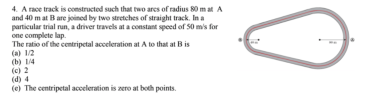
4. A race track is constructed such that two arcs of radius 80 m at A and 40 m at B are joined by two stretches of straight track. In a particular trial run, a driver travels at a constant speed of 50 m/s for one complete lap. The ratio of the centripetal...
The ratio of the angular velocity at A to
that at B is
Same answer choices except in E it says angular velocity instead
of centripetal acceleration.
4. A race track is constructed such that two arcs of radius 80 m at A and 40 m at B are joined by two stretches of straight track. In a particular trial run, a driver travels at a constant speed of 50 m/s for one complete lap. The ratio of the centripetal...
A non-zero angular acceleration corresponds to all of these EXCEPT: a. the value of v2/r. b....
A non-zero angular acceleration corresponds to all of these EXCEPT: a. the value of v2/r. b. a change in angular velocity. c. a change in the tangential velocity. d. a spinning object that is slowly coming to rest. e. an object that is turning faster and faster as it spins.
Part A: An object is moving with constant non-zero velocity in the +x axis. The position...
Part A: An object is moving with constant non-zero velocity in the +x axis. The position versus time graph of this object is Part B: An object is moving with constant non-zero acceleration in the +x axis. The position versus time graph of this object is Part C: An object is moving with constant non-zero velocity in the +x axis. The velocity versus time graph of this object is Part D: An object is moving with constant non-zero acceleration in...
5. Starting from rest, a particle confined to move along a straight line is accelerated at...
 5. Starting from rest, a particle confined to move along a straight line is accelerated at a rate of 5.0 m/s Which one of the following statements accurately describes the motion of this particle? A) The particle travels 5.0 m during each second. B) The particle travels 5.0 m only during the first second. C) The speed of the particle increases by 5.0 m/s during each second. D) The acceleration of the particle increases by 5.0 m/s during each second....
ULLII 5 points. Select only one correct 1. A boy and a girl are riding a...
 ULLII 5 points. Select only one correct 1. A boy and a girl are riding a merry-go-round which is turning at a constant rate. The boy is near the outer edge, while the girl is closer to the center. Who has the greater tangential acceleration? (a) The girl (b) The boy (c) Both have zero tangential acceleration. (d) Both have the same non-zero tangential acceleration. 2. Consider two uniform solid spheres where both have the same diameter, but one has...
 Which of the following situations is impossible? An object has velocity directed cast and acceleration directed west. An object has velocity directed cast and acceleration directed east. An object has zero velocity but non-zero acceleration. An object has constant non-zero acceleration and changing velocity. An object has constant non-zero velocity and changing acceleration. An object is thrown upwards with a speed of 16 m/s. How long does it take it to reach a height of 7.0 m on the way...
 2. A helium-neon laser (2 633 nm) illuminates a single slit, and a diffraction pattern is observed on a wall 1.5 m behind the slit. The distance between the first and second dark fringes is 4.75 mrm What is the width of the slit? c. 0.35 mm e. 0.004 mm 3. Of the following situations, which one is impossible? a. A body having westward velocity and westward acceleration b. A body having westward velocity and eastward acceleration c. A body...
 At the instant shown, rod AB has zero angular acceleration and an angular velocity of 8 rad/s clockwise. Knowing that I 0.3 m, determine the acceleration of the midpoint C of member BD. E C A D Fig. P15.129 and P15.130
At the instant shown, rod AB has zero angular acceleration and an angular velocity of 8 rad/s clockwise. Knowing that I 0.3 m, determine the acceleration of the midpoint C of member BD. E C A D Fig. P15.129...
At the instant shown, rod AB has zero angular acceleration and an angular velocity of 8 rad/s clockwise. Knowing that I 0.3 m, determine the acceleration of the midpoint C of member BD. E C A D Fig. P15.129 and P15.130
At the instant shown, rod AB has zero angular acceleration and an angular velocity of 8 rad/s clockwise. Knowing that I 0.3 m, determine the acceleration of the midpoint C of member BD. E C A D Fig. P15.129...
 Question 5 A spinning wheel initially has an angular velocity of 50rad/s east: 20s later its angular velocity is 50rad/s west. If the angular acceleration is constant, what are (a) the magnitude and direction of angular acceleration, (b) the angular displacement over 20 s and (c) the angular speed? Question 6 Use Calculus to derive the Work- Energy Theorem and use the equation to solve the following questions Question 7. A crate of Mass 50kg slides down a 30o incline....
 The ratio of the angular velocity at A to
that at B is
Same answer choices except in E it says angular velocity instead
of centripetal acceleration.
4. A race track is constructed such that two arcs of radius 80 m at A and 40 m at B are joined by two stretches of straight track. In a particular trial run, a driver travels at a constant speed of 50 m/s for one complete lap. The ratio of the centripetal...
The ratio of the angular velocity at A to
that at B is
Same answer choices except in E it says angular velocity instead
of centripetal acceleration.
4. A race track is constructed such that two arcs of radius 80 m at A and 40 m at B are joined by two stretches of straight track. In a particular trial run, a driver travels at a constant speed of 50 m/s for one complete lap. The ratio of the centripetal...
 5. Starting from rest, a particle confined to move along a straight line is accelerated at a rate of 5.0 m/s Which one of the following statements accurately describes the motion of this particle? A) The particle travels 5.0 m during each second. B) The particle travels 5.0 m only during the first second. C) The speed of the particle increases by 5.0 m/s during each second. D) The acceleration of the particle increases by 5.0 m/s during each second....
 ULLII 5 points. Select only one correct 1. A boy and a girl are riding a merry-go-round which is turning at a constant rate. The boy is near the outer edge, while the girl is closer to the center. Who has the greater tangential acceleration? (a) The girl (b) The boy (c) Both have zero tangential acceleration. (d) Both have the same non-zero tangential acceleration. 2. Consider two uniform solid spheres where both have the same diameter, but one has...
Most questions answered within 3 hours.
-
Where is the error in this code sequence?
String s1 = "Hello";
String s2 = "ello";...
asked 11 months ago -
Financial data for Joel de Paris, Inc., for last year
follow:
Joel de Paris, Inc.
Balance...
asked 11 months ago -
Consider this reaction:
Al2(SO4)3 (aq)+ BaCl3
(aq) Al2Cl6 (aq)- +
3BaSO4(s) . What is the...
asked 11 months ago -
Suppose that Savneet is considering increasing her
recent random sample from 20 car rentals to 40...
asked 11 months ago -
Trucks arrive at an unloading terminal at an average rate of 120
per hour.
Trucks arrive...
asked 11 months ago -
Why are methanol and ethanol completely soluble in water while
octanol is not very little soluble....
asked 11 months ago -
A facilities manager at a university reads in a research report
that the mean amount of...
asked 11 months ago -
When the CuSO4 is rehydrated by adding water to the anhydrous
compound, is this an endothermic...
asked 11 months ago -
A ray of sunlight is passing from diamond into crown glass; the
angle of incidence is...
asked 11 months ago -
A block of mass 0.249 kg is placed on top of a light, vertical
spring of...
asked 11 months ago -
how do the kidneys compensate in the presences of acidosis
a) trigger hyperventilate
b) reserve acid...
asked 11 months ago -
Question 501 pts
The rental rate of capital to the firm increases. Which of the
following...
asked 11 months ago