You are hired to design a reliable byte-stream protocol that uses a sliding window (like TCP)....
You are hired to design a reliable byte-stream protocol that
uses a sliding window (like TCP). This protocol will run over a
1-Gbps network. The RTT of the network is 200 ms.
How many bits would you include in the AdvertisedWindow field of
your protocol header? (choose the closest number that can satisfy
the above requirement).
Hints:
- First, determine how much data to keep the pipe full (i.e. delay
* bandwidth)
- Second, if we assume the window is measured in bytes then
calculate how many bits are required in the AdvertisedWindow field
to represent those data in pipe.
Homework Answers
The maximum amount of data that will fit is given by the Bandwidth Delay Product
Bandwidth Delay Product = Bandwidth x RTT = 1 Gbps x 200 ms = 25,000,000 bytes / sec
No. of bits needed in the window is

Add Answer to:
You are hired to design a reliable byte-stream protocol that
uses a sliding window (like TCP)....
You are designing a reliable byte stream transport layer protocol (not TCP) to operate over a...
You are designing a reliable byte stream transport layer protocol (not TCP) to operate over a 1x10⁷ bps network and it is using a sliding window for flow control. The time for keeping the transmission pipe full is taken to be the RTT of the network which is 50ms. Each number in the advertised window or sequence number represents 2 bytes of data. a) What is the minimum number of bits necessary for the Advertised Window field of your protocol...
Could someone help with just part a please ? You are hired to design a reliable...
 Could someone help with just part a please ?
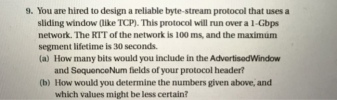
You are hired to design a reliable byte stream protocol that uses a sliding window (like TCP). This protocol will run over a 1 -Gbps network. The RTT of the network is 100 ms. and the maximum segment lifetime is 30 seconds. (a) How many bits would you include in the AdvertisedWindow and SequenceNum fields of your protocol header? (b) How would you determine the numbers given above, and which values...
Could someone help with just part a please ?
You are hired to design a reliable byte stream protocol that uses a sliding window (like TCP). This protocol will run over a 1 -Gbps network. The RTT of the network is 100 ms. and the maximum segment lifetime is 30 seconds. (a) How many bits would you include in the AdvertisedWindow and SequenceNum fields of your protocol header? (b) How would you determine the numbers given above, and which values...
(a) In a sliding window protocol with RWS=SWS=5, a very large set of possible sequence numbers...
(a) In a sliding window protocol with RWS=SWS=5, a very large set of possible sequence numbers (assume no wrapping), and in-order packet arrivals, why can the receiver be assured -3- that it will never again receive the frame with sequence number 10 if it is currently expecting frame 17? (b) For the sliding window protocol, if the sender’s window size (SWS) equals the receiver’s window size (RWS), what is the minimum number of sequence numbers that are required? How many...
help with computer network questions 1. What is the difference between circuit switching and packet switching?...
help with computer network questions 1. What is the difference between circuit switching and packet switching? 2. What are the different layers in today’s Internet? Why do we create layers? 3. Suppose there is a 10 Mbps microwave link between a geostationary satellite and its base station on Earth. Every minute the satellite takes a digital photo and sends it to the base station. Assume a propagation speed of 2.4 * 10^8 meters/sec. a. What is the propagation delay of...
QUESTION 45 What is NOT one of the three characteristics of TCP in its role as...
QUESTION 45 What is NOT one of the three characteristics of TCP in its role as a reliable delivery protocol? a. Sequencing and checksums b. Flow Control c. Framing d. Connection-oriented Protocol 1.25 points QUESTION 46 What is by far the most popular DNS server software available? a. Dnsmasq b. Microsoft DNS c. BIND d. Oracle Resolver 1.25 points QUESTION 47 What is routing protocol convergence time defined as? a. It is the time it takes for the...
check my answers for Networking I came up with these answers, can check my answers Question...
check my answers for Networking I came up with these answers, can check my answers Question 1: General What data rate is needed to transmit an uncompressed 4" x 6" photograph every second with a resolution of 1200 dots per inch and 24 bits per dot (pixel)? 691,200 kb/s 28.8 kb/s 8.29 Mb/s 829 Mb/s Question 2: Layering "Layering" is commonly used in computer networks because (check all that apply): -It forces all network software to be written in ‘C’....
I need help with this assignment, please; Programming Assignment 3: UDP Pinger Lab In this lab,...
I need help with this assignment, please; Programming Assignment 3: UDP Pinger Lab In this lab, you will study a simple Internet ping server written in the Java language, and implement a corresponding client. The functionality provided by these programs is similar to the standard ping programs available in modern operating systems, except that they use UDP rather than Internet Control Message Protocol (ICMP) to communicate with each other. (Java does not provide a straightforward means to interact with ICMP.)...
Q1 Error detection/correction Can these schemes correct bit errors: Internet checksums, two-dimendional parity, cyclic...
 Q1 Error detection/correction Can these schemes correct bit errors: Internet checksums, two-dimendional parity, cyclic redundancy check (CRC) A. Yes, No, No B. No, Yes, Yes c. No, Yes, No D. No, No, Yes E. Ho, hum, ha Q2 CRC vs Internet checksums Which of these is not true? A. CRC's are commonly used at the link layer B. CRC's can detect any bit error of up to r bits with an r-bit EDC. c. CRC's are more resilient to bursty...
In this lab, we’ll investigate the 802.11 wireless network protocol. Follow the instructions and answers questions...
 In this lab, we’ll investigate the 802.11 wireless network
protocol. Follow the instructions and answers questions 7 - 10.
http://gaia.cs.umass.edu/wireshark-labs/wireshark-traces.zip
In this lab, we'll investigate the 802.11 wireless network protocol. Before beginning this lab, you might want to re-read Section 6.3 in the text. Since we l1 be delving a bit deeper into 802.11 than is covered in the text, you might want to check out "A Technical Tutorial on the 802.11Protocol," by Pablo Brenner (Breezecom Communications) http://www.sss-mag.com/pdf802_11tut.pdf, and "Understanding...
In this lab, we’ll investigate the 802.11 wireless network
protocol. Follow the instructions and answers questions 7 - 10.
http://gaia.cs.umass.edu/wireshark-labs/wireshark-traces.zip
In this lab, we'll investigate the 802.11 wireless network protocol. Before beginning this lab, you might want to re-read Section 6.3 in the text. Since we l1 be delving a bit deeper into 802.11 than is covered in the text, you might want to check out "A Technical Tutorial on the 802.11Protocol," by Pablo Brenner (Breezecom Communications) http://www.sss-mag.com/pdf802_11tut.pdf, and "Understanding...
 Could someone help with just part a please ?
You are hired to design a reliable byte stream protocol that uses a sliding window (like TCP). This protocol will run over a 1 -Gbps network. The RTT of the network is 100 ms. and the maximum segment lifetime is 30 seconds. (a) How many bits would you include in the AdvertisedWindow and SequenceNum fields of your protocol header? (b) How would you determine the numbers given above, and which values...
Could someone help with just part a please ?
You are hired to design a reliable byte stream protocol that uses a sliding window (like TCP). This protocol will run over a 1 -Gbps network. The RTT of the network is 100 ms. and the maximum segment lifetime is 30 seconds. (a) How many bits would you include in the AdvertisedWindow and SequenceNum fields of your protocol header? (b) How would you determine the numbers given above, and which values...
 Q1 Error detection/correction Can these schemes correct bit errors: Internet checksums, two-dimendional parity, cyclic redundancy check (CRC) A. Yes, No, No B. No, Yes, Yes c. No, Yes, No D. No, No, Yes E. Ho, hum, ha Q2 CRC vs Internet checksums Which of these is not true? A. CRC's are commonly used at the link layer B. CRC's can detect any bit error of up to r bits with an r-bit EDC. c. CRC's are more resilient to bursty...
 In this lab, we’ll investigate the 802.11 wireless network
protocol. Follow the instructions and answers questions 7 - 10.
http://gaia.cs.umass.edu/wireshark-labs/wireshark-traces.zip
In this lab, we'll investigate the 802.11 wireless network protocol. Before beginning this lab, you might want to re-read Section 6.3 in the text. Since we l1 be delving a bit deeper into 802.11 than is covered in the text, you might want to check out "A Technical Tutorial on the 802.11Protocol," by Pablo Brenner (Breezecom Communications) http://www.sss-mag.com/pdf802_11tut.pdf, and "Understanding...
In this lab, we’ll investigate the 802.11 wireless network
protocol. Follow the instructions and answers questions 7 - 10.
http://gaia.cs.umass.edu/wireshark-labs/wireshark-traces.zip
In this lab, we'll investigate the 802.11 wireless network protocol. Before beginning this lab, you might want to re-read Section 6.3 in the text. Since we l1 be delving a bit deeper into 802.11 than is covered in the text, you might want to check out "A Technical Tutorial on the 802.11Protocol," by Pablo Brenner (Breezecom Communications) http://www.sss-mag.com/pdf802_11tut.pdf, and "Understanding...
Most questions answered within 3 hours.
-
Where is the error in this code sequence?
String s1 = "Hello";
String s2 = "ello";...
asked 10 months ago -
Financial data for Joel de Paris, Inc., for last year
follow:
Joel de Paris, Inc.
Balance...
asked 10 months ago -
Consider this reaction:
Al2(SO4)3 (aq)+ BaCl3
(aq) Al2Cl6 (aq)- +
3BaSO4(s) . What is the...
asked 10 months ago -
Suppose that Savneet is considering increasing her
recent random sample from 20 car rentals to 40...
asked 10 months ago -
Trucks arrive at an unloading terminal at an average rate of 120
per hour.
Trucks arrive...
asked 10 months ago -
Why are methanol and ethanol completely soluble in water while
octanol is not very little soluble....
asked 10 months ago -
A facilities manager at a university reads in a research report
that the mean amount of...
asked 10 months ago -
When the CuSO4 is rehydrated by adding water to the anhydrous
compound, is this an endothermic...
asked 10 months ago -
A ray of sunlight is passing from diamond into crown glass; the
angle of incidence is...
asked 10 months ago -
A block of mass 0.249 kg is placed on top of a light, vertical
spring of...
asked 10 months ago -
how do the kidneys compensate in the presences of acidosis
a) trigger hyperventilate
b) reserve acid...
asked 10 months ago -
Question 501 pts
The rental rate of capital to the firm increases. Which of the
following...
asked 10 months ago