[ ke = 8.99 × 10⁹ Nm2/C2 ] 5. _____ A small sphere with a radius of...
[ ke = 8.99 × 10⁹ Nm2/C2 ]
5. _____ A small sphere with a radius of 1 cm and with a charge of −20 nC sticks to a large sphere with a radius of 19 cm and charge +5 nC. What is the force on the small sphere?
Homework Answers

Add Answer to:
[ ke = 8.99 ×
109 Nm2/C2 ]
5. _____ A small sphere with a radius of...
Two small negatively charged spheres spaced 35.00 cm apart have equal amounts of net charge. If...
 Two small negatively charged spheres spaced 35.00 cm apart have equal amounts of net charge. If the magnitude of the force of repulsion between them is 2.430 x 10²¹ N, How many excess electrons must be present on each sphere? (For this calculation, use ke-8.988 x 10⁹ Nm2/C2 for Coulomb's constant and use qo 1.602 x 10⁻¹⁹C for the charge of an electron).
14. Two charged particles create influences at the origin, scribed by the expressions 8.99 × 10⁹...
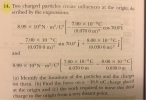 14. Two charged particles create influences at the origin, scribed by the expressions 8.99 × 10⁹ N·m?/C? | 7.00 × 10⁻⁹C (0.070 0 m)2 cos 70.0°i 7.00 × 10⁻⁹ C (00700m)2, sin 700° j + 8.00×10⁻⁹C1 (0.030 0 m) and [ 7.00 × 10⁻⁹ C 0.070 0 mm 8.00 × 10⁻⁹ C 0.0300 m 8.99 × 10⁹ N·m2/C2| -' (a) Identify the locations of the particles and the charges on them. (b) Find the force on a -16.0 nC charge...
A point charge of 5.1 μC is located at the center of a sphere with a...
A point charge of 5.1 μC is located at the center of a sphere with a radius of 7 cm. The Coulomb constant is 8.98755 × 10⁹ Nm2/C2, and the acceleration of gravity is 9.8 m/s2. Determine the electric flux through the surface of the sphere. Answer in units of N/C.
Show work plz 20C. A conducting sphere of radius 20.0 cm carries an excess charge of...
 Show work plz
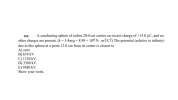
20C. A conducting sphere of radius 20.0 cm carries an excess charge of +15.0 uC, and no other charges are present. (k = 1/4180 = 8.99 109 N·m2/C2) The potential (relative to infinity) due to this sphere at a point 12.0 cm from its center is closest to A) zero. B) 674 kV. C) 1130 kv. D) 3380 kV. E) 9380 kv. Show your work.
Show work plz
20C. A conducting sphere of radius 20.0 cm carries an excess charge of +15.0 uC, and no other charges are present. (k = 1/4180 = 8.99 109 N·m2/C2) The potential (relative to infinity) due to this sphere at a point 12.0 cm from its center is closest to A) zero. B) 674 kV. C) 1130 kv. D) 3380 kV. E) 9380 kv. Show your work.
109 N m2/C2 A thin spherical metal shell of radius 8.0 cm carries 7.5 pC of...
 109 N m2/C2 A thin spherical metal shell of radius 8.0 cm carries 7.5 pC of excess charge. What is the magnitude of the electric field it produces at the following places? に14πε0-9.0 (a) at 1.0 cm above the surface (b) at 7.0 cm from the center of the sphere
Two isolated conducting spheres are separated by a large distance. Sphere 1 has a radius of...
Two isolated conducting spheres are separated by a large distance. Sphere 1 has a radius of 20 cm and an initial charge 30 nC while Sphere 2 has a radius of 60 cm and an initial charge 70 nC. A very thin copper wire is now connected to the spheres to allow charge to flow between them. How much charge will be transferred from Sphere 2 to Sphere 1? (Note that the charge transferred can be positive, negative or zero.)
A hollow metal sphere has an inner radius of 6 cm and an outer radius of 10 cm. The sphere has a charge of +30 nC.
 A hollow metal sphere has an inner radius of 6 cm and an outer radius of 10 cm. The sphere has a charge of +30 nC. Inside the sphere is a charged particle located 3 cm from the center of the sphere with a charge of -10 nC. What is the electric field strength at a point P at distance of 20 cm from the center of the sphere?
108. A large, hollow metallic sphere surrounds a small er metallic sphere of radius r with...
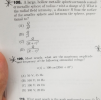 108. A large, hollow metallic sphere surrounds a small er metallic sphere of radius r with a charge of Q What is the radial field intensity, a distance R from the surface of the smaller sphere and between the spheres, propor- tional to? (A) . (B) (C) (R+r)2 (R 109. Most nearly, what are the maxi amplitnde and frecuency of the following sinusoidal voltage? 1.(1)-100 eos(20π1+ 45°) (A) 50 V: 45 Hz (B) 100 V; 10 Hz (C) 100 V:...
Problem 2. A small charged conducting sphere with q25.0 x 10-12C and radius 5 mm is...
 Problem 2. A small charged conducting sphere with q25.0 x 10-12C and radius 5 mm is placed at the centre of a spherical conducting shell of inner radius 5.00 cm and outer radius 6.00 cm. The spherical shell has zero net charge. (a) What is the electric field between the inner and outer surfaces of the spherical shell? b) What is the surface charge density on the inner surface of the shell? (c) What is the surface charge density on...
Consider the group of three+7.4 nC point charges shown in the figure. What is the electric...
 Consider the group of three+7.4 nC point charges shown in the figure. What is the electric potential energy of this system of charges relative to infinity? (k= 1/4x80 = 8.99 x 10⁹ Nm2/C2) --- 3.0 cm ! 4.0 cm 4.4 x 10⁻⁵) 4.2 * 10-5) 4.0 x 10⁻⁵) 3.9 x 10⁻⁵)
 Two small negatively charged spheres spaced 35.00 cm apart have equal amounts of net charge. If the magnitude of the force of repulsion between them is 2.430 x 10²¹ N, How many excess electrons must be present on each sphere? (For this calculation, use ke-8.988 x 10⁹ Nm2/C2 for Coulomb's constant and use qo 1.602 x 10⁻¹⁹C for the charge of an electron).
 14. Two charged particles create influences at the origin, scribed by the expressions 8.99 × 10⁹ N·m?/C? | 7.00 × 10⁻⁹C (0.070 0 m)2 cos 70.0°i 7.00 × 10⁻⁹ C (00700m)2, sin 700° j + 8.00×10⁻⁹C1 (0.030 0 m) and [ 7.00 × 10⁻⁹ C 0.070 0 mm 8.00 × 10⁻⁹ C 0.0300 m 8.99 × 10⁹ N·m2/C2| -' (a) Identify the locations of the particles and the charges on them. (b) Find the force on a -16.0 nC charge...
 Show work plz
20C. A conducting sphere of radius 20.0 cm carries an excess charge of +15.0 uC, and no other charges are present. (k = 1/4180 = 8.99 109 N·m2/C2) The potential (relative to infinity) due to this sphere at a point 12.0 cm from its center is closest to A) zero. B) 674 kV. C) 1130 kv. D) 3380 kV. E) 9380 kv. Show your work.
Show work plz
20C. A conducting sphere of radius 20.0 cm carries an excess charge of +15.0 uC, and no other charges are present. (k = 1/4180 = 8.99 109 N·m2/C2) The potential (relative to infinity) due to this sphere at a point 12.0 cm from its center is closest to A) zero. B) 674 kV. C) 1130 kv. D) 3380 kV. E) 9380 kv. Show your work.
 109 N m2/C2 A thin spherical metal shell of radius 8.0 cm carries 7.5 pC of excess charge. What is the magnitude of the electric field it produces at the following places? に14πε0-9.0 (a) at 1.0 cm above the surface (b) at 7.0 cm from the center of the sphere
 108. A large, hollow metallic sphere surrounds a small er metallic sphere of radius r with a charge of Q What is the radial field intensity, a distance R from the surface of the smaller sphere and between the spheres, propor- tional to? (A) . (B) (C) (R+r)2 (R 109. Most nearly, what are the maxi amplitnde and frecuency of the following sinusoidal voltage? 1.(1)-100 eos(20π1+ 45°) (A) 50 V: 45 Hz (B) 100 V; 10 Hz (C) 100 V:...
 Problem 2. A small charged conducting sphere with q25.0 x 10-12C and radius 5 mm is placed at the centre of a spherical conducting shell of inner radius 5.00 cm and outer radius 6.00 cm. The spherical shell has zero net charge. (a) What is the electric field between the inner and outer surfaces of the spherical shell? b) What is the surface charge density on the inner surface of the shell? (c) What is the surface charge density on...
 Consider the group of three+7.4 nC point charges shown in the figure. What is the electric potential energy of this system of charges relative to infinity? (k= 1/4x80 = 8.99 x 10⁹ Nm2/C2) --- 3.0 cm ! 4.0 cm 4.4 x 10⁻⁵) 4.2 * 10-5) 4.0 x 10⁻⁵) 3.9 x 10⁻⁵)
Most questions answered within 3 hours.
-
Where is the error in this code sequence?
String s1 = "Hello";
String s2 = "ello";...
asked 10 months ago -
Financial data for Joel de Paris, Inc., for last year
follow:
Joel de Paris, Inc.
Balance...
asked 10 months ago -
Consider this reaction:
Al2(SO4)3 (aq)+ BaCl3
(aq) Al2Cl6 (aq)- +
3BaSO4(s) . What is the...
asked 10 months ago -
Suppose that Savneet is considering increasing her
recent random sample from 20 car rentals to 40...
asked 10 months ago -
Trucks arrive at an unloading terminal at an average rate of 120
per hour.
Trucks arrive...
asked 10 months ago -
Why are methanol and ethanol completely soluble in water while
octanol is not very little soluble....
asked 10 months ago -
A facilities manager at a university reads in a research report
that the mean amount of...
asked 10 months ago -
When the CuSO4 is rehydrated by adding water to the anhydrous
compound, is this an endothermic...
asked 10 months ago -
A ray of sunlight is passing from diamond into crown glass; the
angle of incidence is...
asked 10 months ago -
A block of mass 0.249 kg is placed on top of a light, vertical
spring of...
asked 10 months ago -
how do the kidneys compensate in the presences of acidosis
a) trigger hyperventilate
b) reserve acid...
asked 10 months ago -
Question 501 pts
The rental rate of capital to the firm increases. Which of the
following...
asked 10 months ago