Sound two tuning forks of slightly different frequency. First sound each one separately and then the...
Sound two tuning forks of slightly different
frequency. First sound each one separately and then the sound both
at the same time. Notice the beats when you sound both tuning forks
at the same time.
Describe the sound of the beats.
Homework Answers
Let the frequency of fork 1 be f1 and the frequency of fork 2 be f2.when sound at different times we hear the individual frequencies.But when sound at same time we hear the sound that is a result of interference of two waves,the frequency of such waves is called beat frequency.
Beat frequency f= (f1-f2)
The sound of beats is loud at the places of constructive interference and soft at the destructive interference.
Add Answer to:
Sound two tuning forks of slightly different
frequency. First sound each one separately and then the...
QUESTIONS (SHOW YOUR WORK) 22. Two tuning forks of frequencies fi- 860 Hz are sounded together...
 QUESTIONS (SHOW YOUR WORK) 22. Two tuning forks of frequencies fi- 860 Hz are sounded together and produce a new sine way wgeuner and produce a new sine wave. Both tuning forks have same amplitude What is the frequency of the resulting sine wave? Hz and f- 790 What is the beat frequency? How many beats are there in one complete cycle of the cosine curve? tunina farke each with a frequency off off660 Hz are sound
Tuning fork 1 Tuning fork 2 Bob 9.0 m - 3.0m - Two identical tuning forks...
 Tuning fork 1 Tuning fork 2 Bob 9.0 m - 3.0m - Two identical tuning forks are positioned 9.0 m apart, and emit sound equally in all directions. Alex is standing exactly halfway between the tuning forks, and Bob is standing 3.0 m to the right of the rightmost tuning fork. Alex hears an intensity of one tuning fork of 55 dB playing at 300 Hz. 1. How much power is emitted as sound by one tuning fork? 2. When...
017 10.0 points Two similar tuning forks produce sound waves of the same 3.6 mPa amplitude....
 017 10.0 points Two similar tuning forks produce sound waves of the same 3.6 mPa amplitude. One tuning fork yı has a frequency 1168 s- and the other y2 has a frequency of 1314 s-, producing interference. HATIR ** TRADEMARAN -A + Tbeat Ive Yi ----- Y2 --- - Yi+y2 JIJINI TUNTII -Af 0 3 Tbeat 6 Tbeat What is the beat frequency of the wave? Answer in units of Hz.
Beats occur when two superimposed waves are of a. slightly different amplitudes and the same frequency....
Beats occur when two superimposed waves are of a. slightly different amplitudes and the same frequency. b. slightly different frequencies. c. the opposite amplitude and identical frequency. d. the same amplitude and frequency, but different phase.
Question 5 1 pts Tuning fork A has a frequency of 440 Hz. When A and...
 Question 5 1 pts Tuning fork A has a frequency of 440 Hz. When A and a second tuning fork B are struck simultaneously, four beats per second are heard. When a small mass is added to one of the tines of B, the two forks struck simultaneously produce two beats per second. The original frequency of tuning fork B was 436 Hz. 432 Hz. 444 Hz. 448 Hz 438 Hz.
Two tuning forks having frequencies of 428 and 454 Hz are struck simultaneously. What average frequency...
Two tuning forks having frequencies of 428 and 454 Hz are struck simultaneously. What average frequency will you hear, and what will the beat frequency be? Average frequency: Beat frequency:
Sara is experimenting with 2 tuning forks. She obtains the following data for 4 different trials....
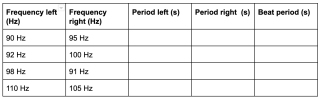 Sara is experimenting with 2 tuning forks. She obtains the
following data for 4 different trials. a) Complete the table. b)
Calculate the beat frequency in two different ways
for the first trial.
Period left (s) Frequency left (Hz) Frequency right (Hz) Period right (s) Beat period (s) 90 Hz 95 Hz 92 Hz 100 Hz 98 Hz 91 Hz 110 Hz 105 Hz
Sara is experimenting with 2 tuning forks. She obtains the
following data for 4 different trials. a) Complete the table. b)
Calculate the beat frequency in two different ways
for the first trial.
Period left (s) Frequency left (Hz) Frequency right (Hz) Period right (s) Beat period (s) 90 Hz 95 Hz 92 Hz 100 Hz 98 Hz 91 Hz 110 Hz 105 Hz
You have 2 tuning forks in your hands; one plays the note D (297 Hz) and...
You have 2 tuning forks in your hands; one plays the note D (297 Hz) and the other plays the note A (220 Hz). Your classmate plays a third fork with an unknown note and listens to the new combined frequency. Assuming that you can measure the combined frequency like 275 Hz when all three forks are played simultaneously, which of the following notes is most likely to correspond to the mysterious tuning fork a. C (264 Hz) b. F...
Please help with question 2,3 and 4 and filling out the table Lab 12. Sound Waves...
 Please help with question 2,3
and 4 and filling out the table
Lab 12. Sound Waves and Beats Introduction Sound waves consist of a series of air pressure variations. A Microphone diaphragm records these variations by moving in response to the pressure changes. The diaphragm motion is then converted to an electrical signal. Using a Microphone and an interface, you can explore the properties of common sounds. The first property you will measure is the period, or the time for...
Please help with question 2,3
and 4 and filling out the table
Lab 12. Sound Waves and Beats Introduction Sound waves consist of a series of air pressure variations. A Microphone diaphragm records these variations by moving in response to the pressure changes. The diaphragm motion is then converted to an electrical signal. Using a Microphone and an interface, you can explore the properties of common sounds. The first property you will measure is the period, or the time for...
Two speakers emit sinusoidal sound waves with equal amplitudes and slightly different frequencies, resulting in beats....
 Two speakers emit sinusoidal sound waves with equal amplitudes and slightly different frequencies, resulting in beats. This graph illustrates the resulting sound's slowly-varying envelope of oscillation. Suppose the volume on one of the speakers is turned down slightly. Which of the following graphs illustrates the new envelope? The scale in all of the graphs is the same. boO AP t АР а. АР DOCO b. ΔΡ C. ΔΡ d.
 QUESTIONS (SHOW YOUR WORK) 22. Two tuning forks of frequencies fi- 860 Hz are sounded together and produce a new sine way wgeuner and produce a new sine wave. Both tuning forks have same amplitude What is the frequency of the resulting sine wave? Hz and f- 790 What is the beat frequency? How many beats are there in one complete cycle of the cosine curve? tunina farke each with a frequency off off660 Hz are sound
 Tuning fork 1 Tuning fork 2 Bob 9.0 m - 3.0m - Two identical tuning forks are positioned 9.0 m apart, and emit sound equally in all directions. Alex is standing exactly halfway between the tuning forks, and Bob is standing 3.0 m to the right of the rightmost tuning fork. Alex hears an intensity of one tuning fork of 55 dB playing at 300 Hz. 1. How much power is emitted as sound by one tuning fork? 2. When...
 017 10.0 points Two similar tuning forks produce sound waves of the same 3.6 mPa amplitude. One tuning fork yı has a frequency 1168 s- and the other y2 has a frequency of 1314 s-, producing interference. HATIR ** TRADEMARAN -A + Tbeat Ive Yi ----- Y2 --- - Yi+y2 JIJINI TUNTII -Af 0 3 Tbeat 6 Tbeat What is the beat frequency of the wave? Answer in units of Hz.
 Question 5 1 pts Tuning fork A has a frequency of 440 Hz. When A and a second tuning fork B are struck simultaneously, four beats per second are heard. When a small mass is added to one of the tines of B, the two forks struck simultaneously produce two beats per second. The original frequency of tuning fork B was 436 Hz. 432 Hz. 444 Hz. 448 Hz 438 Hz.
 Sara is experimenting with 2 tuning forks. She obtains the
following data for 4 different trials. a) Complete the table. b)
Calculate the beat frequency in two different ways
for the first trial.
Period left (s) Frequency left (Hz) Frequency right (Hz) Period right (s) Beat period (s) 90 Hz 95 Hz 92 Hz 100 Hz 98 Hz 91 Hz 110 Hz 105 Hz
Sara is experimenting with 2 tuning forks. She obtains the
following data for 4 different trials. a) Complete the table. b)
Calculate the beat frequency in two different ways
for the first trial.
Period left (s) Frequency left (Hz) Frequency right (Hz) Period right (s) Beat period (s) 90 Hz 95 Hz 92 Hz 100 Hz 98 Hz 91 Hz 110 Hz 105 Hz
 Please help with question 2,3
and 4 and filling out the table
Lab 12. Sound Waves and Beats Introduction Sound waves consist of a series of air pressure variations. A Microphone diaphragm records these variations by moving in response to the pressure changes. The diaphragm motion is then converted to an electrical signal. Using a Microphone and an interface, you can explore the properties of common sounds. The first property you will measure is the period, or the time for...
Please help with question 2,3
and 4 and filling out the table
Lab 12. Sound Waves and Beats Introduction Sound waves consist of a series of air pressure variations. A Microphone diaphragm records these variations by moving in response to the pressure changes. The diaphragm motion is then converted to an electrical signal. Using a Microphone and an interface, you can explore the properties of common sounds. The first property you will measure is the period, or the time for...
 Two speakers emit sinusoidal sound waves with equal amplitudes and slightly different frequencies, resulting in beats. This graph illustrates the resulting sound's slowly-varying envelope of oscillation. Suppose the volume on one of the speakers is turned down slightly. Which of the following graphs illustrates the new envelope? The scale in all of the graphs is the same. boO AP t АР а. АР DOCO b. ΔΡ C. ΔΡ d.
Most questions answered within 3 hours.
-
Where is the error in this code sequence?
String s1 = "Hello";
String s2 = "ello";...
asked 10 months ago -
Financial data for Joel de Paris, Inc., for last year
follow:
Joel de Paris, Inc.
Balance...
asked 10 months ago -
Consider this reaction:
Al2(SO4)3 (aq)+ BaCl3
(aq) Al2Cl6 (aq)- +
3BaSO4(s) . What is the...
asked 10 months ago -
Suppose that Savneet is considering increasing her
recent random sample from 20 car rentals to 40...
asked 10 months ago -
Trucks arrive at an unloading terminal at an average rate of 120
per hour.
Trucks arrive...
asked 10 months ago -
Why are methanol and ethanol completely soluble in water while
octanol is not very little soluble....
asked 10 months ago -
A facilities manager at a university reads in a research report
that the mean amount of...
asked 10 months ago -
When the CuSO4 is rehydrated by adding water to the anhydrous
compound, is this an endothermic...
asked 10 months ago -
A ray of sunlight is passing from diamond into crown glass; the
angle of incidence is...
asked 10 months ago -
A block of mass 0.249 kg is placed on top of a light, vertical
spring of...
asked 10 months ago -
how do the kidneys compensate in the presences of acidosis
a) trigger hyperventilate
b) reserve acid...
asked 10 months ago -
Question 501 pts
The rental rate of capital to the firm increases. Which of the
following...
asked 10 months ago