Reacting an internal alkyne with H2 in the presence of Lindlar's catalyst produces A)a terminal alkyne...
Reacting an internal alkyne with H2 in the presence of Lindlar's catalyst produces
A)a terminal alkyne
B)a Z alkene
C)an E alkene
D)an alkane
Homework Answers
Request Answer!
We need at least 10 more requests to produce the answer.
0 / 10 have requested this problem solution
The more requests, the faster the answer.
Add Answer to:
Reacting an internal alkyne with H2 in the presence of Lindlar's
catalyst produces
A)a terminal alkyne...
QuestIUIT Which reaction proceeds through a vinylic radical? (1) Hg catalyzed hydration of an alkyne )...
 QuestIUIT Which reaction proceeds through a vinylic radical? (1) Hg catalyzed hydration of an alkyne ) Catalytic hydrogenation of an alkyne (3) Li / NH3 reduction of an alkyne (4) Treatment of an alkyne with strong base Question 2 -- / 1 Select the correct statement regarding the hydrogenation of 6-decyne: n The hydrogenation occurs with anti additon of hydrogen to the double bond Lindlar's catalyst typicaly will produce the fully saturated alkane product A cis alkene results in the...
Question8 The reaction of 2-butyne with H2 and Lindlar's catalyst produces: H2 (9) Which one of...
 Question8 The reaction of 2-butyne with H2 and Lindlar's catalyst produces: H2 (9) Which one of the following reagents will convert propyne into the sodium acetylide shown? CH3-CEC-CH3- Pd/PbO/CaCO3 CH-C CH +? H CH3 CH, H 0% NaCl NaNH2 O NaOH BI CH3-CH2-CH2-CHs CH3 C-C-CH2 IC] Na CO3 НН CH3
11. Consider molecular formula C3H14 and draw (a) terminal alkyne (b) symmetric internal alkyne (d) conjugated...
 11. Consider molecular formula C3H14 and draw (a) terminal alkyne (b) symmetric internal alkyne (d) conjugated diene (e) isolated diene (C) asymmetric internal alkyne (f) cumulative diene.
Hydration of terminal alkynes in the presence of mercuric sulfate always yields a methyl ketone whereas...
 Hydration of terminal alkynes in the presence of mercuric sulfate always yields a methyl ketone whereas hydration of internal alkynes produces mixture of ketones. Explain with appropriate example. Hydroboration-Oxidation of an internal alkyne produces ketone whereas the same reaction for a terminal alkyne yields aldehyde - why? State the rule associated in it.
A chiral alkyne A with molecular formula C6H10 is reduced with H2 and Lindlar catalyst to...
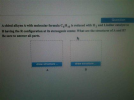 A chiral alkyne A with molecular formula C6H10 is reduced with H2 and Lindlar catalyst to B having the R configuration at its stereogenic center. What are the structure of A and B? Be sure to answer all parts.
What is the major organic product of the following reaction? H2 Н2 (9) Н Lindlar's catalyst...
 What is the major organic product of the following reaction? H2 Н2 (9) Н Lindlar's catalyst H₂C=CC-CECH Select one: Н, О НАС С. с CECH H2 H2 с C-CH3 Н. Н. О НАС H2 o HC.cco CC-CH2 Н. Н H2 0 H₂Cc. C=CH2 Н н H2 НСС, Hн IO C=c-CHE
1) Provide the products produced from each of the following reactions. a) H2 Lindlar's Catalyst b) CH3CH2ONa c) 1) LiAIH4 2) H20 но d) 8.25% NaClO NaHSO4 но e) 1 NaBHA 2) H20 но 1) Provide t...
 1) Provide the products produced from each of the following reactions. a) H2 Lindlar's Catalyst b) CH3CH2ONa c) 1) LiAIH4 2) H20 но d) 8.25% NaClO NaHSO4 но e) 1 NaBHA 2) H20 но
1) Provide the products produced from each of the following reactions. a) H2 Lindlar's Catalyst b) CH3CH2ONa c) 1) LiAIH4 2) H20 но d) 8.25% NaClO NaHSO4 но e) 1 NaBHA 2) H20 но
1) Provide the products produced from each of the following reactions. a) H2 Lindlar's Catalyst b) CH3CH2ONa c) 1) LiAIH4 2) H20 но d) 8.25% NaClO NaHSO4 но e) 1 NaBHA 2) H20 но
The compound below is an H2C CH-CH3 Select one: a. alkyne b. alkene c. alkane d. aromatic compound e. olefin
 The compound below is an H2C CH-CH3 Select one: a. alkyne b. alkene c. alkane d. aromatic compound e. olefin
, The reagents needed to convert 2-butyne to frans-2-butene are A) H2 and Pt/C B) H/Lindlar's...
 , The reagents needed to convert 2-butyne to frans-2-butene are A) H2 and Pt/C B) H/Lindlar's catalyst C) L/NH D) Ca/NHs E) H2,LİNH3 For questions 15 through 17, identify the major product for each of the reactions. 15. 2 Br2 H-CH, ether Br CH s B) HC c) A) HyC Br Br. Br CH Br CH3 E) H D) HC 16. 1. BH,/THF он A) он он E) D) 1. NaNH/THF 2. CH,Br B) A) Page 13 of 15 HjC
Which of the following reagents should be used to convert hex-3-yne to (Z)-hex-3-ene? A) H2, Pt...
Which of the following reagents should be used to convert hex-3-yne to (Z)-hex-3-ene? A) H2, Pt B) Na, NH3 C) H2, Lindlar's catalyst D) H2SO4, H2O E) HgSO4, H2O
 QuestIUIT Which reaction proceeds through a vinylic radical? (1) Hg catalyzed hydration of an alkyne ) Catalytic hydrogenation of an alkyne (3) Li / NH3 reduction of an alkyne (4) Treatment of an alkyne with strong base Question 2 -- / 1 Select the correct statement regarding the hydrogenation of 6-decyne: n The hydrogenation occurs with anti additon of hydrogen to the double bond Lindlar's catalyst typicaly will produce the fully saturated alkane product A cis alkene results in the...
 Question8 The reaction of 2-butyne with H2 and Lindlar's catalyst produces: H2 (9) Which one of the following reagents will convert propyne into the sodium acetylide shown? CH3-CEC-CH3- Pd/PbO/CaCO3 CH-C CH +? H CH3 CH, H 0% NaCl NaNH2 O NaOH BI CH3-CH2-CH2-CHs CH3 C-C-CH2 IC] Na CO3 НН CH3
 11. Consider molecular formula C3H14 and draw (a) terminal alkyne (b) symmetric internal alkyne (d) conjugated diene (e) isolated diene (C) asymmetric internal alkyne (f) cumulative diene.
 Hydration of terminal alkynes in the presence of mercuric sulfate always yields a methyl ketone whereas hydration of internal alkynes produces mixture of ketones. Explain with appropriate example. Hydroboration-Oxidation of an internal alkyne produces ketone whereas the same reaction for a terminal alkyne yields aldehyde - why? State the rule associated in it.
 A chiral alkyne A with molecular formula C6H10 is reduced with H2 and Lindlar catalyst to B having the R configuration at its stereogenic center. What are the structure of A and B? Be sure to answer all parts.
 What is the major organic product of the following reaction? H2 Н2 (9) Н Lindlar's catalyst H₂C=CC-CECH Select one: Н, О НАС С. с CECH H2 H2 с C-CH3 Н. Н. О НАС H2 o HC.cco CC-CH2 Н. Н H2 0 H₂Cc. C=CH2 Н н H2 НСС, Hн IO C=c-CHE
 1) Provide the products produced from each of the following reactions. a) H2 Lindlar's Catalyst b) CH3CH2ONa c) 1) LiAIH4 2) H20 но d) 8.25% NaClO NaHSO4 но e) 1 NaBHA 2) H20 но
1) Provide the products produced from each of the following reactions. a) H2 Lindlar's Catalyst b) CH3CH2ONa c) 1) LiAIH4 2) H20 но d) 8.25% NaClO NaHSO4 но e) 1 NaBHA 2) H20 но
1) Provide the products produced from each of the following reactions. a) H2 Lindlar's Catalyst b) CH3CH2ONa c) 1) LiAIH4 2) H20 но d) 8.25% NaClO NaHSO4 но e) 1 NaBHA 2) H20 но
 The compound below is an H2C CH-CH3 Select one: a. alkyne b. alkene c. alkane d. aromatic compound e. olefin
 , The reagents needed to convert 2-butyne to frans-2-butene are A) H2 and Pt/C B) H/Lindlar's catalyst C) L/NH D) Ca/NHs E) H2,LİNH3 For questions 15 through 17, identify the major product for each of the reactions. 15. 2 Br2 H-CH, ether Br CH s B) HC c) A) HyC Br Br. Br CH Br CH3 E) H D) HC 16. 1. BH,/THF он A) он он E) D) 1. NaNH/THF 2. CH,Br B) A) Page 13 of 15 HjC
Most questions answered within 3 hours.
-
Where is the error in this code sequence?
String s1 = "Hello";
String s2 = "ello";...
asked 10 months ago -
Financial data for Joel de Paris, Inc., for last year
follow:
Joel de Paris, Inc.
Balance...
asked 10 months ago -
Consider this reaction:
Al2(SO4)3 (aq)+ BaCl3
(aq) Al2Cl6 (aq)- +
3BaSO4(s) . What is the...
asked 10 months ago -
Suppose that Savneet is considering increasing her
recent random sample from 20 car rentals to 40...
asked 10 months ago -
Trucks arrive at an unloading terminal at an average rate of 120
per hour.
Trucks arrive...
asked 10 months ago -
Why are methanol and ethanol completely soluble in water while
octanol is not very little soluble....
asked 10 months ago -
A facilities manager at a university reads in a research report
that the mean amount of...
asked 10 months ago -
When the CuSO4 is rehydrated by adding water to the anhydrous
compound, is this an endothermic...
asked 10 months ago -
A ray of sunlight is passing from diamond into crown glass; the
angle of incidence is...
asked 10 months ago -
A block of mass 0.249 kg is placed on top of a light, vertical
spring of...
asked 10 months ago -
how do the kidneys compensate in the presences of acidosis
a) trigger hyperventilate
b) reserve acid...
asked 10 months ago -
Question 501 pts
The rental rate of capital to the firm increases. Which of the
following...
asked 10 months ago