You drop an ice cube into an insulated bottle full of water and wait for the...
You drop an ice cube into an insulated bottle full of water and wait for the ice cube to completely melt. The ice cube initially has a mass of 90.0 g and a temperature of 0°C. The water (before the ice cube is added) has a mass of 840 g and an initial temperature of 24.0°C. What is the final temperature (in °C) of the mixture? (Assume no energy is lost to the walls of the bottle, or to the environment.)
Homework Answers

Add Answer to:
You drop an ice cube into an insulated bottle full of water and
wait for the...
You drop an ice cube into an insulated flask full of water and wait for the...
You drop an ice cube into an insulated flask full of water and wait for the ice cube to completely melt. The ice cube initially has a mass of 65.0 g and a temperature of 0°C. The water (before the ice cube is added) has a mass of 770 g and an initial temperature of 22.0°C. What is the final temperature (in °C) of the mixture? (Assume no energy is lost to the walls of the flask, or to the...
You drop an ice cube into an insulated container full of water and wait for the...
You drop an ice cube into an insulated container full of water and wait for the ice cube to completely melt. The ice cube initially has a mass of 80.0 g and a temperature of 0°C. The water (before the ice cube is added) has a mass of 660 g and an initial temperature of 20.0°C. What is the final temperature (in °C) of the mixture? (Assume no energy is lost to the walls of the container, or to the...
We drop a cube of ice into a glass of water. The mass of the cube...
We drop a cube of ice into a glass of water. The mass of the cube of ice is40.0 g and its initial temperature is −10.2∘C−10.2∘C. The mass of the water is 251 g and its initial temperature is 19.7∘C19.7∘C. What is the final temperature of the water after all of the ice has melted? ??????=4186?/??⋅∘?cwater=4186J/kg⋅∘C ????=2090?/??⋅∘?cice=2090J/kg⋅∘C ?????=128?/??⋅∘?clead=128J/kg⋅∘C ??????=380?/??⋅∘?cbrass=380J/kg⋅∘C ??????−???=3.33×10⁵?/??
An ice cube of mass 500 g at 0 °C is dropped into an insulated container...
 An ice cube of mass 500 g at 0 °C is dropped into an insulated container of 1.0 kg of water that initially is at room temperature (25 °C), and eventually the system reaches equilibrium. The insulator is not perfect, so 20 kJ of heat flows from the room into the water during the process. 3. a. Calculate the entropy increase in the ice that melts into water. b. Calculate the entropy loss of the water that cools down. c....
a 120 gram ice cube at 0°C is added to an insulated cup containing 414 grams...
a 120 gram ice cube at 0°C is added to an insulated cup containing 414 grams of water at 66°C. After thermal equilibrium has been reached, what is the temperature and state (solid, liquid, gas) of the mixture?
A 0.6850-kg ice cube at-12.40°C is placed inside a chamber of steam at 365.0℃. Later, you...
 A 0.6850-kg ice cube at-12.40°C is placed inside a chamber of steam at 365.0℃. Later, you notice that the ice cube has completely melted into a puddle of water. If the chamber initially contained 6.670 moles of steam (water) molecules before the ice is added, calculate the final temperature of the puddle once it settled to eqilibrium. (Assume the chamber walls aresufficiently flexible to allow the system to remain isobaric and consider thermal losses/gains from the chamber walls as negligible.)...
A copper vessel of mass 1000g contains 500g of water at 50C. An ice cube of...
A copper vessel of mass 1000g contains 500g of water at 50C. An ice cube of mass 100g at temperature 30C is dropped into the vessel. a)Does the ice melt? Explain in a few words how you reached to your answer. b) What is the final temperature? c) Repeat part b if at the same time as dropping in the ice cube, wealso drop in a 200g piece of glass at a temperature of 110C. Specific heats in cal/g.C Ice=0.5...
A 0.6630-kg ice cube at -12.40°C is placed inside a chamber of steam at 365.0°C. Later,...
A 0.6630-kg ice cube at -12.40°C is placed inside a chamber of steam at 365.0°C. Later, you notice that the ice cube has completely melted into a puddle of water. If the chamber initially contained 6.550 moles of steam (water) molecules before the ice is added, calculate the final temperature of the puddle once it settled to equilibrium. (Assume the chamber walls are sufficiently flexible to allow the system to remain isobaric and consider thermal losses/gains from the chamber walls...
A 0.6630-kg ice cube at -12.40°C is placed inside a chamber of steam at 365.0°C. Later,...
A 0.6630-kg ice cube at -12.40°C is placed inside a chamber of steam at 365.0°C. Later, you notice that the ice cube has completely melted into a puddle of water. If the chamber initially contained 5.950 moles of steam (water) molecules before the ice is added, calculate the final temperature of the puddle once it settled to equilibrium. (Assume the chamber walls are sufficiently flexible to allow the system to remain isobaric and consider thermal losses/gains from the chamber walls...
A 0.6630-kg ice cube at-12.40℃ is placed inside a chamber of steam at 365 0°C Later,...
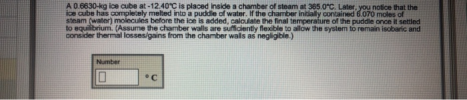 A 0.6630-kg ice cube at-12.40℃ is placed inside a chamber of steam at 365 0°C Later, you notice that the ice cube has completely melted into a puddle of water. If the chamber initially contained 6.070 moles of steam (water) molecules before the ice is added, caloulate the final temperature of the puddle once it settled to equilibrium. (Assume the chamber walls are sufficiently flexible to allow the system to remain isobaric and consider thermal losses/gains from the chamber walls...
 An ice cube of mass 500 g at 0 °C is dropped into an insulated container of 1.0 kg of water that initially is at room temperature (25 °C), and eventually the system reaches equilibrium. The insulator is not perfect, so 20 kJ of heat flows from the room into the water during the process. 3. a. Calculate the entropy increase in the ice that melts into water. b. Calculate the entropy loss of the water that cools down. c....
 A 0.6850-kg ice cube at-12.40°C is placed inside a chamber of steam at 365.0℃. Later, you notice that the ice cube has completely melted into a puddle of water. If the chamber initially contained 6.670 moles of steam (water) molecules before the ice is added, calculate the final temperature of the puddle once it settled to eqilibrium. (Assume the chamber walls aresufficiently flexible to allow the system to remain isobaric and consider thermal losses/gains from the chamber walls as negligible.)...
 A 0.6630-kg ice cube at-12.40℃ is placed inside a chamber of steam at 365 0°C Later, you notice that the ice cube has completely melted into a puddle of water. If the chamber initially contained 6.070 moles of steam (water) molecules before the ice is added, caloulate the final temperature of the puddle once it settled to equilibrium. (Assume the chamber walls are sufficiently flexible to allow the system to remain isobaric and consider thermal losses/gains from the chamber walls...
Most questions answered within 3 hours.
-
Where is the error in this code sequence?
String s1 = "Hello";
String s2 = "ello";...
asked 10 months ago -
Financial data for Joel de Paris, Inc., for last year
follow:
Joel de Paris, Inc.
Balance...
asked 10 months ago -
Consider this reaction:
Al2(SO4)3 (aq)+ BaCl3
(aq) Al2Cl6 (aq)- +
3BaSO4(s) . What is the...
asked 10 months ago -
Suppose that Savneet is considering increasing her
recent random sample from 20 car rentals to 40...
asked 10 months ago -
Trucks arrive at an unloading terminal at an average rate of 120
per hour.
Trucks arrive...
asked 10 months ago -
Why are methanol and ethanol completely soluble in water while
octanol is not very little soluble....
asked 10 months ago -
A facilities manager at a university reads in a research report
that the mean amount of...
asked 10 months ago -
When the CuSO4 is rehydrated by adding water to the anhydrous
compound, is this an endothermic...
asked 10 months ago -
A ray of sunlight is passing from diamond into crown glass; the
angle of incidence is...
asked 10 months ago -
A block of mass 0.249 kg is placed on top of a light, vertical
spring of...
asked 10 months ago -
how do the kidneys compensate in the presences of acidosis
a) trigger hyperventilate
b) reserve acid...
asked 10 months ago -
Question 501 pts
The rental rate of capital to the firm increases. Which of the
following...
asked 10 months ago