The diameter of the moon as seen from earth subtends an angle of about 0.5°. Find...
The diameter of the moon as seen from earth subtends an angle of about 0.5°. Find the probability that a laser beam aimed in a random direction from the earth's surface will strike the moon.
Homework Answers

Add Answer to:
The diameter of the moon as seen from earth subtends an angle of
about 0.5°. Find...
33C Moon-Earth distance Eq. (33.31) Because of diffraction, the beam spreads by a total angle 20...
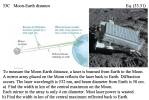 33C Moon-Earth distance Eq. (33.31) Because of diffraction, the beam spreads by a total angle 20 When the beam reaches the earth, it has spread out into a circle of diameter w. Mirror on moon 24 L Rellected beam returning to earth To measure the Moon-Earth distance, a laser is beamed from Earth to the Moon. A mirror array placed on the Moon reflects the laser back to Earth. Diffraction occurs. The laser wavelength is 532 nm, and beam diameter...
The international space station (ISS) orbits the Earth with an approximately circular orbit 420 km above...
The international space station (ISS) orbits the Earth with an approximately circular orbit 420 km above Earth's surface (6790 km above the center of the Earth). Suppose one evening the ISS passes in front of the full moon - which subtends an angle of 30 arc minutes (0.5 degrees)- in such a way that it exactly bisects the moon. How long will it take to cross in front of the Moon from one end to the other, as viewed by...
4. (4 points) A laser beam is to be directed toward the center of the moon,...
 4. (4 points) A laser beam is to be directed toward the center of the moon, but the beam strays 0.5" from its intended path. (This problem requires the use of a calculator.) (a) How far has the beam diverged from its assigned target when it reaches the moon? (The distance from the earth to the moon is 240,000 miles.) N (b) The radius of the moon is about 1,000 miles. Will the beam strike the moon?
69. Solar Eclipse on Earth The sun has a Sun diameter of about 865,000 mi with...
 69. Solar Eclipse on Earth The sun has a Sun diameter of about 865,000 mi with a maxi- mum distance from Earth's surface of about Moon Earth 94,500,000 mi. The moon has a smaller diam- eter of 2159 mi. For a total solar eclipse to occur, the moon must pass between Earth and NOT TO SCALE Umbra the sun. The moon must also be close enough to Earth for the moon's umbra (shadow) to reach the surface of Earth. (Source:...
009 (part 1 of 4) 10.0 points The radius of the moon is 1.74 x 10°...
 009 (part 1 of 4) 10.0 points The radius of the moon is 1.74 x 10° m, the radius of the sun is 6.96 x 10⁸ m, the averagie moon-earth distance is 3.84 x 10° m, and the average sun-earth distance is 1.496 x 10" m hat is the apparent angle the diameter of the moon subtends, as seen from the earth? Answer in units of rad. 010 (part 2 of 4) 10.0 points What will the result be in...
What is the maximum angular diameter of Ceres in seconds of arc as seen from Earth?...
What is the maximum angular diameter of Ceres in seconds of arc as seen from Earth? (Hints: Use the small-angle formula; angular size in seconds of arc = 206,265 x physical size/distance; Ceres's orbital radius is 413.9 million km; and its diameter is 965 km. Note that the Earth is about 149.6 million km from the sun.) Can details be seen on the surface of Ceres with a 100 inch simple mirror reflecting telescope?
This problem shows why the shape of the sun appears to be somewhat flattened at sunset...
 This problem shows why the shape of the sun appears to be somewhat flattened at sunset (Fig. 23-57). The sun subtends an angle of approximately 0.5 degree at the earth. Suppose that a ray from the bottom of the sun's disk is incident on the earth's atmosphere at an angle of 89.0 degree, and a ray from the top of the sun's disk is incident on the atmosphere at an angle of 88.5 degree. Find the angle between the two...
The average distance from the Moon to the center of the Earth is 384,400 km, and...
The average distance from the Moon to the center of the Earth is 384,400 km, and the diameter of the Earth is 12,756 km. Calculate the gravitational force that the Moon exerts (a) on a 1-kg rock at the point on the Earth’s surface closest to the Moon and (b) on a 1-kg rock at a point on the Earth’s surface furthest from the Moon. The mass of the Moon is 7.349 × 10²² kg. (c) Find the difference between...
(a) What is the minimum angular spread (in rad) of a 431 nm wavelength strontium vapor...
(a) What is the minimum angular spread (in rad) of a 431 nm wavelength strontium vapor laser beam that is originally 1.56 mm in diameter? rad (b) If this laser is aimed at a mountain cliff 16.0 km away, how big will the illuminated spot be? (Give the diameter of the spot in meters.) m (c) How big a spot would be illuminated on the Moon, neglecting atmospheric effects? (This might be done to hit a corner reflector to measure...
please show all work. thank you (10 Points) The moon revolves about the earth in a...
 please show all work. thank you
(10 Points) The moon revolves about the earth in a circle (very nearly) of radius R =239,000 mi or 12.6 X 108 ft, and requires 27.3 days of 23.4 X 10⁵ sec to make a complete revolution. (a) What is the acceleration of the moon towards the earth? (Ans: a = 8.96 X 10⁻³ ft/sec) (b) If the gravitational force exerted on a body by the earth is inversely proportional to the square of...
please show all work. thank you
(10 Points) The moon revolves about the earth in a circle (very nearly) of radius R =239,000 mi or 12.6 X 108 ft, and requires 27.3 days of 23.4 X 10⁵ sec to make a complete revolution. (a) What is the acceleration of the moon towards the earth? (Ans: a = 8.96 X 10⁻³ ft/sec) (b) If the gravitational force exerted on a body by the earth is inversely proportional to the square of...
 33C Moon-Earth distance Eq. (33.31) Because of diffraction, the beam spreads by a total angle 20 When the beam reaches the earth, it has spread out into a circle of diameter w. Mirror on moon 24 L Rellected beam returning to earth To measure the Moon-Earth distance, a laser is beamed from Earth to the Moon. A mirror array placed on the Moon reflects the laser back to Earth. Diffraction occurs. The laser wavelength is 532 nm, and beam diameter...
 4. (4 points) A laser beam is to be directed toward the center of the moon, but the beam strays 0.5" from its intended path. (This problem requires the use of a calculator.) (a) How far has the beam diverged from its assigned target when it reaches the moon? (The distance from the earth to the moon is 240,000 miles.) N (b) The radius of the moon is about 1,000 miles. Will the beam strike the moon?
 69. Solar Eclipse on Earth The sun has a Sun diameter of about 865,000 mi with a maxi- mum distance from Earth's surface of about Moon Earth 94,500,000 mi. The moon has a smaller diam- eter of 2159 mi. For a total solar eclipse to occur, the moon must pass between Earth and NOT TO SCALE Umbra the sun. The moon must also be close enough to Earth for the moon's umbra (shadow) to reach the surface of Earth. (Source:...
 009 (part 1 of 4) 10.0 points The radius of the moon is 1.74 x 10° m, the radius of the sun is 6.96 x 10⁸ m, the averagie moon-earth distance is 3.84 x 10° m, and the average sun-earth distance is 1.496 x 10" m hat is the apparent angle the diameter of the moon subtends, as seen from the earth? Answer in units of rad. 010 (part 2 of 4) 10.0 points What will the result be in...
 This problem shows why the shape of the sun appears to be somewhat flattened at sunset (Fig. 23-57). The sun subtends an angle of approximately 0.5 degree at the earth. Suppose that a ray from the bottom of the sun's disk is incident on the earth's atmosphere at an angle of 89.0 degree, and a ray from the top of the sun's disk is incident on the atmosphere at an angle of 88.5 degree. Find the angle between the two...
 please show all work. thank you
(10 Points) The moon revolves about the earth in a circle (very nearly) of radius R =239,000 mi or 12.6 X 108 ft, and requires 27.3 days of 23.4 X 10⁵ sec to make a complete revolution. (a) What is the acceleration of the moon towards the earth? (Ans: a = 8.96 X 10⁻³ ft/sec) (b) If the gravitational force exerted on a body by the earth is inversely proportional to the square of...
please show all work. thank you
(10 Points) The moon revolves about the earth in a circle (very nearly) of radius R =239,000 mi or 12.6 X 108 ft, and requires 27.3 days of 23.4 X 10⁵ sec to make a complete revolution. (a) What is the acceleration of the moon towards the earth? (Ans: a = 8.96 X 10⁻³ ft/sec) (b) If the gravitational force exerted on a body by the earth is inversely proportional to the square of...
Most questions answered within 3 hours.
-
Where is the error in this code sequence?
String s1 = "Hello";
String s2 = "ello";...
asked 11 months ago -
Financial data for Joel de Paris, Inc., for last year
follow:
Joel de Paris, Inc.
Balance...
asked 11 months ago -
Consider this reaction:
Al2(SO4)3 (aq)+ BaCl3
(aq) Al2Cl6 (aq)- +
3BaSO4(s) . What is the...
asked 11 months ago -
Suppose that Savneet is considering increasing her
recent random sample from 20 car rentals to 40...
asked 11 months ago -
Trucks arrive at an unloading terminal at an average rate of 120
per hour.
Trucks arrive...
asked 11 months ago -
Why are methanol and ethanol completely soluble in water while
octanol is not very little soluble....
asked 11 months ago -
A facilities manager at a university reads in a research report
that the mean amount of...
asked 11 months ago -
When the CuSO4 is rehydrated by adding water to the anhydrous
compound, is this an endothermic...
asked 11 months ago -
A ray of sunlight is passing from diamond into crown glass; the
angle of incidence is...
asked 11 months ago -
A block of mass 0.249 kg is placed on top of a light, vertical
spring of...
asked 11 months ago -
how do the kidneys compensate in the presences of acidosis
a) trigger hyperventilate
b) reserve acid...
asked 11 months ago -
Question 501 pts
The rental rate of capital to the firm increases. Which of the
following...
asked 11 months ago