A. A beginning scientist measures an absorbance of 3.0 at 260 nm for a DNA sample....
A. A beginning scientist measures an absorbance of 3.0 at 260 nm for a DNA sample. Is this a meaningful number and why or why not ?(Consider the amount of light passing through the sample, ie. the % transmittance). What range should values of absorbance fall in?
B. A 6.0 mg/L solution of adenine in water has an absorbance of 0.59 at 261 nm in a 1 cm pathlength cell. Adenine has a molecular weight of 135.1 g/mol.What is the extinction coefficient of adenine at 261 nm (ε261) in units of M-1cm-1?
Homework Answers
A.
Absorbance (A) of a sample is related to % transmittance of light through the sample as follows

Hence, if a sample has an absorbance of 3.0, the % transmittance can be calculated as
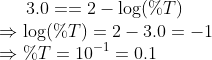
It means only 0.1 % of the incident light has passed through the sample and 99.9% of the light is absorbed. This can only happen if the concentration of the DNA sample is too high. Hence, if we are to measure the concentration of the sample using the Beer-Lamberts law with absorbance of 3.0, the relationship between the concentration and absorbance is not linear anymore as predicted by the equation

Where c is the concentration
l is the path length
 is the
extinction coefficient.
is the
extinction coefficient.
Note that all the high concentrations with absorbance > 3.0 will result in an absorbance of close to 99.9% incident light and it will be practically impossible to relate the concentrations with absorbance as they all give greater than 99.9% absorbance. In other words, high absorbance values like 3.0 leads to non-linearity in the absorbance vs concentration relationship and makes it impossible to predict the correct concentration from absorbance data.
Hence, 3.0 is not a meaningful number for absorbance.
Instead, we dilute our solution enough to get a transmittance of at least 10% where the absorbance value is 1.
Hence, a reading of absorbance between 0 to 1 is preferred where the absorbance and concentration is linear and easily predicted by the Beer Lambert law. Hence, instead of taking a highly concentrated solution which gives a high absorbance reading, we should dilute it to bring the absorbance to 0-1 range.
B.
Concentration of the adenine solution is 6.0 mg/L.
Hence, there are 6.0 mg of adenine in 1 L of the solution.
Molar mass of adenine is 135.1 g/mol
Hence, number of moles of adenine in 1 L is

Hence,  of adenine is present in 1 L of solution. Hence, the molar
concentration of adenine solution is
of adenine is present in 1 L of solution. Hence, the molar
concentration of adenine solution is

Now, it gives an absorbance reading of 0.59 in a 1 cm path length cell with a light of 261 nm wavelength.
Hence,


Now using the Beer-Lamberts law,

Hence, the extinction coefficient of adenine at 261 nm
is about  (rounded to two significant figures)
Add Answer to:
A. A beginning scientist measures an absorbance of 3.0 at 260 nm
for a DNA sample....
Most questions answered within 3 hours.
-
Where is the error in this code sequence?
String s1 = "Hello";
String s2 = "ello";...
asked 10 months ago -
Financial data for Joel de Paris, Inc., for last year
follow:
Joel de Paris, Inc.
Balance...
asked 10 months ago -
Consider this reaction:
Al2(SO4)3 (aq)+ BaCl3
(aq) Al2Cl6 (aq)- +
3BaSO4(s) . What is the...
asked 10 months ago -
Suppose that Savneet is considering increasing her
recent random sample from 20 car rentals to 40...
asked 10 months ago -
Trucks arrive at an unloading terminal at an average rate of 120
per hour.
Trucks arrive...
asked 10 months ago -
Why are methanol and ethanol completely soluble in water while
octanol is not very little soluble....
asked 10 months ago -
A facilities manager at a university reads in a research report
that the mean amount of...
asked 10 months ago -
When the CuSO4 is rehydrated by adding water to the anhydrous
compound, is this an endothermic...
asked 10 months ago -
A ray of sunlight is passing from diamond into crown glass; the
angle of incidence is...
asked 10 months ago -
A block of mass 0.249 kg is placed on top of a light, vertical
spring of...
asked 10 months ago -
how do the kidneys compensate in the presences of acidosis
a) trigger hyperventilate
b) reserve acid...
asked 10 months ago -
Question 501 pts
The rental rate of capital to the firm increases. Which of the
following...
asked 10 months ago