A geometric Brownian motion has parameters mu= 0.2 and sigma=2. What is the probability that the...
A geometric Brownian motion has parameters mu= 0.2 and sigma=2. What is the probability that the process is above 4 at time t=4, given that it starts at 3. Round answer to 3 decimals.
Homework Answers
I HOPE ITS HELP FUL TO YOU IF YOU HAVE ANY DOUBTS PLS COMMENTS BELOW..I WILL BE THERE TO HELP..ALL THE BEST...
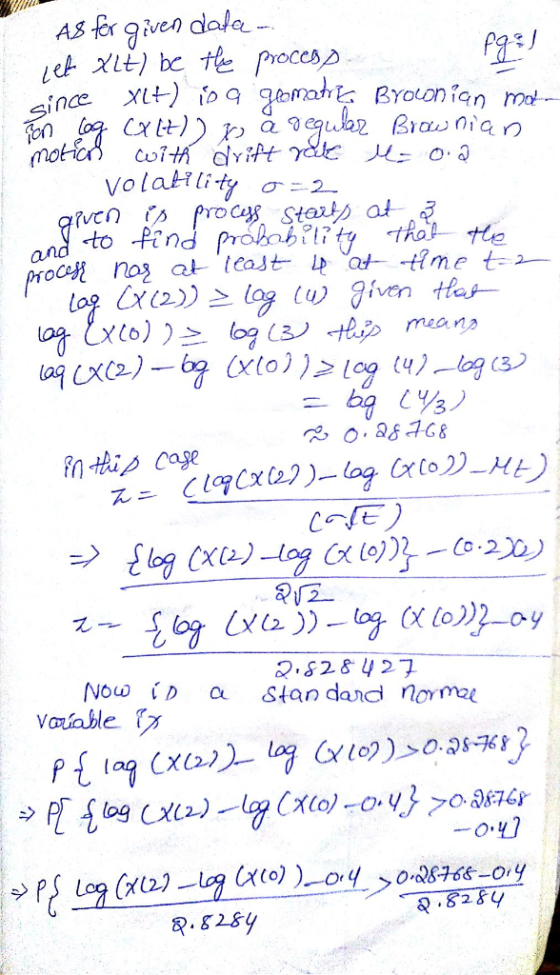
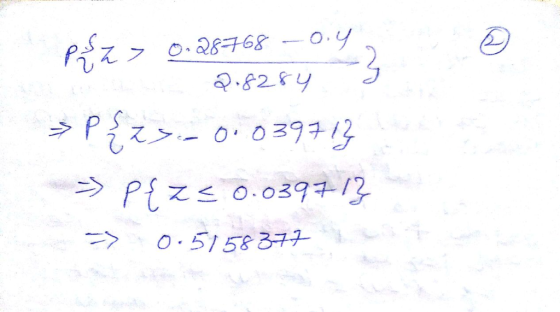
I HOPE YOU UNDERSTAND...
PLS RATE THUMBS UP...ITS HELPS ME ALOT.....
THANK YOU....!!
Add Answer to:
A geometric Brownian motion has parameters mu= 0.2 and sigma=2.
What is the probability that the...
Let S(t), t >=0 be a Geometric Brownian motion process with drift mu = 0.1 and volatility sigma = 0.2. Find P(S(2) &g...
Let S(t), t >=0 be a Geometric Brownian motion process with drift mu = 0.1 and volatility sigma = 0.2. Find P(S(2) >S(1) > S(0))
If X(t), t>=0 is a Brownian motion process with drift mu and variance sigma squared for which X(0)=0, show that -X(t)...
If X(t), t>=0 is a Brownian motion process with drift mu and variance sigma squared for which X(0)=0, show that -X(t), t>=0 is a Brownian Motion process with drift negative mu and variance sigma squared.
If s follows the geometric Brownian motion process ds - S dt+oS dz what is the...
 If s follows the geometric Brownian motion process ds - S dt+oS dz what is the process followed by (a) y = 2S, (b) y S 5.
If s follows the geometric Brownian motion process ds - S dt+oS dz what is the process followed by (a) y = 2S, (b) y S 5.
If s follows the geometric Brownian motion process ds - S dt+oS dz what is the process followed by (a) y = 2S, (b) y S 5.
Let x be an arithmetic brownian motion starting from 0 with drift parameter 0.2 Let X-(Xt...
 Let x be an arithmetic brownian motion starting from 0 with
drift parameter 0.2
Let X-(Xt ,0 < t < 1} be an arithmetic Brownian motion starting from 0 with drift parameter μ-0.2 and variance parameter ơ2-0.125. 1. Calculate the probability that X2 is between 0.1 and 0.5 2. Given that X 0.6, find the probability that X2 is between 0.1 and 0.5 3. Given that Xi- 0.2, find the covariance between X2 and X3
Let x be an arithmetic brownian motion starting from 0 with
drift parameter 0.2
Let X-(Xt ,0 < t < 1} be an arithmetic Brownian motion starting from 0 with drift parameter μ-0.2 and variance parameter ơ2-0.125. 1. Calculate the probability that X2 is between 0.1 and 0.5 2. Given that X 0.6, find the probability that X2 is between 0.1 and 0.5 3. Given that Xi- 0.2, find the covariance between X2 and X3
2. Solving the generalized geometric Brownian motion equation. Let S(t) be a positive stochastic process that...
 2. Solving the generalized geometric Brownian motion equation. Let S(t) be a positive stochastic process that satisfies the generalized geometric Brownian motion SDE dS(t) = u(t)S(t) dt + o(t)S(t) dW(t), where u(t) and o(t) are processes adapted to the filtration Ft, t > 0. (a) Use Itô’s lemma to compute d log S(t). Simplify so that you have a formula for d log S(t) that does not involve S(t). (b) Integrate the formula you obtained in (a), and then exponentiate...
If s follows the geometric Brownian motion process ds - S dt+oS dz what is the...
 If s follows the geometric Brownian motion process ds - S dt+oS dz what is the process followed by (a) y = 2S, (b) y S 5.
1) given mu = 20 and sigma = 3 a) probability(x<18) b)probability(x>21) 2) given mu =...
1) given mu = 20 and sigma = 3 a) probability(x<18) b)probability(x>21) 2) given mu = 50 and sigma = 4 a) find 90% confidence interval b) find 94%
Let X-(Xt ,0 < t < 1} be an arithmetic Brownian motion starting from 0 with...
 Let X-(Xt ,0 < t < 1} be an arithmetic Brownian motion starting from 0 with drift parameter μ-0.2 and variance parameter ơ2-0.125. 1. Calculate the probability that X2 is between 0.1 and 0.5 2. Given that X 0.6, find the probability that X2 is between 0.1 and 0.5 3. Given that Xi- 0.2, find the covariance between X2 and X3
Assume an asset price St follows the geometric Brownian motion, dSt = u Stdt+oS+dZt, So =s...
 Assume an asset price St follows the geometric Brownian motion, dSt = u Stdt+oS+dZt, So =s > 0 where u and o are constants, r is the risk-free rate, and Zt is the Brownian motion. 1. Using the Ito's Lemma find to the stochastic differential equation satisfied by the process X+ = St. 2. Compute E[Xt] and Var[Xt]. 3. Using the Ito's Lemma find the stochastic differential equation satisfied by the process Y1 = Sert'. 4. Compute E[Y] and Var[Y].
3. Brounian motion f(O)eR+ is a special case of a Gaussian process with mean zero and covariance C(s, t) = min(s, t) (a) What is the distribution of f(1), the Brownian motion at time t = 4? (Hint...
 3. Brounian motion f(O)eR+ is a special case of a Gaussian process with mean zero and covariance C(s, t) = min(s, t) (a) What is the distribution of f(1), the Brownian motion at time t = 4? (Hint: it may be useful to function recall that for any random variable X, var(X)-(x, X) (b) Fix tE R. What is the distribution of f(t)? (c) What is the distribution of f(4)-f(2)? (Hint: it may be useful to utilize var(X-Y) = var(X)...
 If s follows the geometric Brownian motion process ds - S dt+oS dz what is the process followed by (a) y = 2S, (b) y S 5.
If s follows the geometric Brownian motion process ds - S dt+oS dz what is the process followed by (a) y = 2S, (b) y S 5.
If s follows the geometric Brownian motion process ds - S dt+oS dz what is the process followed by (a) y = 2S, (b) y S 5.
 Let x be an arithmetic brownian motion starting from 0 with
drift parameter 0.2
Let X-(Xt ,0 < t < 1} be an arithmetic Brownian motion starting from 0 with drift parameter μ-0.2 and variance parameter ơ2-0.125. 1. Calculate the probability that X2 is between 0.1 and 0.5 2. Given that X 0.6, find the probability that X2 is between 0.1 and 0.5 3. Given that Xi- 0.2, find the covariance between X2 and X3
Let x be an arithmetic brownian motion starting from 0 with
drift parameter 0.2
Let X-(Xt ,0 < t < 1} be an arithmetic Brownian motion starting from 0 with drift parameter μ-0.2 and variance parameter ơ2-0.125. 1. Calculate the probability that X2 is between 0.1 and 0.5 2. Given that X 0.6, find the probability that X2 is between 0.1 and 0.5 3. Given that Xi- 0.2, find the covariance between X2 and X3
 2. Solving the generalized geometric Brownian motion equation. Let S(t) be a positive stochastic process that satisfies the generalized geometric Brownian motion SDE dS(t) = u(t)S(t) dt + o(t)S(t) dW(t), where u(t) and o(t) are processes adapted to the filtration Ft, t > 0. (a) Use Itô’s lemma to compute d log S(t). Simplify so that you have a formula for d log S(t) that does not involve S(t). (b) Integrate the formula you obtained in (a), and then exponentiate...
 If s follows the geometric Brownian motion process ds - S dt+oS dz what is the process followed by (a) y = 2S, (b) y S 5.
 Let X-(Xt ,0 < t < 1} be an arithmetic Brownian motion starting from 0 with drift parameter μ-0.2 and variance parameter ơ2-0.125. 1. Calculate the probability that X2 is between 0.1 and 0.5 2. Given that X 0.6, find the probability that X2 is between 0.1 and 0.5 3. Given that Xi- 0.2, find the covariance between X2 and X3
 Assume an asset price St follows the geometric Brownian motion, dSt = u Stdt+oS+dZt, So =s > 0 where u and o are constants, r is the risk-free rate, and Zt is the Brownian motion. 1. Using the Ito's Lemma find to the stochastic differential equation satisfied by the process X+ = St. 2. Compute E[Xt] and Var[Xt]. 3. Using the Ito's Lemma find the stochastic differential equation satisfied by the process Y1 = Sert'. 4. Compute E[Y] and Var[Y].
 3. Brounian motion f(O)eR+ is a special case of a Gaussian process with mean zero and covariance C(s, t) = min(s, t) (a) What is the distribution of f(1), the Brownian motion at time t = 4? (Hint: it may be useful to function recall that for any random variable X, var(X)-(x, X) (b) Fix tE R. What is the distribution of f(t)? (c) What is the distribution of f(4)-f(2)? (Hint: it may be useful to utilize var(X-Y) = var(X)...
Most questions answered within 3 hours.
-
Where is the error in this code sequence?
String s1 = "Hello";
String s2 = "ello";...
asked 10 months ago -
Financial data for Joel de Paris, Inc., for last year
follow:
Joel de Paris, Inc.
Balance...
asked 10 months ago -
Consider this reaction:
Al2(SO4)3 (aq)+ BaCl3
(aq) Al2Cl6 (aq)- +
3BaSO4(s) . What is the...
asked 10 months ago -
Suppose that Savneet is considering increasing her
recent random sample from 20 car rentals to 40...
asked 10 months ago -
Trucks arrive at an unloading terminal at an average rate of 120
per hour.
Trucks arrive...
asked 10 months ago -
Why are methanol and ethanol completely soluble in water while
octanol is not very little soluble....
asked 10 months ago -
A facilities manager at a university reads in a research report
that the mean amount of...
asked 10 months ago -
When the CuSO4 is rehydrated by adding water to the anhydrous
compound, is this an endothermic...
asked 10 months ago -
A ray of sunlight is passing from diamond into crown glass; the
angle of incidence is...
asked 10 months ago -
A block of mass 0.249 kg is placed on top of a light, vertical
spring of...
asked 10 months ago -
how do the kidneys compensate in the presences of acidosis
a) trigger hyperventilate
b) reserve acid...
asked 10 months ago -
Question 501 pts
The rental rate of capital to the firm increases. Which of the
following...
asked 10 months ago