A 45.0-kg girl is standing on a 130-kg plank. The plank, originally at rest, is free...
A 45.0-kg girl is standing on a 130-kg plank. The plank, originally at rest, is free to slide on a frozen lake, which is a flat, frictionless surface. The girl begins to walk along the plank at a constant velocity of 1.59 m/s to the right relative to the plank. (Let the direction the girl is moving in be positive. Indicate the direction with the sign of your answer.)
(a) What is her velocity relative to the surface of ice?
(b) What is the velocity of the plank relative to the surface of ice?
Homework Answers
here,
mass of girl , m1 = 45 kg
mass of plant , m2 = 130 kg
velocity of girl relative to the plank , v1 = 1.59 m/s
let the velocity of girl and plank relative to ice be v2 and v3
relative velocity , v1 = v2 - v3
1.59 = v2 - v3 .....(1)
and
using conservation of momentum
0 = m1 * v2 + m2 * v3
0 = 45 * v2 + 130 * v3 ....(2)
from (1) and (2)
v2 = 1.18 m/s
v1 = - 0.41 m/s
(a)
the velocity relative to the surface of ice is 1.18 m/s
(b)
the velocity of the plank relative to the surface of ice is - 0.41 m/s
Add Answer to:
A 45.0-kg girl is standing on a 130-kg plank. The plank,
originally at rest, is free...
A 45.0-kg girl is standing on a 156-kg plank. The plank, originally at rest, is free...
A 45.0-kg girl is standing on a 156-kg plank. The plank, originally at rest, is free to slide on a frozen lake, which is a flat, frictionless surface. The girl begins to walk along the plank at a constant velocity of 1.44 m/s to the right relative to the plank. (Let the direction the girl is moving in be positive. Indicate the direction with the sign of your answer.) (a) What is her velocity relative to the surface of ice?...
A 45.0 kg girl is standing on a 159 kg plank. The plank, originally at rest,...
A 45.0 kg girl is standing on a 159 kg plank. The plank, originally at rest, is free to slide on a frozen lake, which is a flat, frictionless surface. The girl begins to walk along the plank at a constant velocity of 1.38 m/s relative to the plank. (a) What is her velocity relative to the surface of ice? 1 m/s (b) What is the velocity of the plank relative to the surface of ice? 2 m/s
A 45.0 kg girl is standing on a 150 kg plank. The plank, originally at rest, is free to slide on...
A 45.0 kg girl is standing on a 150 kg plank. The plank, originally at rest, is free to slide on a frozen lake, which is a flat, frictionless surface. The girl beginsto walk along the plank at a constant velocity of 1.50 m/s. What is her velocity relative to the surface of the ice?
A 48.8 kg girl is standing on a 136 kg plank. The plank, originally at rest,...
A 48.8 kg girl is standing on a 136 kg plank. The plank, originally at rest, is free to slide on a frozen lake, which is a flat, frictionless surface. The girl begins to walk along the plank at a constant velocity of 1.59 m/s relative to the plank. What is her velocity relative to the ice surface? What is the velocity of the plank relative to the ice surface?
A 40.7 kg girl is standing on a 151 kg plank. Both are originally at rest...
A 40.7 kg girl is standing on a 151 kg plank. Both are originally at rest on a frozen lake that constitutes a frictionless, flat surface. The girl begins to walk along the plank at a constant velocity of 1.56 m/s x̂ relative to the plank. (a) What is the velocity of the plank relative to the ice surface? (b) What is the girl's velocity relative to the ice surface?
A 44.8-kg girl is standing on a 159-kg plank. Both originally at rest on a frozen...
A 44.8-kg girl is standing on a 159-kg plank. Both originally at rest on a frozen lake that constitutes a frictionless, flat surface. The girl begins to walk along the plank at a constant velocity of 1.48î m/s relative to the plank. (a) What is the velocity of the plank relative to the ice surface? (b) What is the girl's velocity relative to the ice surface? î m/s
Show and explain every step for every part please! Problem 4. Walking along a plank on...
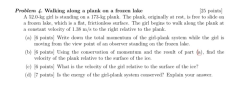 Show and explain every step for every part please!
Problem 4. Walking along a plank on a frozen lake [25 points] A 52.0-kg girl is standing on a 173-kg plank. The plank, originally at rest, is free to slide on a frozen lake, which is a flat, frictionless surface. The girl begins to walk along the plank at a constant velocity of 1.38 m/s to the right relative to the plank. (a) [6 points Write down the total momentum of...
Show and explain every step for every part please!
Problem 4. Walking along a plank on a frozen lake [25 points] A 52.0-kg girl is standing on a 173-kg plank. The plank, originally at rest, is free to slide on a frozen lake, which is a flat, frictionless surface. The girl begins to walk along the plank at a constant velocity of 1.38 m/s to the right relative to the plank. (a) [6 points Write down the total momentum of...
2-3 2. 0/6.66 points Previous Answers SerPSE10 9.1.P.003. My Notes Ask Your Teacher A baseball approaches...
 2-3
2. 0/6.66 points Previous Answers SerPSE10 9.1.P.003. My Notes Ask Your Teacher A baseball approaches home plate at a speed of 49.0 m/s, moving horizontally just before being hit by a bat. The batter hits a pop-up such that after hitting the bat, the baseball is moving at 58.0 m/s straight up. The ball has a mass of 145 g and is in contact with the bat for 2.40 ms. What is the average vector force the ball exerts...
2-3
2. 0/6.66 points Previous Answers SerPSE10 9.1.P.003. My Notes Ask Your Teacher A baseball approaches home plate at a speed of 49.0 m/s, moving horizontally just before being hit by a bat. The batter hits a pop-up such that after hitting the bat, the baseball is moving at 58.0 m/s straight up. The ball has a mass of 145 g and is in contact with the bat for 2.40 ms. What is the average vector force the ball exerts...
A boy of mass 35.2 kg is standing on the edge of a merry-go-round which is at rest.
A boy of mass 35.2 kg is standing on the edge of a merry-go-round which is at rest. The merry-go-round is a flat disk of mass 59.3 kg and radius 2.3m (the moment of inertia of a cylinder is ½ mr^2 ), turning on a frictionless pivot. The boy starts to walk around the edge of the merry-go-round in the clock-wise direction (when viewed from the top). When the boy is moving at 2.4 m/s relative to the merry-go-round: a....
Two ice skaters, Daniel (mass 70.0 kg ) and Rebecca (mass 45.0 kg ), are practicing....
Two ice skaters, Daniel (mass 70.0 kg ) and Rebecca (mass 45.0 kg ), are practicing. Daniel stops to tie his shoelace and, while at rest, is struck by Rebecca, who is moving at 14.0 m/s before she collides with him. After the collision, Rebecca has a velocity of magnitude 7.00 m/s at an angle of 55.1 ∘ from her initial direction. Both skaters move on the frictionless, horizontal surface of the rink. Part A What is the magnitude of...
 Show and explain every step for every part please!
Problem 4. Walking along a plank on a frozen lake [25 points] A 52.0-kg girl is standing on a 173-kg plank. The plank, originally at rest, is free to slide on a frozen lake, which is a flat, frictionless surface. The girl begins to walk along the plank at a constant velocity of 1.38 m/s to the right relative to the plank. (a) [6 points Write down the total momentum of...
Show and explain every step for every part please!
Problem 4. Walking along a plank on a frozen lake [25 points] A 52.0-kg girl is standing on a 173-kg plank. The plank, originally at rest, is free to slide on a frozen lake, which is a flat, frictionless surface. The girl begins to walk along the plank at a constant velocity of 1.38 m/s to the right relative to the plank. (a) [6 points Write down the total momentum of...
 2-3
2. 0/6.66 points Previous Answers SerPSE10 9.1.P.003. My Notes Ask Your Teacher A baseball approaches home plate at a speed of 49.0 m/s, moving horizontally just before being hit by a bat. The batter hits a pop-up such that after hitting the bat, the baseball is moving at 58.0 m/s straight up. The ball has a mass of 145 g and is in contact with the bat for 2.40 ms. What is the average vector force the ball exerts...
2-3
2. 0/6.66 points Previous Answers SerPSE10 9.1.P.003. My Notes Ask Your Teacher A baseball approaches home plate at a speed of 49.0 m/s, moving horizontally just before being hit by a bat. The batter hits a pop-up such that after hitting the bat, the baseball is moving at 58.0 m/s straight up. The ball has a mass of 145 g and is in contact with the bat for 2.40 ms. What is the average vector force the ball exerts...
Most questions answered within 3 hours.
-
Where is the error in this code sequence?
String s1 = "Hello";
String s2 = "ello";...
asked 11 months ago -
Financial data for Joel de Paris, Inc., for last year
follow:
Joel de Paris, Inc.
Balance...
asked 11 months ago -
Consider this reaction:
Al2(SO4)3 (aq)+ BaCl3
(aq) Al2Cl6 (aq)- +
3BaSO4(s) . What is the...
asked 11 months ago -
Suppose that Savneet is considering increasing her
recent random sample from 20 car rentals to 40...
asked 11 months ago -
Trucks arrive at an unloading terminal at an average rate of 120
per hour.
Trucks arrive...
asked 11 months ago -
Why are methanol and ethanol completely soluble in water while
octanol is not very little soluble....
asked 11 months ago -
A facilities manager at a university reads in a research report
that the mean amount of...
asked 11 months ago -
When the CuSO4 is rehydrated by adding water to the anhydrous
compound, is this an endothermic...
asked 11 months ago -
A ray of sunlight is passing from diamond into crown glass; the
angle of incidence is...
asked 11 months ago -
A block of mass 0.249 kg is placed on top of a light, vertical
spring of...
asked 11 months ago -
how do the kidneys compensate in the presences of acidosis
a) trigger hyperventilate
b) reserve acid...
asked 11 months ago -
Question 501 pts
The rental rate of capital to the firm increases. Which of the
following...
asked 11 months ago