A steel ball travelling at 8m/s collides with a cart initially at rest. The cart travels...
Homework Answers


Add Answer to:
A
steel ball travelling at 8m/s collides with a cart initially at
rest. The cart travels...
A bowling ball collides elastically with a ping-pong ball, which is initially at rest. After the...
A bowling ball collides elastically with a ping-pong ball, which is initially at rest. After the collision, the ping-pong ball’s speed is vp. What is the approximate final speed of the bowling ball? A. vp B. −vp C. 1 vp 2 D. zero
A cart on a table (cart A) collides with another cart that is initially at rest...
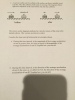 A cart on a table (cart A) collides with another cart that is initially at rest (cart B). After the collision, both carts are moving. The diagrams below represent snapshots of the carts before and after the collision. The arrows on the diagrams indicate the velocity vectors of the carts at the instants shown. (The vectors are drawn to scale.) Consider the time interval between the two instants shown. During this time interval, is the magnitude of the average acceleration...
A 20 kg cart travelling to the right at 10 m/s collides head- on with a...
A 20 kg cart travelling to the right at 10 m/s collides head- on with a 10 kg cart travelling 6 m/s to the left. After the collision, the 10 kg cart is travelling 8 m/s to the right. a) What is the velocity of the 20 kg cart after the collision? b) Determine wheter or not the collision is elastic (Show your calculations). c) Discuss whether or not your answers to parts a) and b) are reasonable. Include specific...
A 5 kg cart moving at a velocity 2 m/s in the +x-direction collides completely inelastically...
A 5 kg cart moving at a velocity 2 m/s in the +x-direction collides completely inelastically (i.e. they stick) with a second cart of mass 1.5 kg which is initially moving at a velocity of 10 m/s in the +y-direction. What is the total initial kinetic energy? J. What is the total x-component of momentum just before the collision? Kg m/s. What is the total y-component of momentum just before the collision? Kg m/s. What is the total x-component of momentum just after...
4. Energy and Momentum for 15 points: A 200 gram lab cart is initially at rest...
 4. Energy and Momentum for 15 points: A 200 gram lab cart is initially at rest on top of a 50 cm ramp, as shown. Note that the wheels are very light and the axle has no friction in it. You push the cart as it moves through a distance of 20 cm with a constant force of 10N in a direction oriented 20 degrees below horizontal. After you stop pushing on the cart, it encounters a ramp, and rolls...
12) A ball of mass 1 kg travelling right at 2 m/s collides elastically with a...
 12) A ball of mass 1 kg travelling right at 2 m/s collides elastically with a ball of mass 2 kg travelling left at 1 m/s. After the collision, what is the total kinetic energy of the two balls? A) OJ D 1
A ball of mass 0.265 kg that is moving with a speed of 5.1 m/s collides...
A ball of mass 0.265 kg that is moving with a speed of 5.1 m/s collides head-on and elastically with another ball initially at rest. Immediately after the collision, the incoming ball bounces backward with a speed of 3.3 m/s . a) Calculate the velocity of the target ball after the collision. b) Calculate the mass of the target ball. Solve using conservation of momentum and conservation of energy.
A cart of mass 0.20 kg starts moving at velocity 3.0 m/s collides inelastically with an...
A cart of mass 0.20 kg starts moving at velocity 3.0 m/s collides inelastically with an initially stationary cart of mass 0.40 kg. (A) If the carts stick together, what is their combined velocity immediately after the collision? (B) How much kinetic energy is lost in the collision?
A 1-kg pellet travels with velocity 160 m/s to the right when it collides with a...
A 1-kg pellet travels with velocity 160 m/s to the right when it collides with a 39-kg hanging mass which is initially at rest. After the collision, the pellet remains lodged in the hanging mass, i.e., it is a completely inelastic collision. The hanging mass (+pellet) then swings upward and reaches a maximum height hmax before swinging downward again. Assume that no external forces are present and therefore the momentum of the system is conserved. What is the velocity vf...
A 1.0-kg standard cart collides on a low-friction track with cart A. The standard cart has...
A 1.0-kg standard cart collides on a low-friction track with cart A. The standard cart has an initial x component of velocity of +0.40 m/s, and cart A is initially at rest. After the collision the x component of velocity of the standard cart is +0.20 m/s and the x component of velocity of cart A is +0.65 m/s . After the collision, cart A continues to the end of the track and rebounds with its speed unchanged. Before the...
 A cart on a table (cart A) collides with another cart that is initially at rest (cart B). After the collision, both carts are moving. The diagrams below represent snapshots of the carts before and after the collision. The arrows on the diagrams indicate the velocity vectors of the carts at the instants shown. (The vectors are drawn to scale.) Consider the time interval between the two instants shown. During this time interval, is the magnitude of the average acceleration...
 4. Energy and Momentum for 15 points: A 200 gram lab cart is initially at rest on top of a 50 cm ramp, as shown. Note that the wheels are very light and the axle has no friction in it. You push the cart as it moves through a distance of 20 cm with a constant force of 10N in a direction oriented 20 degrees below horizontal. After you stop pushing on the cart, it encounters a ramp, and rolls...
 12) A ball of mass 1 kg travelling right at 2 m/s collides elastically with a ball of mass 2 kg travelling left at 1 m/s. After the collision, what is the total kinetic energy of the two balls? A) OJ D 1
Most questions answered within 3 hours.
-
Where is the error in this code sequence?
String s1 = "Hello";
String s2 = "ello";...
asked 11 months ago -
Financial data for Joel de Paris, Inc., for last year
follow:
Joel de Paris, Inc.
Balance...
asked 11 months ago -
Consider this reaction:
Al2(SO4)3 (aq)+ BaCl3
(aq) Al2Cl6 (aq)- +
3BaSO4(s) . What is the...
asked 11 months ago -
Suppose that Savneet is considering increasing her
recent random sample from 20 car rentals to 40...
asked 11 months ago -
Trucks arrive at an unloading terminal at an average rate of 120
per hour.
Trucks arrive...
asked 11 months ago -
Why are methanol and ethanol completely soluble in water while
octanol is not very little soluble....
asked 11 months ago -
A facilities manager at a university reads in a research report
that the mean amount of...
asked 11 months ago -
When the CuSO4 is rehydrated by adding water to the anhydrous
compound, is this an endothermic...
asked 11 months ago -
A ray of sunlight is passing from diamond into crown glass; the
angle of incidence is...
asked 11 months ago -
A block of mass 0.249 kg is placed on top of a light, vertical
spring of...
asked 11 months ago -
how do the kidneys compensate in the presences of acidosis
a) trigger hyperventilate
b) reserve acid...
asked 11 months ago -
Question 501 pts
The rental rate of capital to the firm increases. Which of the
following...
asked 11 months ago