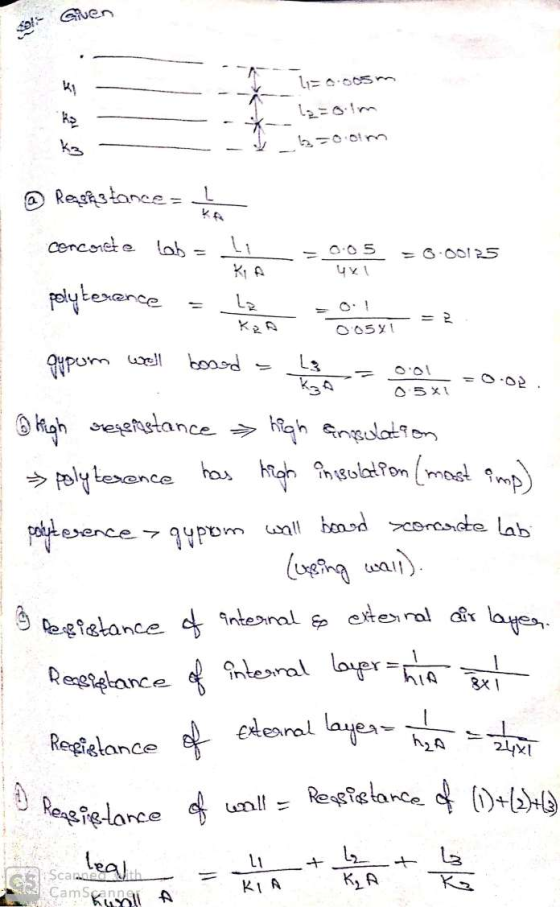
The roof ceiling has the following assembly: 1) metal structure slab: conductivity k1=4.0 W/mK, thickness L1=0.5...
The roof ceiling has the following assembly:
1) metal structure slab: conductivity k1=4.0 W/mK, thickness L1=0.5 cm,
2) Polystyrene: k2=0.05 W/mK, L2=10 cm,
3) Ceiling tiles: k3=0.5 W/mK, L3=1.0 cm.
Internal and external convection coefficients are: hinternal= 8 W/m2K and hexternal= 24 W/m2K.
a) (2 points) Calculate the resistance of Concrete slab, Polystyrene, and Gypsum wall board.
b) (1 point) Considering the insulation properties, which assembly component is the most important? Rank themaccording to the thermal insulation contribution.
c) (2 points) Calculate the resistance of internal and external air layer.
d) (2 points) Calculate the conductivity (U-value) of the wall.
Homework Answers
 If you do not get anything in
this solution, please put a comment and I will help you out.
If you do not get anything in
this solution, please put a comment and I will help you out.
Do not give a downvote instantly. It is a humble request. If you
like my answer, please give an upvote.
Add Answer to:
The roof ceiling has the following assembly:
1) metal structure slab:
conductivity k1=4.0 W/mK, thickness L1=0.5...
An exterior wall of a house made in three layers (brick (layer 1) + loosely packed...
An exterior wall of a house made in three layers (brick (layer 1) + loosely packed rock (layer 2) + gypsum plaster (layer 3)) may be approximated by a L1=10 cm layer of common brick k1=0.7 W/m℃ and a L3=4 cm layer of gypsum plaster k3=1.07 W/m℃. The total wall surface A=55 m2. The thickness L2 of loosely packed rock-wool insulation k2=0.65 W/m℃. The outlet temperature To=45℃, the inner temperature Ti=22℃, The internal wall temperature T1=27℃ . The heat transfer...
The wall of a furnace consists of a sheet metal (em=3 mm, km=14 W/mK), an insulator...
The wall of a furnace consists of a sheet metal (em=3 mm, km=14 W/mK), an insulator (eisn=3 cm, kins=0.5 W/mK) and another sheet metal like the first. If the interior temperature is 250ºC and the ambient temperature 25ºC, calculate the power dissipated to the outside and the temperature of the internal plate when the emissivity of the inner surface is 0.9, the inner film coefficient 15 W/m2K and the temperature of the sheet external 42ºC
summatize the following info and break them into differeng key points. write them in yojr own...
 summatize the following info and break them into differeng key points. write them in yojr own words
apartus
6.1 Introduction—The design of a successful hot box appa- ratus is influenced by many factors. Before beginning the design of an apparatus meeting this standard, the designer shall review the discussion on the limitations and accuracy, Section 13, discussions of the energy flows in a hot box, Annex A2, the metering box wall loss flow, Annex A3, and flanking loss, Annex...
summatize the following info and break them into differeng key points. write them in yojr own words
apartus
6.1 Introduction—The design of a successful hot box appa- ratus is influenced by many factors. Before beginning the design of an apparatus meeting this standard, the designer shall review the discussion on the limitations and accuracy, Section 13, discussions of the energy flows in a hot box, Annex A2, the metering box wall loss flow, Annex A3, and flanking loss, Annex...
summarizr the followung info and write them in your own words and break them into different...
summarizr the followung info and write them in your own words and break them into different key points. 6.5 Metering Chamber: 6.5.1 The minimum size of the metering box is governed by the metering area required to obtain a representative test area for the specimen (see 7.2) and for maintenance of reasonable test accuracy. For example, for specimens incorporating air spaces or stud spaces, the metering area shall span an integral number of spaces (see 5.5). The depth of...
 summatize the following info and break them into differeng key points. write them in yojr own words
apartus
6.1 Introduction—The design of a successful hot box appa- ratus is influenced by many factors. Before beginning the design of an apparatus meeting this standard, the designer shall review the discussion on the limitations and accuracy, Section 13, discussions of the energy flows in a hot box, Annex A2, the metering box wall loss flow, Annex A3, and flanking loss, Annex...
summatize the following info and break them into differeng key points. write them in yojr own words
apartus
6.1 Introduction—The design of a successful hot box appa- ratus is influenced by many factors. Before beginning the design of an apparatus meeting this standard, the designer shall review the discussion on the limitations and accuracy, Section 13, discussions of the energy flows in a hot box, Annex A2, the metering box wall loss flow, Annex A3, and flanking loss, Annex...
Most questions answered within 3 hours.
-
Where is the error in this code sequence?
String s1 = "Hello";
String s2 = "ello";...
asked 11 months ago -
Financial data for Joel de Paris, Inc., for last year
follow:
Joel de Paris, Inc.
Balance...
asked 11 months ago -
Consider this reaction:
Al2(SO4)3 (aq)+ BaCl3
(aq) Al2Cl6 (aq)- +
3BaSO4(s) . What is the...
asked 11 months ago -
Suppose that Savneet is considering increasing her
recent random sample from 20 car rentals to 40...
asked 11 months ago -
Trucks arrive at an unloading terminal at an average rate of 120
per hour.
Trucks arrive...
asked 11 months ago -
Why are methanol and ethanol completely soluble in water while
octanol is not very little soluble....
asked 11 months ago -
A facilities manager at a university reads in a research report
that the mean amount of...
asked 11 months ago -
When the CuSO4 is rehydrated by adding water to the anhydrous
compound, is this an endothermic...
asked 11 months ago -
A ray of sunlight is passing from diamond into crown glass; the
angle of incidence is...
asked 11 months ago -
A block of mass 0.249 kg is placed on top of a light, vertical
spring of...
asked 11 months ago -
how do the kidneys compensate in the presences of acidosis
a) trigger hyperventilate
b) reserve acid...
asked 11 months ago -
Question 501 pts
The rental rate of capital to the firm increases. Which of the
following...
asked 11 months ago