A 1μC charge is keeping a 1kg mass that is 1 m away from it from...
Homework Answers
let
q1 = 1 micro C
m = 1 kg
d = 1 m
let q2 is the charge of 1 kg mass.
in the equilibrium, Fe = Fg
k*q1*q2/d^2 = m*g
q2 = m*g*d^2/(k*q1)
= 1*9.8*1^2/(9*10^9*1*10^-6)
= 0.00109 C (or) 1090 micro C <<<<<<<<-----Answer
a ball of mass 1kg is dropped from a height of 3 m. assume no air...
a ball of mass 1kg is dropped from a height of 3 m. assume no air resistance. after it bounces off the ground it only reaches a height of 2 m. what is the change in momentum of the before and after the bounce?
7. A body of mass m-1kg initially is at position xo- -1m and starts moving away from the origin with speed to = 10m/sec...
 7. A body of mass m-1kg initially is at position xo- -1m and starts moving away from the origin with speed to = 10m/sec. It is moving along the z axis under the influence of three forces (i) an attractive force towards the origin which is 8 times the position of the body (ii) the air resistance which is 6 times the velocity of the body; 160 (iii) and the kinetic friction with coefficient μ (a) The initial value problem...
A little mouse of mass m=.1kg got into a dryer which has a cylinder with radius...
A little mouse of mass m=.1kg got into a dryer which has a cylinder with radius r=25cm rotating horizontally. When the dryer was turned on it archived angular speed of 125 revolutions per minute, it was found that the mouse stuck to the vertical wall of the drum. What is the minimum coefficient of static friction that prevents the mouse from falling on the bottom of the dryer?
A particle with a charge of 1 = -4C is placed 4m away from another charged...
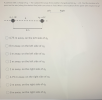 A particle with a charge of 1 = -4C is placed 4m away from another charged particle q2 = +1C. Find the location of a point on the axis (along the dashed-line) with zero electric field. What is the location of this point with respect to 41? Left Right 91 = -4C А 92 = +1C 4 m 4.75 m away, on the left side of 1 8 m away, on the left side of q1 1 m away, on...
Offline 1 Name: Phys 214 1. A small charged object of mass m-0.200 kg and charge...
 Offline 1 Name: Phys 214 1. A small charged object of mass m-0.200 kg and charge q·+10.0 μc is placed at point 0. a. What is the net electric field at point O (include direction)? 0.035 m b. 0.012 m What is the net force on the charge q (include direction)? What will be the acceleration of the charge q (include direction)? c. A spring is attached to a object with charge q, +3.00 HC on a frictionless horizontal surface....
A particle with a charge of 41 = 16C is placed 4m away from another charged...
 A particle with a charge of 41 = 16C is placed 4m away from another charged particle 42 = -9C. Find the location of a point on the axis (along the dashed-line) with zero electric field. What is the location of this point with respect to qı? Left Right 91 = 16C А 92 = .9C 4 m O 16 m away, on the left side of 1 3.2 m away, on the right side of q1 3.2 m away,...
A q charge is taken from a +Q charge and placed 1 m away. What q...
A q charge is taken from a +Q charge and placed 1 m away. What q charge will make the force between the two at a maximum
A positive charge 1.1X10⁻¹¹ C is located 10-2 m away from a negative charge of the...
A positive charge 1.1X10⁻¹¹ C is located 10-2 m away from a negative charge of the same magnitude. Point P is exactly half way between them --what is the E field at point P?
A positive point charge q of mass m is released from rest from the positive plate...
A positive point charge q of mass m is released from rest from the positive plate of a capacitor. Determine the following as a function of the electric field E: a) x (distance from the + plate) b) Vf (velocity before hitting the negative plate a distance d away) c) the kinetic energy of the charge just before hitting the negative plate.
A point charge -1.2 μC is 0.40 m away from a second point charge +1.0 μC...
A point charge -1.2 μC is 0.40 m away from a second point charge +1.0 μC . The force on a third charge, +1.5 μC , placed exactly halfway between the other two is a) 2.97 N , directed toward the negative charge b) 0.19 N , directed toward the positive charge. c) 0.74 N , directed toward the negative charge. d) 0.19 N , directed toward the negative charge.
 7. A body of mass m-1kg initially is at position xo- -1m and starts moving away from the origin with speed to = 10m/sec. It is moving along the z axis under the influence of three forces (i) an attractive force towards the origin which is 8 times the position of the body (ii) the air resistance which is 6 times the velocity of the body; 160 (iii) and the kinetic friction with coefficient μ (a) The initial value problem...
 A particle with a charge of 1 = -4C is placed 4m away from another charged particle q2 = +1C. Find the location of a point on the axis (along the dashed-line) with zero electric field. What is the location of this point with respect to 41? Left Right 91 = -4C А 92 = +1C 4 m 4.75 m away, on the left side of 1 8 m away, on the left side of q1 1 m away, on...
 Offline 1 Name: Phys 214 1. A small charged object of mass m-0.200 kg and charge q·+10.0 μc is placed at point 0. a. What is the net electric field at point O (include direction)? 0.035 m b. 0.012 m What is the net force on the charge q (include direction)? What will be the acceleration of the charge q (include direction)? c. A spring is attached to a object with charge q, +3.00 HC on a frictionless horizontal surface....
 A particle with a charge of 41 = 16C is placed 4m away from another charged particle 42 = -9C. Find the location of a point on the axis (along the dashed-line) with zero electric field. What is the location of this point with respect to qı? Left Right 91 = 16C А 92 = .9C 4 m O 16 m away, on the left side of 1 3.2 m away, on the right side of q1 3.2 m away,...
Most questions answered within 3 hours.
-
Where is the error in this code sequence?
String s1 = "Hello";
String s2 = "ello";...
asked 11 months ago -
Financial data for Joel de Paris, Inc., for last year
follow:
Joel de Paris, Inc.
Balance...
asked 11 months ago -
Consider this reaction:
Al2(SO4)3 (aq)+ BaCl3
(aq) Al2Cl6 (aq)- +
3BaSO4(s) . What is the...
asked 11 months ago -
Suppose that Savneet is considering increasing her
recent random sample from 20 car rentals to 40...
asked 11 months ago -
Trucks arrive at an unloading terminal at an average rate of 120
per hour.
Trucks arrive...
asked 11 months ago -
Why are methanol and ethanol completely soluble in water while
octanol is not very little soluble....
asked 11 months ago -
A facilities manager at a university reads in a research report
that the mean amount of...
asked 11 months ago -
When the CuSO4 is rehydrated by adding water to the anhydrous
compound, is this an endothermic...
asked 11 months ago -
A ray of sunlight is passing from diamond into crown glass; the
angle of incidence is...
asked 11 months ago -
A block of mass 0.249 kg is placed on top of a light, vertical
spring of...
asked 11 months ago -
how do the kidneys compensate in the presences of acidosis
a) trigger hyperventilate
b) reserve acid...
asked 11 months ago -
Question 501 pts
The rental rate of capital to the firm increases. Which of the
following...
asked 11 months ago