Discuss how microwave irradiation was used to accelerate the reaction of intramolecular aldol condensation of 2,5-hexanedione...
Discuss how microwave irradiation was used to accelerate the reaction of intramolecular aldol condensation of 2,5-hexanedione using 0.05 M NaOH.
Homework Answers


Add Answer to:
Discuss how microwave irradiation was used to accelerate the
reaction of intramolecular aldol condensation of 2,5-hexanedione...
What product results from the intramolecular aldol reaction of 2,5-hexanedione? ů CH3 сн. Accн, сн. Асен,...
 What product results from the intramolecular aldol reaction of 2,5-hexanedione? ů CH3 сн. Accн, сн. Асен, CH3 CH3 o I II III IV V O A. I B. II C. III D. IV E.V
1. What is the major organic product obtained from the following intramolecular aldol condensation reaction? NaOH,...
 1. What is the major organic product obtained from the following intramolecular aldol condensation reaction? NaOH, HẠO . 1 b. 2 . 3 d. 4 2. What is the major organic product obtained from the following intramolecular Claisen Condensation (Diepkova ) reaction? مع عمه Baraeenie Product onlained from ( 1. NaOCH2CH3 CH3CH2OH CH3CH30 OCH2CH3 2. H30+ OCH CHE OCH2CH3 مسلسلا سلال OCH2CH3 OCH2CH3
Draw the organic product(s) of this intramolecular aldol condensation reaction. Consider only the formation of 5-...
 Draw the organic product(s) of this intramolecular aldol
condensation reaction. Consider only the formation of 5- and
6-membered rings.
base Draw the organic product(s) of this intramolecular aldol condensation reaction. Consider only the formation of 5-and 6 membered rings. You do not have to consider stereochemistry. You do not have to explicitly draw H atoms. Do not include lone pairs in your answer. They will not be considered in the grading . Draw one structure per sketcher. Add additional sketchers...
Draw the organic product(s) of this intramolecular aldol
condensation reaction. Consider only the formation of 5- and
6-membered rings.
base Draw the organic product(s) of this intramolecular aldol condensation reaction. Consider only the formation of 5-and 6 membered rings. You do not have to consider stereochemistry. You do not have to explicitly draw H atoms. Do not include lone pairs in your answer. They will not be considered in the grading . Draw one structure per sketcher. Add additional sketchers...
Aldol Condensation: 1) What is the purpose of using NaOH solution in this Aldol condensation? 2)...
 Aldol Condensation: 1) What is the purpose of using NaOH solution in this Aldol condensation? 2) Why acetic acid is used to wash the solid on the fiter? 3) Draw the structure of the product from the reaction: NaOH H +Acetone in ethanol
why is it important to grind the NaOH pellets used in an aldol condensation reaction between...
why is it important to grind the NaOH pellets used in an aldol condensation reaction between p-tolualdehyde and p-acetyltoluene to a powder?
8. The Aldol condensation reaction can be used to synthesize an ingredient commonly found in commercially...
8. The Aldol condensation reaction can be used to synthesize an ingredient commonly found in commercially available sunscreens. The procedure for this reaction is given below. Benzaldehyde (3.0 mL) and acetone (1.0 mL) are combined in a 25.0 mL round bottom flask. 2.5 M NaOH(aq) (1.4 mL) was then added, and the reaction was stirred for 30 minutes at room temperature. The resulting precipitate was isolated, and recrystallized using ethanol. The isolated yield of the target product was 2.68 g,...
The “ Aldol Condensation" is a widely used reaction in organic chemistry. The first step involves...
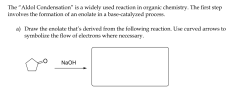 The “ Aldol Condensation" is a widely used reaction in organic chemistry. The first step involves the formation of an enolate in a base-catalyzed process. a) Draw the enolate that's derived from the following reaction. Use curved arrows to symbolize the flow of electrons where necessary. no NaOH NaOH
aldol condensation reaction Question 3: Is this reaction acid or base catalyzed? Tell the name of...
 aldol condensation reaction
Question 3: Is this reaction acid or base catalyzed? Tell the name of the base used. Question 4: What is the role of ethanol in the experiment? Question 5: Why 1.0 M HCl is used at the end of the experiment? Question 6: 4-nirobenzaldehye cannot undergo aldol condensation reaction by itself in the presence of strong base, give the reason for that?
aldol condensation reaction
Question 3: Is this reaction acid or base catalyzed? Tell the name of the base used. Question 4: What is the role of ethanol in the experiment? Question 5: Why 1.0 M HCl is used at the end of the experiment? Question 6: 4-nirobenzaldehye cannot undergo aldol condensation reaction by itself in the presence of strong base, give the reason for that?
In our Aldol condensation reaction, p-anisaldehyde and acetophenone were reacted in the presence of NaOH to...
In our Aldol condensation reaction, p-anisaldehyde and acetophenone were reacted in the presence of NaOH to form trans-p-anisalacetophenone. Provide a benchtop test that can enable a student to confirm that the correct product was obtained at the end of an aldol condensation experiment, and explain how the test will work.
Postlab Assignment for Minilab 34 “Preparation of Aldol Condensation Produ...
Postlab Assignment for Minilab 34 “Preparation of Aldol Condensation Products” 1. Explain why benzaldehyde is expected to be the most reactive aldehyde among the three aldehydes used in this experiment. (used benzaldehyde, 4-methylbenzaldehyde, and 4-methoxybenzaldehyde) 2. What is the role of aqueous NaOH used in the experiment you carried out? 3. How would you change the procedures in this experiment if you wished to synthesize benzalacetophenone (C6H5CH=CHCOC6H5). Just indicate the two main organic starting materials. 4. Write a mechanism for...
 What product results from the intramolecular aldol reaction of 2,5-hexanedione? ů CH3 сн. Accн, сн. Асен, CH3 CH3 o I II III IV V O A. I B. II C. III D. IV E.V
 1. What is the major organic product obtained from the following intramolecular aldol condensation reaction? NaOH, HẠO . 1 b. 2 . 3 d. 4 2. What is the major organic product obtained from the following intramolecular Claisen Condensation (Diepkova ) reaction? مع عمه Baraeenie Product onlained from ( 1. NaOCH2CH3 CH3CH2OH CH3CH30 OCH2CH3 2. H30+ OCH CHE OCH2CH3 مسلسلا سلال OCH2CH3 OCH2CH3
 Draw the organic product(s) of this intramolecular aldol
condensation reaction. Consider only the formation of 5- and
6-membered rings.
base Draw the organic product(s) of this intramolecular aldol condensation reaction. Consider only the formation of 5-and 6 membered rings. You do not have to consider stereochemistry. You do not have to explicitly draw H atoms. Do not include lone pairs in your answer. They will not be considered in the grading . Draw one structure per sketcher. Add additional sketchers...
Draw the organic product(s) of this intramolecular aldol
condensation reaction. Consider only the formation of 5- and
6-membered rings.
base Draw the organic product(s) of this intramolecular aldol condensation reaction. Consider only the formation of 5-and 6 membered rings. You do not have to consider stereochemistry. You do not have to explicitly draw H atoms. Do not include lone pairs in your answer. They will not be considered in the grading . Draw one structure per sketcher. Add additional sketchers...
 Aldol Condensation: 1) What is the purpose of using NaOH solution in this Aldol condensation? 2) Why acetic acid is used to wash the solid on the fiter? 3) Draw the structure of the product from the reaction: NaOH H +Acetone in ethanol
 The “ Aldol Condensation" is a widely used reaction in organic chemistry. The first step involves the formation of an enolate in a base-catalyzed process. a) Draw the enolate that's derived from the following reaction. Use curved arrows to symbolize the flow of electrons where necessary. no NaOH NaOH
 aldol condensation reaction
Question 3: Is this reaction acid or base catalyzed? Tell the name of the base used. Question 4: What is the role of ethanol in the experiment? Question 5: Why 1.0 M HCl is used at the end of the experiment? Question 6: 4-nirobenzaldehye cannot undergo aldol condensation reaction by itself in the presence of strong base, give the reason for that?
aldol condensation reaction
Question 3: Is this reaction acid or base catalyzed? Tell the name of the base used. Question 4: What is the role of ethanol in the experiment? Question 5: Why 1.0 M HCl is used at the end of the experiment? Question 6: 4-nirobenzaldehye cannot undergo aldol condensation reaction by itself in the presence of strong base, give the reason for that?
Most questions answered within 3 hours.
-
Where is the error in this code sequence?
String s1 = "Hello";
String s2 = "ello";...
asked 10 months ago -
Financial data for Joel de Paris, Inc., for last year
follow:
Joel de Paris, Inc.
Balance...
asked 10 months ago -
Consider this reaction:
Al2(SO4)3 (aq)+ BaCl3
(aq) Al2Cl6 (aq)- +
3BaSO4(s) . What is the...
asked 10 months ago -
Suppose that Savneet is considering increasing her
recent random sample from 20 car rentals to 40...
asked 10 months ago -
Trucks arrive at an unloading terminal at an average rate of 120
per hour.
Trucks arrive...
asked 10 months ago -
Why are methanol and ethanol completely soluble in water while
octanol is not very little soluble....
asked 10 months ago -
A facilities manager at a university reads in a research report
that the mean amount of...
asked 10 months ago -
When the CuSO4 is rehydrated by adding water to the anhydrous
compound, is this an endothermic...
asked 10 months ago -
A ray of sunlight is passing from diamond into crown glass; the
angle of incidence is...
asked 10 months ago -
A block of mass 0.249 kg is placed on top of a light, vertical
spring of...
asked 10 months ago -
how do the kidneys compensate in the presences of acidosis
a) trigger hyperventilate
b) reserve acid...
asked 10 months ago -
Question 501 pts
The rental rate of capital to the firm increases. Which of the
following...
asked 10 months ago