When 1g of compound X is dissolved in 100mL of solvent, the observed rotation is +12....
When 1g of compound X is dissolved in 100mL of solvent, the observed rotation is +12. What will be the observed rotation if 1g of compound X is dissolved in 50 mL of solvent?
Homework Answers
 Optical
activity of a solution inversely proportional to the strength
(g/mL) of the solution.
Optical
activity of a solution inversely proportional to the strength
(g/mL) of the solution.
Add Answer to:
When 1g of compound X is dissolved in 100mL of
solvent, the observed rotation is +12....
A 0.110 M solution of an enantiomerically pure chiral compound D has an observed rotation of...
 A 0.110 M solution of an enantiomerically pure chiral compound D has an observed rotation of +0.24° in a 1-dm sample container. The molar mass of the compound is 144.0 g/mol. (a) What is the specific rotation of D? (b) What is the observed rotation if this solution is mixed with an equal volume of a solution that is 0.110 M in L, the enantiomer of D? Number deg mL Number g dm deg (c) What is the observed rotation...
A 0.120 M solution of an enantiomerically pure chiral compound D has an observed rotation of...
 A 0.120 M solution of an enantiomerically pure chiral compound D has an observed rotation of + 0.26 degree in a 1-dm sample container. The molar mass of the compound is 153.0 g/mol. What is the specific rotation of D? What is the observed rotation if this solut is mixed with an equal volume of a solution t is 0.120 M in L, the enantiomer of D? What is the observed rotation if the solution of D is diluted with...
A 0.110 M solution of an enantiomerically pure chiral compound D has an observed rotation of...
A 0.110 M solution of an enantiomerically pure chiral compound D has an observed rotation of 0.18° in a 1-dm sample container. The molar mass of the compound is 174.0 g/mol. (a) What is the specific rotation of D? (b) What is the observed rotation if this solution is mixed with an equal volume of a solution that is 0.110 M in L, the enantiomer of D? (c) What is the observed rotation if the solution of D is diluted...
A 0.140 M solution of an enantiomerically pure chiral compound D has an observed rotation of...
A 0.140 M solution of an enantiomerically pure chiral compound D has an observed rotation of 0.18° in a 1-dm sample container. The molar mass of the compound is 150.0 g/mol. (a) What is the specific rotation of D? (b) What is the observed rotation if this solution is mixed with an equal volume of a solution that is 0.140 M in L, the enantiomer of D? (c) What is the observed rotation if the solution of D is diluted...
The specific rotation, (a)p, for (+)-alanine is +8.5. What is the observed rotation for a solution...
 The specific rotation, (a)p, for (+)-alanine is +8.5. What is the observed rotation for a solution of 1.7 g of (+)-alanine in 10 mL of water in a sample tube having a pathlength of 10 cm? degrees The observed rotation of a solution of 1.3 g of a compound in 10 mL of water is +8.2 degrees. If the pathlength is 10 cm, what is the specific rotation of the compound? The specific rotation, (a)p, for(-)-pseudoephedrine is - 52. What...
Given that 10g of a compound with pkow= -0.7 is dissolved in 100mL of water. To...
Given that 10g of a compound with pkow= -0.7 is dissolved in 100mL of water. To the nearest gram, how much compound is extracted into 100mL of octan-1-ol when mixed in a separatory funnel?
The observed rotation of compound Y is +4.5 when 0.1g/mL of its solution is measured in...
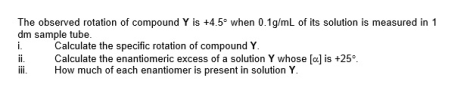 The observed rotation of compound Y is +4.5 when 0.1g/mL of its solution is measured in 1 dm sample tube. Calculate the specific rotation of compound Y ii Calculate the enantiomeric excess of a solution Y whose [o] is +25 i. How much of each enantiomer is present in solution Y
A. In this equation for specific rotation of a solution: a is the observed rotation in degrees, i...
 a. In this equation for specific rotation of a solution: a is the observed rotation in degrees, is the path length in decimetres, c is the concentration in g mL-1, Tis the temperature at which the measurement was taken in °C, and A is the wavelength in nanometres. You used variable path lengths for the polarised light (589 nm) to pass through, and you obtained the fol solutions (A, B, C, D and E) at variable concentrations. observed rotation data...
The specific rotation, [a]D, for (-)-pseudoephedrine is-52. What is the observed rotation for a solution of...
 The specific rotation, [a]D, for (-)-pseudoephedrine is-52. What is the observed rotation for a solution of 0.50 g of (-)- pseudoephedrine in 10 mL of water in a sample tube having a pathlength of 10 cm? degrees The observed rotation of a solution of 1.7 g of a compound in 10 mL of water is +13 degrees. If the pathlength is 10 cm, what is the specific rotation of the compound? Submit Answer Retry Entire Group No more group attempts...
4. a) 7.00 mg sample dissolved in 1.00ml solvent and solution was placed in a cell...
 4. a) 7.00 mg sample dissolved in 1.00ml solvent and solution was placed in a cell with 2.00 cm pathlength, an observed rotation of +0.08 was found. Calculate [a ]p for sample. b) A sample with a concentration of 0.3 g/mL was placed in a cell with a length of 5 cm. The resulting rotation at the sodium D line was t1.52°. What is the [a]D?
 A 0.110 M solution of an enantiomerically pure chiral compound D has an observed rotation of +0.24° in a 1-dm sample container. The molar mass of the compound is 144.0 g/mol. (a) What is the specific rotation of D? (b) What is the observed rotation if this solution is mixed with an equal volume of a solution that is 0.110 M in L, the enantiomer of D? Number deg mL Number g dm deg (c) What is the observed rotation...
 A 0.120 M solution of an enantiomerically pure chiral compound D has an observed rotation of + 0.26 degree in a 1-dm sample container. The molar mass of the compound is 153.0 g/mol. What is the specific rotation of D? What is the observed rotation if this solut is mixed with an equal volume of a solution t is 0.120 M in L, the enantiomer of D? What is the observed rotation if the solution of D is diluted with...
 The specific rotation, (a)p, for (+)-alanine is +8.5. What is the observed rotation for a solution of 1.7 g of (+)-alanine in 10 mL of water in a sample tube having a pathlength of 10 cm? degrees The observed rotation of a solution of 1.3 g of a compound in 10 mL of water is +8.2 degrees. If the pathlength is 10 cm, what is the specific rotation of the compound? The specific rotation, (a)p, for(-)-pseudoephedrine is - 52. What...
 The observed rotation of compound Y is +4.5 when 0.1g/mL of its solution is measured in 1 dm sample tube. Calculate the specific rotation of compound Y ii Calculate the enantiomeric excess of a solution Y whose [o] is +25 i. How much of each enantiomer is present in solution Y
 a. In this equation for specific rotation of a solution: a is the observed rotation in degrees, is the path length in decimetres, c is the concentration in g mL-1, Tis the temperature at which the measurement was taken in °C, and A is the wavelength in nanometres. You used variable path lengths for the polarised light (589 nm) to pass through, and you obtained the fol solutions (A, B, C, D and E) at variable concentrations. observed rotation data...
 The specific rotation, [a]D, for (-)-pseudoephedrine is-52. What is the observed rotation for a solution of 0.50 g of (-)- pseudoephedrine in 10 mL of water in a sample tube having a pathlength of 10 cm? degrees The observed rotation of a solution of 1.7 g of a compound in 10 mL of water is +13 degrees. If the pathlength is 10 cm, what is the specific rotation of the compound? Submit Answer Retry Entire Group No more group attempts...
 4. a) 7.00 mg sample dissolved in 1.00ml solvent and solution was placed in a cell with 2.00 cm pathlength, an observed rotation of +0.08 was found. Calculate [a ]p for sample. b) A sample with a concentration of 0.3 g/mL was placed in a cell with a length of 5 cm. The resulting rotation at the sodium D line was t1.52°. What is the [a]D?
Most questions answered within 3 hours.
-
Where is the error in this code sequence?
String s1 = "Hello";
String s2 = "ello";...
asked 11 months ago -
Financial data for Joel de Paris, Inc., for last year
follow:
Joel de Paris, Inc.
Balance...
asked 11 months ago -
Consider this reaction:
Al2(SO4)3 (aq)+ BaCl3
(aq) Al2Cl6 (aq)- +
3BaSO4(s) . What is the...
asked 11 months ago -
Suppose that Savneet is considering increasing her
recent random sample from 20 car rentals to 40...
asked 11 months ago -
Trucks arrive at an unloading terminal at an average rate of 120
per hour.
Trucks arrive...
asked 11 months ago -
Why are methanol and ethanol completely soluble in water while
octanol is not very little soluble....
asked 11 months ago -
A facilities manager at a university reads in a research report
that the mean amount of...
asked 11 months ago -
When the CuSO4 is rehydrated by adding water to the anhydrous
compound, is this an endothermic...
asked 11 months ago -
A ray of sunlight is passing from diamond into crown glass; the
angle of incidence is...
asked 11 months ago -
A block of mass 0.249 kg is placed on top of a light, vertical
spring of...
asked 11 months ago -
how do the kidneys compensate in the presences of acidosis
a) trigger hyperventilate
b) reserve acid...
asked 11 months ago -
Question 501 pts
The rental rate of capital to the firm increases. Which of the
following...
asked 11 months ago