Q3. Suppose we toss a coin until we see a heads, and let X be the...
Q3. Suppose we toss a coin until we see a heads, and let X be the number of tosses. Recall that this is what we called the geometric distribution. Assume that it is a fair coin (equal probability of heads and tails).
-
What is the p.m.f. of X? (I.e., for an integer i, what is P(X=i)?
-
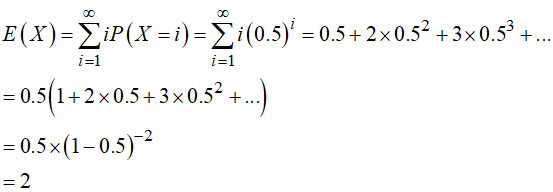
What is ?[X]? ({} this is a discrete variable that takes infinitely many values.)
Homework Answers
-
What is the p.m.f. of X? (I.e., for an integer i, what is P(X=i)
Ans :It is a geometric distribution with p=0.5.
P(X=i) = p(1-p)i-1 = 0.5*0.5i-1 = 0.5i ( i=1,2,3,...)
-
What is ?[X]? ({} this is a discrete variable that takes infinitely many values.
Add Answer to:
Q3. Suppose we toss a coin until we see a
heads, and let X be the...
Suppose that Anna and Ben will each toss a fair coin until an outcome of Heads...
Suppose that Anna and Ben will each toss a fair coin until an outcome of Heads is obtained. (I.e., each person will toss their coin until they obtain an outcome of Heads.) What is the probability that it will take Ben MORE THAN TWICE as many tosses as it takes Anna? (Make the usual assumptions regarding tosses of fair coins.)
Suppose you toss a fair coin until you’ve gotten a total of 2 heads or a...
Suppose you toss a fair coin until you’ve gotten a total of 2 heads or a total of 4 tails (neither the 2 heads nor the 4 tails occur necessarily consecutively), and then you stop. What is the probability that your last coin toss came up tails?
9.74. Suppose we toss a biased coin independently until we get two heads or two tails...
9.74. Suppose we toss a biased coin independently until we get two heads or two tails in total. The coin produces a head with probability p on any toss. 1. What is the sample space of this experiment? 2. What is the probability function? 3. What is the probability that the experiment stops with two heads?
Suppose you flip a fair coin repeatedly until you see a Heads followed by another Heads...
Suppose you flip a fair coin repeatedly until you see a Heads followed by another Heads or a Tails followed by another Tails (i.e. until you see the pattern HH or TT). (a)What is the expected number of flips you need to make? (b)Suppose you repeat the above with a weighted coin that has probability of landing Heads equal to p.Show that the expected number of flips you need is 2+p(1−p)/1−p(1−p)
A fair coin is flipped independently until the first Heads is observed. Let the random variable...
 A fair coin is flipped independently until the first Heads is observed. Let the random variable K be the number of tosses until the first Heads is observed plus 1. For example, if we see TTTHTH, then K = 5. For k 1, 2, , K, let Xk be a continuous random variable that is uniform over the interval [0, 5]. The Xk are independent of one another and of the coin flips. LetX = Σ i Xo Find the...
2. Let X be the number of Heads when we toss a coin 3 times. Find...
 2. Let X be the number of Heads when we toss a coin 3 times. Find the probability distribution (that is, the probability function) for X.
You toss a penny and observe whether it lands heads up or tails up. Suppose the...
 You toss a penny and observe whether it lands heads up or tails up. Suppose the penny is fair, i.e., the probability of heads is 1/2 and the probability of tails is y. This means every occurrence of a head must be balanced by a tail in one of the next two or three tosses. if I flip the coin many, many times, the proportion of heads will be approximately %, and this proportion will tend to get closer and...
4. Toss a fair coin 6 times and let X denote the number of heads that...
 4. Toss a fair coin 6 times and let X denote the number of heads
that appear. Compute P(X ≤ 4). If the coin has probability p of
landing heads, compute P(X ≤ 3)
4. Toss a fair coin 6 times and let X denote the number of heads that appear. Compute P(X 4). If the coin has probability p of landing heads, compute P(X < 3).
4. Toss a fair coin 6 times and let X denote the number of heads
that appear. Compute P(X ≤ 4). If the coin has probability p of
landing heads, compute P(X ≤ 3)
4. Toss a fair coin 6 times and let X denote the number of heads that appear. Compute P(X 4). If the coin has probability p of landing heads, compute P(X < 3).
2. SUPPLEMENTAL QUESTION 1 (a) Toss a fair coin so that with probability pheads occurs and...
 2. SUPPLEMENTAL QUESTION 1 (a) Toss a fair coin so that with probability pheads occurs and with probability p tails occurs. Let X be the number of heads and Y be the number of tails. Prove X and Y are dependent (b) Now, toss the same coin n times, where n is a random integer with Poisson distribution: n~Poisson(A) Let X be the random variable counting the number of heads, Y the random variable counting the number of tails. Prove...
Suppose that I toss a fair coin 100 times. Write 'p-hat' for the proportion of Heads...
Suppose that I toss a fair coin 100 times. Write 'p-hat' for the proportion of Heads in the 100 tosses. What is the approximate probability that p-hat is greater than 0.6? 0.460 0.023 0.540 We can't do the problem because we don't know the probability that the coin lands Heads uppermost 0.977
 A fair coin is flipped independently until the first Heads is observed. Let the random variable K be the number of tosses until the first Heads is observed plus 1. For example, if we see TTTHTH, then K = 5. For k 1, 2, , K, let Xk be a continuous random variable that is uniform over the interval [0, 5]. The Xk are independent of one another and of the coin flips. LetX = Σ i Xo Find the...
 2. Let X be the number of Heads when we toss a coin 3 times. Find the probability distribution (that is, the probability function) for X.
 You toss a penny and observe whether it lands heads up or tails up. Suppose the penny is fair, i.e., the probability of heads is 1/2 and the probability of tails is y. This means every occurrence of a head must be balanced by a tail in one of the next two or three tosses. if I flip the coin many, many times, the proportion of heads will be approximately %, and this proportion will tend to get closer and...
 4. Toss a fair coin 6 times and let X denote the number of heads
that appear. Compute P(X ≤ 4). If the coin has probability p of
landing heads, compute P(X ≤ 3)
4. Toss a fair coin 6 times and let X denote the number of heads that appear. Compute P(X 4). If the coin has probability p of landing heads, compute P(X < 3).
4. Toss a fair coin 6 times and let X denote the number of heads
that appear. Compute P(X ≤ 4). If the coin has probability p of
landing heads, compute P(X ≤ 3)
4. Toss a fair coin 6 times and let X denote the number of heads that appear. Compute P(X 4). If the coin has probability p of landing heads, compute P(X < 3).
 2. SUPPLEMENTAL QUESTION 1 (a) Toss a fair coin so that with probability pheads occurs and with probability p tails occurs. Let X be the number of heads and Y be the number of tails. Prove X and Y are dependent (b) Now, toss the same coin n times, where n is a random integer with Poisson distribution: n~Poisson(A) Let X be the random variable counting the number of heads, Y the random variable counting the number of tails. Prove...
Most questions answered within 3 hours.
-
Where is the error in this code sequence?
String s1 = "Hello";
String s2 = "ello";...
asked 11 months ago -
Financial data for Joel de Paris, Inc., for last year
follow:
Joel de Paris, Inc.
Balance...
asked 11 months ago -
Consider this reaction:
Al2(SO4)3 (aq)+ BaCl3
(aq) Al2Cl6 (aq)- +
3BaSO4(s) . What is the...
asked 11 months ago -
Suppose that Savneet is considering increasing her
recent random sample from 20 car rentals to 40...
asked 11 months ago -
Trucks arrive at an unloading terminal at an average rate of 120
per hour.
Trucks arrive...
asked 11 months ago -
Why are methanol and ethanol completely soluble in water while
octanol is not very little soluble....
asked 11 months ago -
A facilities manager at a university reads in a research report
that the mean amount of...
asked 11 months ago -
When the CuSO4 is rehydrated by adding water to the anhydrous
compound, is this an endothermic...
asked 11 months ago -
A ray of sunlight is passing from diamond into crown glass; the
angle of incidence is...
asked 11 months ago -
A block of mass 0.249 kg is placed on top of a light, vertical
spring of...
asked 11 months ago -
how do the kidneys compensate in the presences of acidosis
a) trigger hyperventilate
b) reserve acid...
asked 11 months ago -
Question 501 pts
The rental rate of capital to the firm increases. Which of the
following...
asked 11 months ago