A rocket of mass 4.89 × 10⁵ kg is in flight near earth's surface. Its thrust...
A rocket of mass 4.89 × 10⁵ kg is in flight near earth's surface. Its thrust is directed at an angle of 52.4° above the horizontal and has a magnitude of 7.65 × 10⁶ N. Find the (a) magnitude and (b) direction of the rocket's acceleration. Give the direction as an angle above the horizontal.
Homework Answers

Add Answer to:
A rocket of mass 4.89 × 10⁵ kg is in flight near earth's
surface. Its thrust...
A rocket of mass 3.21 × 10⁵ kg is in flight near earth's surface. Its thrust...
A rocket of mass 3.21 × 10⁵ kg is in flight near earth's surface. Its thrust is directed at an angle of 67.8° above the horizontal and has a magnitude of 8.12 × 10⁶ N. Find the magnitude of the rocket's acceleration in meters per second squared.
Interactive LearningWare 4.4 provides a review of the concepts that are important in this problem. A...
Interactive LearningWare 4.4 provides a review of the concepts that are important in this problem. A rocket of mass 3.53 × 10⁵ kg is in flight near earth's surface. Its thrust is directed at an angle of 53.4° above the horizontal and has a magnitude of 7.76 × 10⁶ N. Find the (a) magnitude and (b) direction of the rocket's acceleration. Give the direction as an angle above the horizontal. (a) Number Units (b) Number Units
Interactive LearningWare 4.4 provides a review of the concepts that are important in this problem. A...
 Interactive LearningWare 4.4 provides a review of the concepts that are important in this problem. A rocket of mass 3.22 Times 10^5 kg is in flight near earth's surface. Its thrust is directed at an angle of 57.7 degree above the horizontal and has a magnitude of 7.54 Times 10^6 N. Find the magnitude and direction of the rocket's acceleration. Give the direction as an angle above the horizontal. Number Units Number Units
1. A rocket is launched vertically from the Earth, and the thrust (pushing force) from the engines...
1. A rocket is launched vertically from the Earth, and the thrust (pushing force) from the engines is directed upward, and has a magnitude of 5.00 x 10⁶ N. The mass of the rocket is initially 2.00 x 10⁵ kg. (a) What is the initial acceleration of the rocket, assuming you can neglect air resistance? (b) After the rocket has been in flight for a while, burning and exhausting a lot of fuel, its mass has decreased to 1.20 x 10⁵ kg, and...
At launch, the new rocket became the most powerful rocket in operation. It is capable of...
 At launch, the new rocket became the most powerful rocket in operation. It is capable of producing 5 million pounds of thrust (about 2.22 × 10⁷ newtons). At launch, the rocket has a mass of about 1.42 × 10⁶ kg. Estimate the acceleration of the rocket while it is still near the surface of the Earth and its engines must work against Earth's gravitational force. 2.
A rocket takes off from Earth's surface, accelerating straight up at 43.2 m/s2. Calculate the normal...
A rocket takes off from Earth's surface, accelerating straight up at 43.2 m/s2. Calculate the normal force (in N) acting on an astronaut of mass 81.9 kg, including her space suit. (Assume the rocket's initial motion parallel to the +y-direction. Indicate the direction with the sign of your answer.)
Robert has just bought a new model rocket, and is trying to measure its flight characteristics....
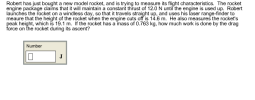 Robert has just bought a new model rocket, and is trying to measure its flight characteristics. The rocket engine package claims that it will maintain a constant thrust of 12.0 N until the engine is used up. Robert launches the rocket on a windless day, so that it travels straight up, and uses his laser range-finder to measure that the height of the rocket when the engine cuts off is 14.6 m. He also measures the rocket's peak height, which...
(6%) Problem 13: A 48 105-kg rocket is accelerating straight up. Its engines produce 1.15 107...
 (6%) Problem 13: A 48 105-kg rocket is accelerating straight up. Its engines produce 1.15 107 N of thrust, and air resistance is 4.7 106 N. Randomized Variables m 4.8 105-kg f=1.15. 107 N fr=4.7 106 N What is the rocket's acceleration, using a coordinate system where up is positive? Grade Summ a 13.8 Deductions Potential Submissions tan 7 8 sin0 cos0 HOME Attempts rema (0% per attemg detailed view asin) acos) 4 6 cotan) sinh) 2 3 atan) acotan)...
rocket of mass 4.50 x 10^5 kg in flight, thrust directed at angle of 55.0 degrees above horizon...
Find magnitude and direction (as an angle above the horizontal) of rockets acceleration.
A 170 kg rocket is moving radially outward from the earth at an altitude of 180...
A 170 kg rocket is moving radially outward from the earth at an altitude of 180 km above the surface with a velocity of 3.5 km/sec. At this point, its final stage engine shuts off. 1) Ignoring any minor air resistance, what is the rocket's velocity 780 km above the surface of the earth?"; m/sec 2) Again ignoring any minor air resistance, what is the rocket's velocity 780 km above the surface of the earth if its mass were 340...
 Interactive LearningWare 4.4 provides a review of the concepts that are important in this problem. A rocket of mass 3.22 Times 10^5 kg is in flight near earth's surface. Its thrust is directed at an angle of 57.7 degree above the horizontal and has a magnitude of 7.54 Times 10^6 N. Find the magnitude and direction of the rocket's acceleration. Give the direction as an angle above the horizontal. Number Units Number Units
 At launch, the new rocket became the most powerful rocket in operation. It is capable of producing 5 million pounds of thrust (about 2.22 × 10⁷ newtons). At launch, the rocket has a mass of about 1.42 × 10⁶ kg. Estimate the acceleration of the rocket while it is still near the surface of the Earth and its engines must work against Earth's gravitational force. 2.
 Robert has just bought a new model rocket, and is trying to measure its flight characteristics. The rocket engine package claims that it will maintain a constant thrust of 12.0 N until the engine is used up. Robert launches the rocket on a windless day, so that it travels straight up, and uses his laser range-finder to measure that the height of the rocket when the engine cuts off is 14.6 m. He also measures the rocket's peak height, which...
 (6%) Problem 13: A 48 105-kg rocket is accelerating straight up. Its engines produce 1.15 107 N of thrust, and air resistance is 4.7 106 N. Randomized Variables m 4.8 105-kg f=1.15. 107 N fr=4.7 106 N What is the rocket's acceleration, using a coordinate system where up is positive? Grade Summ a 13.8 Deductions Potential Submissions tan 7 8 sin0 cos0 HOME Attempts rema (0% per attemg detailed view asin) acos) 4 6 cotan) sinh) 2 3 atan) acotan)...
Most questions answered within 3 hours.
-
Where is the error in this code sequence?
String s1 = "Hello";
String s2 = "ello";...
asked 11 months ago -
Financial data for Joel de Paris, Inc., for last year
follow:
Joel de Paris, Inc.
Balance...
asked 11 months ago -
Consider this reaction:
Al2(SO4)3 (aq)+ BaCl3
(aq) Al2Cl6 (aq)- +
3BaSO4(s) . What is the...
asked 11 months ago -
Suppose that Savneet is considering increasing her
recent random sample from 20 car rentals to 40...
asked 11 months ago -
Trucks arrive at an unloading terminal at an average rate of 120
per hour.
Trucks arrive...
asked 11 months ago -
Why are methanol and ethanol completely soluble in water while
octanol is not very little soluble....
asked 11 months ago -
A facilities manager at a university reads in a research report
that the mean amount of...
asked 11 months ago -
When the CuSO4 is rehydrated by adding water to the anhydrous
compound, is this an endothermic...
asked 11 months ago -
A ray of sunlight is passing from diamond into crown glass; the
angle of incidence is...
asked 11 months ago -
A block of mass 0.249 kg is placed on top of a light, vertical
spring of...
asked 11 months ago -
how do the kidneys compensate in the presences of acidosis
a) trigger hyperventilate
b) reserve acid...
asked 11 months ago -
Question 501 pts
The rental rate of capital to the firm increases. Which of the
following...
asked 11 months ago