In MIPS give at 5 different instructions that can be used to clear an arbitrary register
In MIPS give at 5 different instructions that can be used to clear an arbitrary register
Homework Answers
xor    $t0, $t0, $t0
and    $t0, $t0, $0
move   $t0, $0
li     $t0, 0
add    $t0, $0, $0
Out of five xor is more efficient and the fastest, however there isn't much difference between them.
Add Answer to:
In MIPS give at 5 different instructions that can be used to
clear an arbitrary register
Write the MIPS assembly instructions corresponding to the following high level instruction. The used base register...
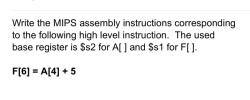 Write the MIPS assembly instructions corresponding to the following high level instruction. The used base register is $s2 for Al] and $s1 for F[]. and s 1 for F[6]A[4] +5
Write a sequence of MIPS instructions to find the absolute value of the value in register...
Write a sequence of MIPS instructions to find the absolute value of the value in register $s0 and store it into register $t0. Assume you do not have access to multiplication instructions. Use as few instructions as possible. You do not have to assemble your code for this question, but you may do so to validate that it works.
B2. Convert the C code to MIPS assembly with only 2 efficient instructions: Register assignment: ...
 B2. Convert the C code to MIPS assembly with only 2 efficient instructions: Register assignment: timer-v0 int timer = 0x0AC8 0001; B3. Write MIPS assembly code segment for the following C code snippet for (i - 0, i < 100; i++) -array Register assignment: i-) $ao Base of array -> $s0 array [ i+1] [i] / 2;
B2. Convert the C code to MIPS assembly with only 2 efficient instructions: Register assignment: timer-v0 int timer = 0x0AC8 0001; B3. Write...
B2. Convert the C code to MIPS assembly with only 2 efficient instructions: Register assignment: timer-v0 int timer = 0x0AC8 0001; B3. Write MIPS assembly code segment for the following C code snippet for (i - 0, i < 100; i++) -array Register assignment: i-) $ao Base of array -> $s0 array [ i+1] [i] / 2;
B2. Convert the C code to MIPS assembly with only 2 efficient instructions: Register assignment: timer-v0 int timer = 0x0AC8 0001; B3. Write...
2. The table below holds MIPS assembly code fragments with different branch instructions LOOP addi $s2....
 2. The table below holds MIPS assembly code fragments with different branch instructions LOOP addi $s2. $s2. 2 subi $t1. st1. 1 bne t1. 0. LOOP DONE: LOOP: it st2. $0. stl beq t2. 0. DONE addi $s2. Ss2. 2 LOOP DONE: For the loops written in MIPS assembly in the above table, assume that the register Şt1 is initialized to the value of 10. What is the value in register $s2 assuming that $s2 initially has a value of...
Give MIPS instruction(s) to take the contents of register $t0, extract the least significant 4 bits,...
Give MIPS instruction(s) to take the contents of register $t0, extract the least significant 4 bits, and store the result in register $s0.
Assembly language (MIPS) Let register $8 be x and register $9 be y. Write a program...
Assembly language (MIPS) Let register $8 be x and register $9 be y. Write a program to evaluate: Z = 3x - 5y+5 Leave the result in register $10. Inspect the register after running the program to check that the program works. Run the program several times, initialize x and y to different values for each run.
Translate the following C code to MIPS assembly code. Use a minimum number of instructions. Register...
Translate the following C code to MIPS assembly code. Use a minimum number of instructions. Register allocations - i $s0 - j $s1 - base of A[] $s2 - base of B[] $s3 2) A[3] = B[i] + B[j]; 3) i = 0; while (j != A[i]) { i++; }
Usc only the following MIPS instructions for assignment questions 3, 4 and 5: add, sub, addi,...
 Usc only the following MIPS instructions for assignment questions 3, 4 and 5: add, sub, addi, j, beq, bne, lw, sw. You may not need as many lines as we provide space for 4. (4 pts) Write a MIPS program starting at address 20 that writes a value of 488 to register $7. Next, you will test if register $10 is equal to register $7. If the values are equal, continue execution at address 48; otherwise set the value in...
Please answer all questions 6. T/F On MIPS-32 architecture, branch instructions "bgt" and "ble" can be...
 Please answer all questions
6. T/F On MIPS-32 architecture, branch instructions "bgt" and "ble" can be directly executed by the processor 7. On MIPS-32 architecture, the field of an instruction specifies the shift amount. 8 register points to the next instruction to be executed. 9. The special register specifies the address of instruction to be fetched and executed. 10. R-type instructions use 1. A caller function uses the 12. The instruction "jr" is a(n) addressing mode. instruction to call a...
Please answer all questions
6. T/F On MIPS-32 architecture, branch instructions "bgt" and "ble" can be directly executed by the processor 7. On MIPS-32 architecture, the field of an instruction specifies the shift amount. 8 register points to the next instruction to be executed. 9. The special register specifies the address of instruction to be fetched and executed. 10. R-type instructions use 1. A caller function uses the 12. The instruction "jr" is a(n) addressing mode. instruction to call a...
Given: MIPS Programming in MIPS Assembly Language Assume: Load, Store, R-format, and Jump (j) instructions have CPI...
Given: MIPS Programming in MIPS Assembly Language Assume: Load, Store, R-format, and Jump (j) instructions have CPI = 1 Assume: Branch and jr or ja Instructions (e.g., branches) have CPI = 2 Assume: All MIPS system calls (e.g., for printing) have CPI = 3 Assume: Variable x stored in register $s1, y in $s2, z in $s3, i in $t0 Express the following precondition loop in MIPS assembly language x := 0 ; i := 5 ; # Document each MIPS...
 Write the MIPS assembly instructions corresponding to the following high level instruction. The used base register is $s2 for Al] and $s1 for F[]. and s 1 for F[6]A[4] +5
 B2. Convert the C code to MIPS assembly with only 2 efficient instructions: Register assignment: timer-v0 int timer = 0x0AC8 0001; B3. Write MIPS assembly code segment for the following C code snippet for (i - 0, i < 100; i++) -array Register assignment: i-) $ao Base of array -> $s0 array [ i+1] [i] / 2;
B2. Convert the C code to MIPS assembly with only 2 efficient instructions: Register assignment: timer-v0 int timer = 0x0AC8 0001; B3. Write...
B2. Convert the C code to MIPS assembly with only 2 efficient instructions: Register assignment: timer-v0 int timer = 0x0AC8 0001; B3. Write MIPS assembly code segment for the following C code snippet for (i - 0, i < 100; i++) -array Register assignment: i-) $ao Base of array -> $s0 array [ i+1] [i] / 2;
B2. Convert the C code to MIPS assembly with only 2 efficient instructions: Register assignment: timer-v0 int timer = 0x0AC8 0001; B3. Write...
 2. The table below holds MIPS assembly code fragments with different branch instructions LOOP addi $s2. $s2. 2 subi $t1. st1. 1 bne t1. 0. LOOP DONE: LOOP: it st2. $0. stl beq t2. 0. DONE addi $s2. Ss2. 2 LOOP DONE: For the loops written in MIPS assembly in the above table, assume that the register Şt1 is initialized to the value of 10. What is the value in register $s2 assuming that $s2 initially has a value of...
 Usc only the following MIPS instructions for assignment questions 3, 4 and 5: add, sub, addi, j, beq, bne, lw, sw. You may not need as many lines as we provide space for 4. (4 pts) Write a MIPS program starting at address 20 that writes a value of 488 to register $7. Next, you will test if register $10 is equal to register $7. If the values are equal, continue execution at address 48; otherwise set the value in...
 Please answer all questions
6. T/F On MIPS-32 architecture, branch instructions "bgt" and "ble" can be directly executed by the processor 7. On MIPS-32 architecture, the field of an instruction specifies the shift amount. 8 register points to the next instruction to be executed. 9. The special register specifies the address of instruction to be fetched and executed. 10. R-type instructions use 1. A caller function uses the 12. The instruction "jr" is a(n) addressing mode. instruction to call a...
Please answer all questions
6. T/F On MIPS-32 architecture, branch instructions "bgt" and "ble" can be directly executed by the processor 7. On MIPS-32 architecture, the field of an instruction specifies the shift amount. 8 register points to the next instruction to be executed. 9. The special register specifies the address of instruction to be fetched and executed. 10. R-type instructions use 1. A caller function uses the 12. The instruction "jr" is a(n) addressing mode. instruction to call a...
Most questions answered within 3 hours.
-
Where is the error in this code sequence?
String s1 = "Hello";
String s2 = "ello";...
asked 10 months ago -
Financial data for Joel de Paris, Inc., for last year
follow:
Joel de Paris, Inc.
Balance...
asked 10 months ago -
Consider this reaction:
Al2(SO4)3 (aq)+ BaCl3
(aq) Al2Cl6 (aq)- +
3BaSO4(s) . What is the...
asked 10 months ago -
Suppose that Savneet is considering increasing her
recent random sample from 20 car rentals to 40...
asked 10 months ago -
Trucks arrive at an unloading terminal at an average rate of 120
per hour.
Trucks arrive...
asked 10 months ago -
Why are methanol and ethanol completely soluble in water while
octanol is not very little soluble....
asked 10 months ago -
A facilities manager at a university reads in a research report
that the mean amount of...
asked 10 months ago -
When the CuSO4 is rehydrated by adding water to the anhydrous
compound, is this an endothermic...
asked 10 months ago -
A ray of sunlight is passing from diamond into crown glass; the
angle of incidence is...
asked 10 months ago -
A block of mass 0.249 kg is placed on top of a light, vertical
spring of...
asked 10 months ago -
how do the kidneys compensate in the presences of acidosis
a) trigger hyperventilate
b) reserve acid...
asked 10 months ago -
Question 501 pts
The rental rate of capital to the firm increases. Which of the
following...
asked 10 months ago