Modern supply chains have become______________. (S) 1. More complex 2. Interconnected 3. All other answers describe...
Modern supply chains have become______________. (S)
| 1. |
More complex |
|
| 2. |
Interconnected |
|
| 3. |
All other answers describe modern supply chains |
|
| 4. |
Multilayered |
Homework Answers
The correct answer is option 3.
Supply chain management (SCM) is the managing the flow of goods and services. In the globalization era, SCM is giving attention to global systems of suppliers relationship and expanding supply chain globally. This is done to increase the competitive advantage, adding value, and reducing costs through global sourcing.
A supply chain is most efficient when products reach their destination at minimum cost. This type of supply chain focus on eliminating unnecessary expense by optimization, using high quality partners, proper inventory management and focusing on customer satisfaction.
Add Answer to:
Modern supply chains have become______________. (S)
1.
More complex
2.
Interconnected
3.
All other answers describe...
As supply chains have become more global, the risk of supply disruptions has: Select one: O...
 As supply chains have become more global, the risk of supply disruptions has: Select one: O a. increased because emerging economies lack the business ethics of developed nations. O b. stayed the same because the issues are similar wherever suppliers are located. O c. increased because of financial and exchange rate fluctuations. O d. decreased because there are global standards for labor and safety. O e. decreased because risk is spread among suppliers all over the world.
QUESTION 1 If supply chains are complex and multinational, the effects of terrorism can potentially initially...
 QUESTION 1 If supply chains are complex and multinational, the effects of terrorism can potentially initially local focus. Q True spread across the globe from an O False QUESTION 2 Confiscation differs from domestication in that confiscation: e does not involve transfer of ownership from the foreign firm to the host country. e offers compensation in the form of local, nontransferable currency e does not provide compensation to*the foreign firm. provides compensation on the book value of the firm.
4. Development of organelles Aa Aa 3 Modern eukaryotic cells are very complex and have many...
 4. Development of organelles Aa Aa 3 Modern eukaryotic cells are very complex and have many features that allow them to function efficiently. These complexities took a very, very long time to evolve and likely progressed as a series of small improvements that were naturally selected. For example, modern eukaryotic cells have internal membranes surrounding their organelles and the nucleus. This arrangement likely arose when the cellular membranes of some ancient bacterial cells accidentally folded to become internal membranes. Which...
1) describe the Supply Chain activity, 2) explain how it interacts or connects with other Supply...
1) describe the Supply Chain activity, 2) explain how it interacts or connects with other Supply Chain activities and, 3) explain how, when successfully managed, this activity supports the overall business.
1. Describe the law of demand. 2. Describe the law of supply 3. Draw a supply...
 1. Describe the law of demand. 2. Describe the law of supply 3. Draw a supply and demand diagram. Label each axis, the demand curve, the supply curve, the equilibrium price, and the equilibrium quantity. 4. Cons demand curve shifts to the right. This will create a new equilibrium price and ider that a market begins in equilibrium. If there is an increase in demand, it means that the quantity a. Compared to the old equilibrium price, is the new...
2. Assume that the reserve requirement is 3 percent. All other equal, will the money supply...
2. Assume that the reserve requirement is 3 percent. All other equal, will the money supply expand more if the Federal Reserve buys $3,000 worth of bonds or if someone deposits in a bank $3,000 that he had been hiding in his cookie jar? If one creates more, how much more does it create? Explain your reasoning.
1-Flexible supply chains adapting to rapidly changing market conditions generally work on the basis of a...
1-Flexible supply chains adapting to rapidly changing market conditions generally work on the basis of a product imitator business strategy. True False 2- Global supply chains look at demand from a worldwide basis. True False 3- Distinctive competencies can be easy to both copy and imitate. True False 4- According to the paper by Moczadlo, the purpose of business has to be redefined from only profit to one of shared value which considers economic needs. True False
The 1,10-phenanthroline complex below was discovered in the 1950's and 1960's to have a range of...
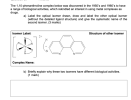 The 1,10-phenanthroline complex below was discovered in the 1950's and 1960's to have a range of biological activities, which rekindled an interest in using metal complexes as drugs. a) Label the optical isomer drawn, draw and label the other optical isomer (without the detailed ligand structure) and give the systematic name of the second isomer. (3 marks) Isomer Label: Structure of other isomer 2+ N Complex Name: b) Briefly explain why these two isomers have different biological activities (1 mark)
1&2 for each part Part 2 For the following complex numbers, find 3. --3-3i Part 3...
 1&2 for each part
Part 2 For the following complex numbers, find 3. --3-3i Part 3 For the following complex numbers, plot : and :-1 on the same diagram. The plot does not have to be "perfect," but try to give a good approximation. Uise the "1 you found in Part 2. 1.2-6i 3.3-3 Part 4 lowing complex numbers, findlel, and I: 11 (do not convert the fractions to decimals.) Use your previous work. 1. 2-6 For more, see: https://www2.clarku.edu/faculty/djoyce/complex/mult.html
1&2 for each part
Part 2 For the following complex numbers, find 3. --3-3i Part 3 For the following complex numbers, plot : and :-1 on the same diagram. The plot does not have to be "perfect," but try to give a good approximation. Uise the "1 you found in Part 2. 1.2-6i 3.3-3 Part 4 lowing complex numbers, findlel, and I: 11 (do not convert the fractions to decimals.) Use your previous work. 1. 2-6 For more, see: https://www2.clarku.edu/faculty/djoyce/complex/mult.html
Topic 1 Describe several of the technological advances seen in anatomically modern H sapiens culture. (multiple...
 Topic 1 Describe several of the technological advances seen in anatomically modern H sapiens culture. (multiple answers) tools made with punch blade technique barbed harpoon used for fishing iron ore invented use of a spear thrower traps and snares for hunting bead making more elaborate burials (than Neandertals) mud baked into hut walls burials are more common (than Neandertal burials) adhesives for spear heads and stone tool handles microliths bone and ivory engravings cave art and clay figurines Partial Question...
 As supply chains have become more global, the risk of supply disruptions has: Select one: O a. increased because emerging economies lack the business ethics of developed nations. O b. stayed the same because the issues are similar wherever suppliers are located. O c. increased because of financial and exchange rate fluctuations. O d. decreased because there are global standards for labor and safety. O e. decreased because risk is spread among suppliers all over the world.
 QUESTION 1 If supply chains are complex and multinational, the effects of terrorism can potentially initially local focus. Q True spread across the globe from an O False QUESTION 2 Confiscation differs from domestication in that confiscation: e does not involve transfer of ownership from the foreign firm to the host country. e offers compensation in the form of local, nontransferable currency e does not provide compensation to*the foreign firm. provides compensation on the book value of the firm.
 4. Development of organelles Aa Aa 3 Modern eukaryotic cells are very complex and have many features that allow them to function efficiently. These complexities took a very, very long time to evolve and likely progressed as a series of small improvements that were naturally selected. For example, modern eukaryotic cells have internal membranes surrounding their organelles and the nucleus. This arrangement likely arose when the cellular membranes of some ancient bacterial cells accidentally folded to become internal membranes. Which...
 1. Describe the law of demand. 2. Describe the law of supply 3. Draw a supply and demand diagram. Label each axis, the demand curve, the supply curve, the equilibrium price, and the equilibrium quantity. 4. Cons demand curve shifts to the right. This will create a new equilibrium price and ider that a market begins in equilibrium. If there is an increase in demand, it means that the quantity a. Compared to the old equilibrium price, is the new...
 The 1,10-phenanthroline complex below was discovered in the 1950's and 1960's to have a range of biological activities, which rekindled an interest in using metal complexes as drugs. a) Label the optical isomer drawn, draw and label the other optical isomer (without the detailed ligand structure) and give the systematic name of the second isomer. (3 marks) Isomer Label: Structure of other isomer 2+ N Complex Name: b) Briefly explain why these two isomers have different biological activities (1 mark)
 1&2 for each part
Part 2 For the following complex numbers, find 3. --3-3i Part 3 For the following complex numbers, plot : and :-1 on the same diagram. The plot does not have to be "perfect," but try to give a good approximation. Uise the "1 you found in Part 2. 1.2-6i 3.3-3 Part 4 lowing complex numbers, findlel, and I: 11 (do not convert the fractions to decimals.) Use your previous work. 1. 2-6 For more, see: https://www2.clarku.edu/faculty/djoyce/complex/mult.html
1&2 for each part
Part 2 For the following complex numbers, find 3. --3-3i Part 3 For the following complex numbers, plot : and :-1 on the same diagram. The plot does not have to be "perfect," but try to give a good approximation. Uise the "1 you found in Part 2. 1.2-6i 3.3-3 Part 4 lowing complex numbers, findlel, and I: 11 (do not convert the fractions to decimals.) Use your previous work. 1. 2-6 For more, see: https://www2.clarku.edu/faculty/djoyce/complex/mult.html
 Topic 1 Describe several of the technological advances seen in anatomically modern H sapiens culture. (multiple answers) tools made with punch blade technique barbed harpoon used for fishing iron ore invented use of a spear thrower traps and snares for hunting bead making more elaborate burials (than Neandertals) mud baked into hut walls burials are more common (than Neandertal burials) adhesives for spear heads and stone tool handles microliths bone and ivory engravings cave art and clay figurines Partial Question...
Most questions answered within 3 hours.
-
Where is the error in this code sequence?
String s1 = "Hello";
String s2 = "ello";...
asked 10 months ago -
Financial data for Joel de Paris, Inc., for last year
follow:
Joel de Paris, Inc.
Balance...
asked 10 months ago -
Consider this reaction:
Al2(SO4)3 (aq)+ BaCl3
(aq) Al2Cl6 (aq)- +
3BaSO4(s) . What is the...
asked 10 months ago -
Suppose that Savneet is considering increasing her
recent random sample from 20 car rentals to 40...
asked 10 months ago -
Trucks arrive at an unloading terminal at an average rate of 120
per hour.
Trucks arrive...
asked 10 months ago -
Why are methanol and ethanol completely soluble in water while
octanol is not very little soluble....
asked 10 months ago -
A facilities manager at a university reads in a research report
that the mean amount of...
asked 10 months ago -
When the CuSO4 is rehydrated by adding water to the anhydrous
compound, is this an endothermic...
asked 10 months ago -
A ray of sunlight is passing from diamond into crown glass; the
angle of incidence is...
asked 10 months ago -
A block of mass 0.249 kg is placed on top of a light, vertical
spring of...
asked 10 months ago -
how do the kidneys compensate in the presences of acidosis
a) trigger hyperventilate
b) reserve acid...
asked 10 months ago -
Question 501 pts
The rental rate of capital to the firm increases. Which of the
following...
asked 10 months ago