In reality, the magnitude of the force between the two spherically symmetrical charge distributions is described...
In reality, the magnitude of the force between the two spherically symmetrical charge distributions is described by Coulomb’s law
F= (kq1q2)/d^2
where k is a constant equal to 8.99×10⁹ Nm2/C2, q1 and q2 are the magnitudes of the charges, and d is the distance between the centers of the spheres.
Assuming that both spheres have equal charges, estimate the charge on each sphere, using the first data point in your table. Remember that, for the calculations to be correct, both force and distance must be expressed in their respective SI units.
Note that 1nC=10^−9C.
The first suggested data point was 31.9 cm and 0.00016 N.
Homework Answers
 hope
this helps.
hope
this helps.
Please rate positively.
Please comment for any doubt or further clarification...
Add Answer to:
In reality, the magnitude of the force between the two
spherically symmetrical charge distributions is described...
The relationship between the electric force F (e) and the gravitational force F (g) (or 1. weight) between two electron...
 The relationship between the electric force F (e) and the gravitational force F (g) (or 1. weight) between two electrons. Two equal and equally charged spheres of 0.1 g of mass each are suspended from the same point by threads of 13 cm in length. Due to the repulsion between both, the spheres are separated 10 cm as seen in the graphic representation. Find the load of 2. each of them. Calculate the number of electrons that add an electric...
Two point charges, A and B, are separated by a distance of 19.0 cm . The magnitude of the charge on A is twice that of the charge on B. If each charge exerts a force of magnitude 40.0 N on the other, find the magnitudes of the charges.
Two point charges, A and B, are separated by a distance of 19.0 cm . The magnitude of the charge on A is twice that of the charge on B. If each charge exerts a force of magnitude 40.0 N on the other, find the magnitudes of the charges.
There are two point charges, +4µC and +1µC. The +4µC point charge is placed at the...
There are two point charges, +4µC and +1µC. The +4µC point charge is placed at the origin of an (x,y) coordinate system and the +1µC point charge is placed at (6,0) in the coordinate system. Please respond to the following questions. (A) Calculate the location on the x-axis where the field is equal to zero. (B) Calculate the electric field (in both direction and magnitude) at the halfway point between the two charges. (C) Consider now that a +1nC point...
The magnitude of the electric force between two point charge is initially 180 N. What will...
The magnitude of the electric force between two point charge is initially 180 N. What will the force be if the distance between the two charges is doubled? (A) 45 N, (B) 90 N, (C) 180 N, (D) 360 N, (E) 720 N
Two point charges Q1 and Q2 are 2.10 m apart, and their total charge is 21.0...
 Two point charges Q1 and Q2 are 2.10 m apart, and their total charge is 21.0 μC. If the force of repulsion between them is 0.206 N, what are magnitudes of the two charges? Enter the smaller charge in the first box. If one charge attracts the other with a force of 0.140N, what are the magnitudes of the two charges if their total charge is also 21.0 μC? The charges are at a distance of 2.10 m apart. Note...
Two point charges Q1 and Q2 are 1.90 m apart, and their total charge is 19.3...
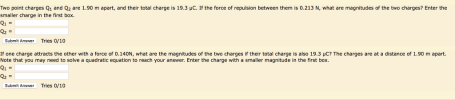 Two point charges Q1 and Q2 are 1.90 m apart, and their total charge is 19.3 HC. If the force of repulsion between them is 0.213 N, what are magnitudes of the two charges? Enter the smaller charge in the first box 21 Submit Answer Tries 0/10 If one charge attracts the other with a force of 0.140N, what are the magnitudes of the two charges if their total charge is also 19.3 μC? The charges are at a distance...
1.) Two point charges are separated by 4 cm. The attractive force between them is 20...
1.) Two point charges are separated by 4 cm. The attractive force between them is 20 N. The value of the Coulomb constant is 8.99 × 10⁹ N · m2/C2. Find the force between them when they are separated by 17 cm. Answer in units of N. 2.) If the two charges have equal magnitude, what is the magnitude of each charge? (F = 20 N .) Answer in units of C.
What is the charge on each sphere if the two charges are equal? Constants Two small...
 What is the charge on each sphere if the two charges are equal? Constants Two small plastic spheres are given positive electrical charges. When they are a distance of 14.5 cm apart, the repulsive force between them has a magnitude of 0.235 N You may want to review (Pages 690 695) For related problemsolving t view a Video Tutor Solution of Force between two point charges. ips and strategies, you may want to SubmitP Previous Answers Request Answer Incorrect; Try...
Consider two equal point charges: (a) If two objects with a charge of 1 C each...
Consider two equal point charges: (a) If two objects with a charge of 1 C each are separated in air by a distance of 1 km, what is the magnitude of the force acting between them? (b) For comparison, the typical magnitudes of charges that we have been dealing with in the lab this quarter are much smaller (on the order of 10-7 C). If you have two equal point charges of 10-7 C, how far apart would you need...
18.26-Coulomb's Law Two point charges Q1 and Q2 are 1.30 m apart, and their total charge...
 18.26-Coulomb's Law Two point charges Q1 and Q2 are 1.30 m apart, and their total charge is 11.2 HC. If the force of repulsion between them is 0.165 N, what are magnitudes of the two charges? Enter the smaller charge in the first box. 2 Submit Answer Tries 0/10 If one charge attracts the other with a force of 0.173N, what are the magnitudes of the two charges if their total charge is also 11.2 μC? The charges are at...
 The relationship between the electric force F (e) and the gravitational force F (g) (or 1. weight) between two electrons. Two equal and equally charged spheres of 0.1 g of mass each are suspended from the same point by threads of 13 cm in length. Due to the repulsion between both, the spheres are separated 10 cm as seen in the graphic representation. Find the load of 2. each of them. Calculate the number of electrons that add an electric...
 Two point charges Q1 and Q2 are 2.10 m apart, and their total charge is 21.0 μC. If the force of repulsion between them is 0.206 N, what are magnitudes of the two charges? Enter the smaller charge in the first box. If one charge attracts the other with a force of 0.140N, what are the magnitudes of the two charges if their total charge is also 21.0 μC? The charges are at a distance of 2.10 m apart. Note...
 Two point charges Q1 and Q2 are 1.90 m apart, and their total charge is 19.3 HC. If the force of repulsion between them is 0.213 N, what are magnitudes of the two charges? Enter the smaller charge in the first box 21 Submit Answer Tries 0/10 If one charge attracts the other with a force of 0.140N, what are the magnitudes of the two charges if their total charge is also 19.3 μC? The charges are at a distance...
 What is the charge on each sphere if the two charges are equal? Constants Two small plastic spheres are given positive electrical charges. When they are a distance of 14.5 cm apart, the repulsive force between them has a magnitude of 0.235 N You may want to review (Pages 690 695) For related problemsolving t view a Video Tutor Solution of Force between two point charges. ips and strategies, you may want to SubmitP Previous Answers Request Answer Incorrect; Try...
 18.26-Coulomb's Law Two point charges Q1 and Q2 are 1.30 m apart, and their total charge is 11.2 HC. If the force of repulsion between them is 0.165 N, what are magnitudes of the two charges? Enter the smaller charge in the first box. 2 Submit Answer Tries 0/10 If one charge attracts the other with a force of 0.173N, what are the magnitudes of the two charges if their total charge is also 11.2 μC? The charges are at...
Most questions answered within 3 hours.
-
Where is the error in this code sequence?
String s1 = "Hello";
String s2 = "ello";...
asked 11 months ago -
Financial data for Joel de Paris, Inc., for last year
follow:
Joel de Paris, Inc.
Balance...
asked 11 months ago -
Consider this reaction:
Al2(SO4)3 (aq)+ BaCl3
(aq) Al2Cl6 (aq)- +
3BaSO4(s) . What is the...
asked 11 months ago -
Suppose that Savneet is considering increasing her
recent random sample from 20 car rentals to 40...
asked 11 months ago -
Trucks arrive at an unloading terminal at an average rate of 120
per hour.
Trucks arrive...
asked 11 months ago -
Why are methanol and ethanol completely soluble in water while
octanol is not very little soluble....
asked 11 months ago -
A facilities manager at a university reads in a research report
that the mean amount of...
asked 11 months ago -
When the CuSO4 is rehydrated by adding water to the anhydrous
compound, is this an endothermic...
asked 11 months ago -
A ray of sunlight is passing from diamond into crown glass; the
angle of incidence is...
asked 11 months ago -
A block of mass 0.249 kg is placed on top of a light, vertical
spring of...
asked 11 months ago -
how do the kidneys compensate in the presences of acidosis
a) trigger hyperventilate
b) reserve acid...
asked 11 months ago -
Question 501 pts
The rental rate of capital to the firm increases. Which of the
following...
asked 11 months ago