Big-O notation. Let T(n) be given using the recursive formula. T(n) = T(n-1) + n, T(1)...
Big-O notation.
Let
T(n) be given using the recursive formula.
T(n) = T(n-1) + n,
T(1) = 1.
Prove that T(n) = O(n2).
Homework Answers
T(n) = T(n-1) + n,
T(1) = 1.

using substitution method:
---------------------------
T(n)
= T(n-1) + n
= T(n-2) + n-1 + n
= T(n-3) + n-2 + n-1 + n
= T(1) + 2 + ... + n-2 + n-1 + n
= 1 + 2 + ... + n-2 + n-1 + n
This is sum of first n natural numbers. It's formula is n(n+1)/2.
= n(n+1)/2
= (n2+n)/2
we can ignore lower order terms(n) and constant factors(/2).
so, time complexity is O(n2)
T(n) = O(n2)
Add Answer to:
Big-O notation.
Let
T(n) be given using the recursive formula.
T(n) = T(n-1) + n,
T(1)...
Analyze and prove the running time of the recursive formula T(n) = n2 + 2T(n/2). (hint-...
Analyze and prove the running time of the recursive formula T(n) = n2 + 2T(n/2). (hint- first prove that it is O(n2 logn). Next see if you could improve your answer. We used the recursion tree method to analyze the running time of MergeSort. Use this method to analyze each one of the following recursive formulas, and obtain its solution. Assume T(n) = 1 when n ≤ 1. Analyze and prove the running time of the recursive formula T(n) =...
Can I get help with this question? Problem 1. Solve the recursive equations with big-O notation....
 Can I get help with this question?
Problem 1. Solve the recursive equations with big-O notation. a) T(n)=167(n/2) + n° with T(1)=1. b) T(n) = T(vn+1 with T(1)=T(2)=T(3)=1, where (a) is the largest integer m less than or equal to a. For example [3.1]=3.
Can I get help with this question?
Problem 1. Solve the recursive equations with big-O notation. a) T(n)=167(n/2) + n° with T(1)=1. b) T(n) = T(vn+1 with T(1)=T(2)=T(3)=1, where (a) is the largest integer m less than or equal to a. For example [3.1]=3.
Given n distinct items: Assuming n is a power of 2, write down a recursive divide-and-conquer...
Given n distinct items: Assuming n is a power of 2, write down a recursive divide-and-conquer algorithm for solving simultaneous minimum and maximum, using n = 2 as the bottom of the recursion. If we let T(n) denote the number of comparisons done by your algorithm, write down the recurrence relation satisfied by T(n). Solve exactly (without using the “big O” notation) the recurrence relation for T(n), showing all the details of your work.
7. [4] (Big-O-Notation) What is the order of growth of the following functions in Big-o notation?...
 7. [4] (Big-O-Notation) What is the order of growth of the following functions in Big-o notation? a. f(N) = (N® + 100M2 + 10N + 50) b. f(N) = (10012 + 10N +50) /N2 c. f(N) = 10N + 50Nlog (N) d. f(N) = 50N2log (n)/N
6. Using big-oh notation, give the runtime for each of the following recursive functions. You do...
 6. Using big-oh notation, give the runtime for each of the following recursive functions. You do not need to justify your answers: a) Int nonesense (int n) if (n <0) return 1; return nonsense (n-2) 1; b) int no nonesense (int n) if (n <0) return 1; return no_nonsense (n-1)+ no nonsense (n-1)
What is the order of the following growth function expressed using Big-Oh notation: T(N)=7*N3 + N/2...
What is the order of the following growth function expressed using Big-Oh notation: T(N)=7*N3 + N/2 + 2 * log N + 38 ? O(2N) O(N3) O(N/2) O(N3 + log N)
Q6) let T(n) be a running time function defined recursively as 0, n=0 n=1 3T(n -...
 Q6) let T(n) be a running time function defined recursively as 0, n=0 n=1 3T(n - 1)- 2T(n - 2), n> 1 a) Find a non-recursive formula for T(n) b) Prove by induction that your answer in part (a) is correct. c) Find a tight bound for T(n).
Choose the equivalent Big Oh notation for the functions given below. If there is more than...
Choose the equivalent Big Oh notation for the functions given below. If there is more than one option, circle the tightest asymptotic bound. function f(n) = 5n - 10 belongs to a) O(1) b) O(n) c) O(n2) d) O(log n) function f(n) = 4n2 + 4n + 1 belongs to a) O(1) b) O(n) c) O(n2) d) O(log n) function f(n) = n2 + 100 log n belongs to a) O(1) b) O(n) c) O(n2) d) O(log n)
Q-6e: Determine the big-O expression for the following T(N) function: T(1) = 1 T(N) = 2T(N...
 Q-6e: Determine the big-O expression for the following T(N) function: T(1) = 1 T(N) = 2T(N – 1)+1 O 0(1) O O(log N) OO(N2) O O(N log N) O 0(2) OO(N)
A 2 × n checkerboard is to be tiled using three types of tiles. The first tile is a white 1 × 1 square tile. The second...
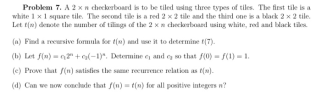 A 2 × n checkerboard is to be tiled using three types of
tiles. The first tile is a
white 1 × 1 square tile. The second tile is a red 2 × 2 tile
and the third one is a black 2 × 2 tile.
Let t(n) denote the number of tilings of the 2 × n
checkerboard using white, red and black tiles.
(a) Find a recursive formula for t(n) and use it to determine
t(7).
(b) Let...
A 2 × n checkerboard is to be tiled using three types of
tiles. The first tile is a
white 1 × 1 square tile. The second tile is a red 2 × 2 tile
and the third one is a black 2 × 2 tile.
Let t(n) denote the number of tilings of the 2 × n
checkerboard using white, red and black tiles.
(a) Find a recursive formula for t(n) and use it to determine
t(7).
(b) Let...
 Can I get help with this question?
Problem 1. Solve the recursive equations with big-O notation. a) T(n)=167(n/2) + n° with T(1)=1. b) T(n) = T(vn+1 with T(1)=T(2)=T(3)=1, where (a) is the largest integer m less than or equal to a. For example [3.1]=3.
Can I get help with this question?
Problem 1. Solve the recursive equations with big-O notation. a) T(n)=167(n/2) + n° with T(1)=1. b) T(n) = T(vn+1 with T(1)=T(2)=T(3)=1, where (a) is the largest integer m less than or equal to a. For example [3.1]=3.
 7. [4] (Big-O-Notation) What is the order of growth of the following functions in Big-o notation? a. f(N) = (N® + 100M2 + 10N + 50) b. f(N) = (10012 + 10N +50) /N2 c. f(N) = 10N + 50Nlog (N) d. f(N) = 50N2log (n)/N
 6. Using big-oh notation, give the runtime for each of the following recursive functions. You do not need to justify your answers: a) Int nonesense (int n) if (n <0) return 1; return nonsense (n-2) 1; b) int no nonesense (int n) if (n <0) return 1; return no_nonsense (n-1)+ no nonsense (n-1)
 Q6) let T(n) be a running time function defined recursively as 0, n=0 n=1 3T(n - 1)- 2T(n - 2), n> 1 a) Find a non-recursive formula for T(n) b) Prove by induction that your answer in part (a) is correct. c) Find a tight bound for T(n).
 Q-6e: Determine the big-O expression for the following T(N) function: T(1) = 1 T(N) = 2T(N – 1)+1 O 0(1) O O(log N) OO(N2) O O(N log N) O 0(2) OO(N)
 A 2 × n checkerboard is to be tiled using three types of
tiles. The first tile is a
white 1 × 1 square tile. The second tile is a red 2 × 2 tile
and the third one is a black 2 × 2 tile.
Let t(n) denote the number of tilings of the 2 × n
checkerboard using white, red and black tiles.
(a) Find a recursive formula for t(n) and use it to determine
t(7).
(b) Let...
A 2 × n checkerboard is to be tiled using three types of
tiles. The first tile is a
white 1 × 1 square tile. The second tile is a red 2 × 2 tile
and the third one is a black 2 × 2 tile.
Let t(n) denote the number of tilings of the 2 × n
checkerboard using white, red and black tiles.
(a) Find a recursive formula for t(n) and use it to determine
t(7).
(b) Let...
Most questions answered within 3 hours.
-
Where is the error in this code sequence?
String s1 = "Hello";
String s2 = "ello";...
asked 1 year ago -
Financial data for Joel de Paris, Inc., for last year
follow:
Joel de Paris, Inc.
Balance...
asked 1 year ago -
Consider this reaction:
Al2(SO4)3 (aq)+ BaCl3
(aq) Al2Cl6 (aq)- +
3BaSO4(s) . What is the...
asked 1 year ago -
Suppose that Savneet is considering increasing her
recent random sample from 20 car rentals to 40...
asked 1 year ago -
Trucks arrive at an unloading terminal at an average rate of 120
per hour.
Trucks arrive...
asked 1 year ago -
Why are methanol and ethanol completely soluble in water while
octanol is not very little soluble....
asked 1 year ago -
A facilities manager at a university reads in a research report
that the mean amount of...
asked 1 year ago -
When the CuSO4 is rehydrated by adding water to the anhydrous
compound, is this an endothermic...
asked 1 year ago -
A ray of sunlight is passing from diamond into crown glass; the
angle of incidence is...
asked 1 year ago -
A block of mass 0.249 kg is placed on top of a light, vertical
spring of...
asked 1 year ago -
how do the kidneys compensate in the presences of acidosis
a) trigger hyperventilate
b) reserve acid...
asked 1 year ago -
Question 501 pts
The rental rate of capital to the firm increases. Which of the
following...
asked 1 year ago