This question is very important and I need solution for this issue with all the details...
This question is very important and I need solution for this issue with all the details a.b.c , and help me with all the details? BR/Ha
a) Find the profit maximizing total output and how much of it that is sold on market A and market B respectively if the monopoly uses third degree price discrimination. What prices will our monopolist charge in the two separate markets?A monopolist faces two totally separated markets with inverse demand p=100 – qA and p=160−2qB respectively. The monopolist has no fixed costs and a marginal cost given by mc= 2/3 q .
b) Calculate the price elasticity of demand in each market and explain the intuition behind the relationship between the prices and elasticities in these two separate markets.
c)Use the definition of marginal revenue and the definition of the price elasticity of demand to derive an expression for the markup for a monopolist. Use this expression to calculate the markup for the two separate markets in question 4a).
Homework Answers
a). In case of third degree price discrimination, the monopolist separates the markets on the basis of elasticity of demand and accordingly sets different prices in different markets.
In the above question, there are two markets - market A and market B. The inverse demand functions are as follows:
p=100-qA and p=160-2qB (where qA and qB are the quantity of A and B respectively)
Also, MC = 2/3q
We need to find the optimum level of output. This can be calculated by using the below condition:
Marginal revenue (MR) = Marginal Cost (MC)
TRA = Price of A * Quantity of A
= (100-qA)*qA = 100qA-qA2
MRA=
 TRA/qA =
100-2qA
TRA/qA =
100-2qA
Similarly,
TRB= Price of B * Quantity of B
= (160-2qB)*qB = 160qB-2qB2
MRB = TRB/qB =
160-4qB
Condition for maximization = MRA = MRB = MC
When MRA = MC
100-2qA = 2/3 (qA+qB)
= 300 -6qA = 2qA + 2qB
= 8qA + 2qB = 300 => 4qA + qB = 150 .....(i)
When MRB = MC
160-4qB = 2/3(qA+qB)
= 240-6qB = qA + qB => qA + 7qB =240 .....(ii)
Solving (i) and (ii), we get,
qA = 30 units and qB = 30 units
Explanation:

Total output produced = qA +qB = 30+30 = 60 Units
Price charged by the monopolist in market A :
p=100-qA = 100-30 = 70
Price charged by the monopolist in market B :
p=160-2qB = 160-2(30/) =160-60 = 100
b). Elasticity in market A given price = 70 and quantity = 30
p = 100 - qA (given)
qA = 100 - p
 qA/P =
-1
qA/P =
-1
We know elasticity (eA) = (qA/p) *
(p/qA)
eA = -1 * 70/30 = -2.33
Similarly,elasticity in market B given price = 100 and quantity = 30
p = 160 -2 qB (given)
qB = (160-p)/2
qB/P =
-1/2
We know elasticity (eB) = (qB/p) *
(p/qB)
eB = -1/2 * 100/30 = -1.66
It can clearly be seen that the elasticity in market A is more than elasticity in market B. And in order to be profitable, a monopolist will always charge a less price in the market with high elasticity which is evident from the price in market A, that is $70 which is less than $100 charged in market B. This is because, the elasticity in market A being more, fall in demand will be more in market A if price increases as compared to market B. Also, market B being less elastic, the change in demand will not be more even if higher price is charged.
Therefore, the monopolist charges prices in separate markets depending upon the elasticity - higher price in less elastic market and lower in more elastic market.
c). We know the mark up of a monopolist is given by (P-MC)/P
Where, P is the price and MC is the marginal cost. This can be derived as follows:
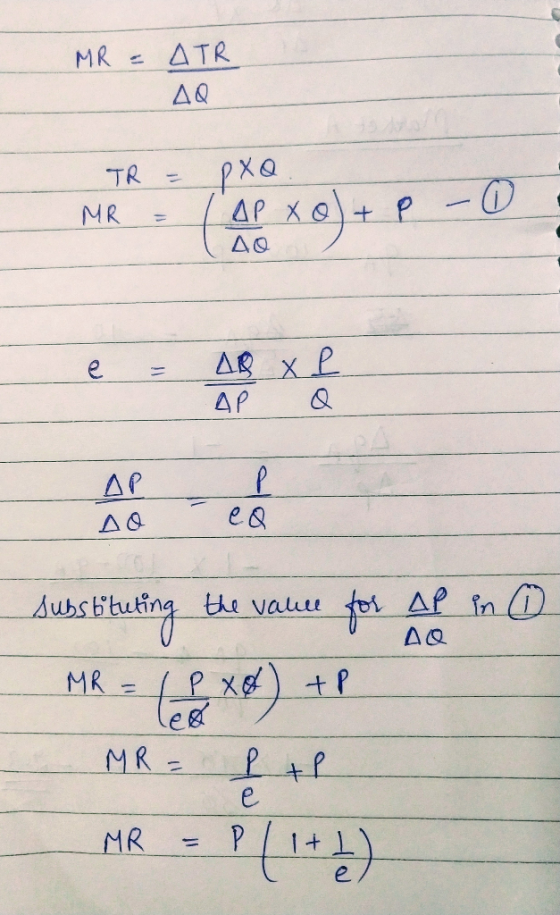
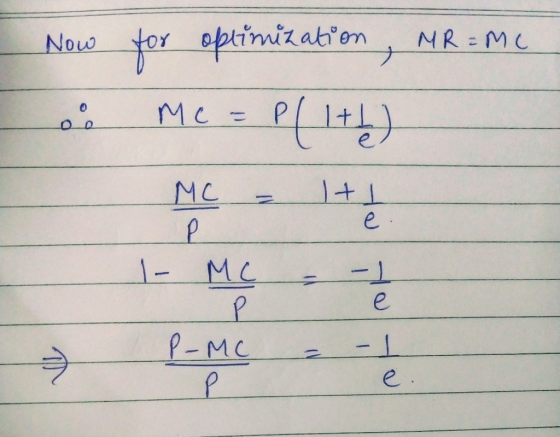
Now we can calculate markup in two markets: (using values of eA and eB from b).)
Market A = -1/eA = -1/(-2.33) = 0.429 or 42.9%
Market B = -1/eB = -1/(-1.66) =0.6024 or 60.24%
Add Answer to:
This question is very important and I need solution for this
issue with all the details...
I need step by step solution to the following this question asap .I have limited time...
 I need step by step solution to the following this question asap
.I have limited time so please do it quickly with detailed
explanation
thanks in advance/Ha
a) A monopolist faces two totally separated markets with inverse demand p=100 – 9a and p=160 – 298 respectively. The monopolist has no fixed costs and a marginal cost given by mc=q . Find the profit maximizing total output and how much of it that is sold on market A and market B...
I need step by step solution to the following this question asap
.I have limited time so please do it quickly with detailed
explanation
thanks in advance/Ha
a) A monopolist faces two totally separated markets with inverse demand p=100 – 9a and p=160 – 298 respectively. The monopolist has no fixed costs and a marginal cost given by mc=q . Find the profit maximizing total output and how much of it that is sold on market A and market B...
A) Suppose a monopoly sells to two identifiably different types of customers, A and B, who...
A) Suppose a monopoly sells to two identifiably different types of customers, A and B, who are unable to practice arbitrage. The inverse demand curve for group A is PA = 29 - QA, and the inverse demand curve for group B is PB = 19 - 2QB. The monopolist is able to produce the good for either type of customer at a constant marginal cost of 3, and the monopolist has no fixed costs. If the monopolist practices group...
A monopolist practices third degree price discrimination by separating its customers into two groups: consumers under...
 A monopolist practices third degree price discrimination by separating its customers into two groups: consumers under 65 and senior citizens. The monopolist's marginal oost is MC = 0.05q, where q is the total output in both markets. The marginal cost does not depend on the market in which the goods are sold. The demand curves are Adults: PA-25-1/6 x QA-25-0.1667 x QA Seniors: PS = 15-⅛xQs-15-0.125 x Qs ● . A. What is the total industry demand curve? (Rewrite each...
This question is very important and I need solution for this issue with all the details...
This question is very important and I need solution for this issue with all the details a.b.c , and help me with all the details? BR/Ha Question : Consider an island with exclusive fishing rights to their own waters. The fishing industry is unregulated and the production function, representing the yearly catch, is given by f ( x )=22 x− x2 /40 where x is the number of boats launched. Yearly industry profit is split equally among fishing boats and...
Question 17 (1 point) Price discrimination is more common for firms selling services than for manufacturing...
 Question 17 (1 point) Price discrimination is more common for firms selling services than for manufacturing firms because monopoly is more common in producing services than in producing manufactured goods. O price elasticities differ among consumers of services more than among customers of manufactured goods. it is easier to prevent resale of a service than of a manufactured product. firms selling services are more likely to have constant marginal cost curves. Question 18 (1 point) Assume that a monopolist produces...
This question is very important and I need solution for this issue with all the details...
This question is very important and I need solution for this issue with all the details a.b.c , and help me with all the details? BR/Ha a) The firm ACME has the production function f ( K , L)=K2/3 L2/3 . Calculate an expression for the marginal product of labour, L , and establish if it is increasing, constant or decreasing. Verify if ACME’s production technology exhibits diminishing, constant or increasing returns to scale. b) Set up ACME’s long run...
22. Suppose a monopoly sells to two identifiably different types of customers, A and B, who...
 22. Suppose a monopoly sells to two identifiably different types of customers, A and B, who are unable to practice arbitrage. The inverse demand curve for group A is PA 20-QA, and the inverse demand curve for group B is PB 20-2QB. The monopolist is able to produce the good for either type of customer at a constant marginal cost of 4, and the monopolist has no fixed costs. If the monopolist practices group price discrimination, what are the profit...
Question 27 (1 point) Imposing a per unit tax on a perfectly_price discriminating monopolist will have...
 Question 27 (1 point) Imposing a per unit tax on a perfectly_price discriminating monopolist will have an uncertain impact on output. shift out the consumer demand curve. reduce its output increase its output. Question 28 (1 point) In a Cournot duopoly model with inverse market demand P = a - bQ, where a and b are positive constants, and zero marginal costs for both firms, the output and price for each duopolist are, a/b and 0. 2a/3b and a/3. a/3b...
10. A monopolist is able to identify two market segments, A and B, with demand curves...
10. A monopolist is able to identify two market segments, A and B, with demand curves given by: PA = 12 − QA PB = 12 − 2QB The monopolist has constant average and marginal costs c = 4. (a) Calculate the profit maximizing prices the monopolist would charge in each market segment. (b) Calculate the efficient price for each market segment. (c) Calculate the deadweight loss due to monopolistic behavior. I am stuck on part C. I am not...
Need as much details as possible. Microeconomics. Suppose that there is only one firm on the...
Need as much details as possible. Microeconomics. Suppose that there is only one firm on the market (a monopoly) and that the (inverse) market demand is P(Q). Which statement is NOT correct? a. If all consumers in the market are identical, the monopoly can achieve the first-degree price discrimination outcome by setting a two-part tariff optimally. b. If the monopoly is setting a uniform price, then MR=P. c. If the monopoly is doing first-degree price discrimination, then MR = P(Q)....
 I need step by step solution to the following this question asap
.I have limited time so please do it quickly with detailed
explanation
thanks in advance/Ha
a) A monopolist faces two totally separated markets with inverse demand p=100 – 9a and p=160 – 298 respectively. The monopolist has no fixed costs and a marginal cost given by mc=q . Find the profit maximizing total output and how much of it that is sold on market A and market B...
I need step by step solution to the following this question asap
.I have limited time so please do it quickly with detailed
explanation
thanks in advance/Ha
a) A monopolist faces two totally separated markets with inverse demand p=100 – 9a and p=160 – 298 respectively. The monopolist has no fixed costs and a marginal cost given by mc=q . Find the profit maximizing total output and how much of it that is sold on market A and market B...
 A monopolist practices third degree price discrimination by separating its customers into two groups: consumers under 65 and senior citizens. The monopolist's marginal oost is MC = 0.05q, where q is the total output in both markets. The marginal cost does not depend on the market in which the goods are sold. The demand curves are Adults: PA-25-1/6 x QA-25-0.1667 x QA Seniors: PS = 15-⅛xQs-15-0.125 x Qs ● . A. What is the total industry demand curve? (Rewrite each...
 Question 17 (1 point) Price discrimination is more common for firms selling services than for manufacturing firms because monopoly is more common in producing services than in producing manufactured goods. O price elasticities differ among consumers of services more than among customers of manufactured goods. it is easier to prevent resale of a service than of a manufactured product. firms selling services are more likely to have constant marginal cost curves. Question 18 (1 point) Assume that a monopolist produces...
 22. Suppose a monopoly sells to two identifiably different types of customers, A and B, who are unable to practice arbitrage. The inverse demand curve for group A is PA 20-QA, and the inverse demand curve for group B is PB 20-2QB. The monopolist is able to produce the good for either type of customer at a constant marginal cost of 4, and the monopolist has no fixed costs. If the monopolist practices group price discrimination, what are the profit...
 Question 27 (1 point) Imposing a per unit tax on a perfectly_price discriminating monopolist will have an uncertain impact on output. shift out the consumer demand curve. reduce its output increase its output. Question 28 (1 point) In a Cournot duopoly model with inverse market demand P = a - bQ, where a and b are positive constants, and zero marginal costs for both firms, the output and price for each duopolist are, a/b and 0. 2a/3b and a/3. a/3b...
Most questions answered within 3 hours.
-
Where is the error in this code sequence?
String s1 = "Hello";
String s2 = "ello";...
asked 11 months ago -
Financial data for Joel de Paris, Inc., for last year
follow:
Joel de Paris, Inc.
Balance...
asked 11 months ago -
Consider this reaction:
Al2(SO4)3 (aq)+ BaCl3
(aq) Al2Cl6 (aq)- +
3BaSO4(s) . What is the...
asked 11 months ago -
Suppose that Savneet is considering increasing her
recent random sample from 20 car rentals to 40...
asked 11 months ago -
Trucks arrive at an unloading terminal at an average rate of 120
per hour.
Trucks arrive...
asked 11 months ago -
Why are methanol and ethanol completely soluble in water while
octanol is not very little soluble....
asked 11 months ago -
A facilities manager at a university reads in a research report
that the mean amount of...
asked 11 months ago -
When the CuSO4 is rehydrated by adding water to the anhydrous
compound, is this an endothermic...
asked 11 months ago -
A ray of sunlight is passing from diamond into crown glass; the
angle of incidence is...
asked 11 months ago -
A block of mass 0.249 kg is placed on top of a light, vertical
spring of...
asked 11 months ago -
how do the kidneys compensate in the presences of acidosis
a) trigger hyperventilate
b) reserve acid...
asked 11 months ago -
Question 501 pts
The rental rate of capital to the firm increases. Which of the
following...
asked 11 months ago