Manufacture ball bearings
a process manufacture s ball bearings with diameters that are normally distributed with mean 25.1 millimeters and standard deviation of 0.08 millimeter what is the probability that a randomly selected ball bearing will have a diameter above 25.2? Probability that a randomly selected ball bearing will have a diameter between 25.05 and 25.15 millimeters? What values are in bottom 1% of diameters? Include work and graphs in all
Homework Answers
Request Answer!
We need at least 10 more requests to produce the answer.
0 / 10 have requested this problem solution
The more requests, the faster the answer.
(2) A process manufactures ball bearings with diameters that are normally distributed with mean 25.1 millimeters...
 (2) A process manufactures ball bearings with diameters that are normally distributed with mean 25.1 millimeters and standard deviation 0.08 millimeter. (a) To meet a certain specification, a ball bearing must have a diameter between 25.0 and 25.2 millimeters. Find the percentage of ball bearings that meet the specification. (b) Find the third quartile of the diameters.
A process manufactures ball bearings with diameters that are normally distributed with mean 25.15 mm and...
A process manufactures ball bearings with diameters that are normally distributed with mean 25.15 mm and standard deviation 0.08 mm. a) A particular ball bearing has a diameter of 25.2 mm. What percentile is its diameter on? (Round up the final answer to the nearest whole number.) b) To meet a certain specification, a ball bearing must have a diameter between 25.0 and 25.3 millimeters. What proportion of the ball bearings meet the specification?
The diameters of ball bearings are distributed normally. The mean diameter is 99 millimeters and the...
The diameters of ball bearings are distributed normally. The mean diameter is 99 millimeters and the standard deviation is 5 millimeters. Find the probability that the diameter of a selected bearing is greater than 109 millimeters. Round your answer to four decimal places.
The diameters of ball bearings are distributed normally. The mean diameter is 74 millimeters and the...
The diameters of ball bearings are distributed normally. The mean diameter is 74 millimeters and the standard deviation is 3 millimeters. Find the probability that the diameter of a selected bearing is greater than 71 millimeters. Round your answer to four decimal places.
The diameters of ball bearings are distributed normally. The mean diameter is 96 millimeters and the...
The diameters of ball bearings are distributed normally. The mean diameter is 96 millimeters and the standard deviation is 6 millimeters. Find the probability that the diameter of a selected bearing is greater than 105 millimeters. Round your answer to four decimal places.
The diameters of ball bearings are distributed normally. The mean diameter is 145 millimeters and the...
The diameters of ball bearings are distributed normally. The mean diameter is 145 millimeters and the standard deviation is 6 millimeters. Find the probability that the diameter of a selected bearing is greater than 134 millimeters. Round your answer to four decimal places.
Precision manufacturing: A process manufactures ball bearings with diameters that are normally distributed with mean 25.2...
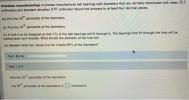 Precision manufacturing: A process manufactures ball bearings with diameters that are normally distributed with mean 25.2 millimeters and standard deviation 0.07 millimeter. Round the answers to at least four decimal places. (a) Find the 20 percentile of the diameters. (b) Find the 34th percentile of the diameters. (c) A hole is to be designed so that 1% of the ball bearings will fit through it. The bearings that fit through the hole will be melted down and remade. What should...
The diameters of ball bearings are distributed normally. The mean diameter is 51 millimeters and the...
The diameters of ball bearings are distributed normally. The mean diameter is 51 millimeters and the variance is 25. Find the probability that the diameter of a selected bearing is greater than 46 millimeters. Round your answer to four decimal places.
The diameters of ball bearings are distributed normally. The mean diameter is 100 100 millimeters and...
The diameters of ball bearings are distributed normally. The mean diameter is 100 100 millimeters and the variance is 36 36 . Find the probability that the diameter of a selected bearing is between 88 88 and 106 106 millimeters. Round your answer to four decimal places.
2. (3 points) The diameter of ball bearings produced in a manufacturing process at a particular...
 2. (3 points) The diameter of ball bearings produced in a manufacturing process at a particular company can be explained using a uniform distribution. All the ball bearings produced have a diameter that ranges over the interval 3.5 milimeters to 5.5 milimeters. What is the probability that a randomly selected ball bearing will have a diameter greater than 4.4 milimeters? 3. (3.5 points) The monthly incomes of trainees at a local mill are normally distributed with a mean of $1050...
 (2) A process manufactures ball bearings with diameters that are normally distributed with mean 25.1 millimeters and standard deviation 0.08 millimeter. (a) To meet a certain specification, a ball bearing must have a diameter between 25.0 and 25.2 millimeters. Find the percentage of ball bearings that meet the specification. (b) Find the third quartile of the diameters.
 Precision manufacturing: A process manufactures ball bearings with diameters that are normally distributed with mean 25.2 millimeters and standard deviation 0.07 millimeter. Round the answers to at least four decimal places. (a) Find the 20 percentile of the diameters. (b) Find the 34th percentile of the diameters. (c) A hole is to be designed so that 1% of the ball bearings will fit through it. The bearings that fit through the hole will be melted down and remade. What should...
 2. (3 points) The diameter of ball bearings produced in a manufacturing process at a particular company can be explained using a uniform distribution. All the ball bearings produced have a diameter that ranges over the interval 3.5 milimeters to 5.5 milimeters. What is the probability that a randomly selected ball bearing will have a diameter greater than 4.4 milimeters? 3. (3.5 points) The monthly incomes of trainees at a local mill are normally distributed with a mean of $1050...
Most questions answered within 3 hours.
-
Where is the error in this code sequence?
String s1 = "Hello";
String s2 = "ello";...
asked 10 months ago -
Financial data for Joel de Paris, Inc., for last year
follow:
Joel de Paris, Inc.
Balance...
asked 10 months ago -
Consider this reaction:
Al2(SO4)3 (aq)+ BaCl3
(aq) Al2Cl6 (aq)- +
3BaSO4(s) . What is the...
asked 10 months ago -
Suppose that Savneet is considering increasing her
recent random sample from 20 car rentals to 40...
asked 10 months ago -
Trucks arrive at an unloading terminal at an average rate of 120
per hour.
Trucks arrive...
asked 10 months ago -
Why are methanol and ethanol completely soluble in water while
octanol is not very little soluble....
asked 10 months ago -
A facilities manager at a university reads in a research report
that the mean amount of...
asked 10 months ago -
When the CuSO4 is rehydrated by adding water to the anhydrous
compound, is this an endothermic...
asked 10 months ago -
A ray of sunlight is passing from diamond into crown glass; the
angle of incidence is...
asked 10 months ago -
A block of mass 0.249 kg is placed on top of a light, vertical
spring of...
asked 10 months ago -
how do the kidneys compensate in the presences of acidosis
a) trigger hyperventilate
b) reserve acid...
asked 10 months ago -
Question 501 pts
The rental rate of capital to the firm increases. Which of the
following...
asked 10 months ago