Draw the tripeptide gly-lys-glu as it exists under physiological pH. Write the reaction for the hydrolysis...
Draw the tripeptide gly-lys-glu as it exists under physiological pH. Write the reaction for the hydrolysis of this tripeptide into the individual amino acids. Be sure to show the reaction conditions and the final products that result under these conditions.
Homework Answers


Add Answer to:
Draw the tripeptide gly-lys-glu as it exists under physiological
pH. Write the reaction for the hydrolysis...
If the peptide Cys-Gly-Phe-Lys-Ala-Arg-Asp-Gly is subjected to acid hydrolysis, what will be the products? peptide fragments...
 If the peptide Cys-Gly-Phe-Lys-Ala-Arg-Asp-Gly is subjected to acid hydrolysis, what will be the products? peptide fragments fragments of amino acids individual amino acids
Complete hydrolysis of an unknown basic decapeptide gives Gly, Ala, Leu, Ile, Phe, Tyr, Glu, Arg,...
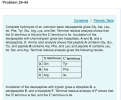 Complete hydrolysis of an unknown basic decapeptide gives Gly,
Ala, Leu, Ile, Phe, Tyr, Glu, Arg, Lys, and Ser.
Problem 24-44 ConstantsI Periodic Table Complete hydrolysis of an unknown basic decapeptide gives Gly, Ala, Leu, lle, Phe, Tyr, Glu, Arg, Lys, and Ser. Terminal residue analysis shows that the N terminus is Ala and the C terminus is lle. Incubation of the decapeptide with chymotrypsin gives two tripeptides, A and B, and a tetrapeptide, C. Amino acid analysis shows that...
Complete hydrolysis of an unknown basic decapeptide gives Gly,
Ala, Leu, Ile, Phe, Tyr, Glu, Arg, Lys, and Ser.
Problem 24-44 ConstantsI Periodic Table Complete hydrolysis of an unknown basic decapeptide gives Gly, Ala, Leu, lle, Phe, Tyr, Glu, Arg, Lys, and Ser. Terminal residue analysis shows that the N terminus is Ala and the C terminus is lle. Incubation of the decapeptide with chymotrypsin gives two tripeptides, A and B, and a tetrapeptide, C. Amino acid analysis shows that...
1. Draw the structure of the following tripeptide as it would exist at physiological pH. Be...
 1. Draw the structure of the following tripeptide as it would exist at physiological pH. Be sure to indicate any positive or negatively charged groups in the tripeptide. lle-Lys-Tyr
1. Partial hydrolysis of lysozyme yielded an octapeptide that was later identified as the N-terminal segment of...
1. Partial hydrolysis of lysozyme yielded an octapeptide that was later identified as the N-terminal segment of the protein. From the following information, determine the sequence of this octapeptide. a. The following amino acids were identified after complete hydrolysis of the octapeptide: Arginine (Arg) Glycine (Gly) Phenylalanine (Phe) Cysteine (Cys) Leucine (Leu) Valine (Val) Glutamic Acid (Glu) Lysine (Lys) b. Treatment of the octapeptide with dinitroflurobenzene (Sanger reagent) followed by complete hydrolysis gave lysine (Lys) labeled with two dinitrophenyl (DNP) groups. c. Treatment of the octapeptide with trypsin gave lysine...
1. Partial hydrolysis of lysozyme yielded an octapeptide that was later identified as the N-terminal segment of...
1. Partial hydrolysis of lysozyme yielded an octapeptide that was later identified as the N-terminal segment of the protein. From the following information, determine the sequence of this octapeptide. a. The following amino acids were identified after complete hydrolysis of the octapeptide: Arginine (Arg) Glycine (Gly) Phenylalanine (Phe) Cysteine (Cys) Leucine (Leu) Valine (Val) Glutamic Acid (Glu) Lysine (Lys) b. Treatment of the octapeptide with dinitroflurobenzene (Sanger reagent) followed by complete hydrolysis gave lysine (Lys) labeled with two dinitrophenyl (DNP) groups. c. Treatment of the octapeptide with trypsin gave lysine...
true or false. at physiological PH, nearly all amino acids have overall positive charge True False...
 true or false. at physiological PH, nearly all amino acids
have overall positive charge
True False 1) At physiological pH, nearly all amino acids have an overall positive charge. 2) The dipeptide abbreviated as Gly-Lys is the same as the dipeptide abbreviated as Lys-Gly. tide 3) The peptide sequence Gly-Gly-Gly gives the primary structure of a tripeptide. 4) The u-helix is a secondary structure. 5) The triple helix of collagen is a tertiary structure.
true or false. at physiological PH, nearly all amino acids
have overall positive charge
True False 1) At physiological pH, nearly all amino acids have an overall positive charge. 2) The dipeptide abbreviated as Gly-Lys is the same as the dipeptide abbreviated as Lys-Gly. tide 3) The peptide sequence Gly-Gly-Gly gives the primary structure of a tripeptide. 4) The u-helix is a secondary structure. 5) The triple helix of collagen is a tertiary structure.
4. Complete hydrolysis of a heptapeptide T gave the following amino acids: 2Ảla, Glu, Leu, Lys,...
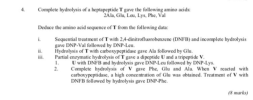 4. Complete hydrolysis of a heptapeptide T gave the following amino acids: 2Ảla, Glu, Leu, Lys, Phe, Val Deduce the amino acid sequence of T from the following data: i. Sequential treatment of T with 2,4-dinitrofluorobenzene (DNFB) and incomplete hydrolysis gave DNP-Val followed by DNP-Leu. Hydrolysis of T with carboxypeptidase gave Ala followed by Glu. Partial enzymatic hydrolysis of T gave a dipeptide and a tripeptide V. U with DNFB and hydrolysis gave DNP-Leu followed by DNP-Lys. 2. Complete hydrolysis...
Asp-Tyr-Phe-Glu-Asn-Cys-Pro-Lys-Gly The optical absorbance of the peptide at 280 nm is the result of the absorbance...
Asp-Tyr-Phe-Glu-Asn-Cys-Pro-Lys-Gly The optical absorbance of the peptide at 280 nm is the result of the absorbance of its aromatic amino acids. What is the molar extinction coefficient of vasopressin (ε280) if the molar extinction coefficient of Tyr is 1.2 x 10³, and that of Phe is 1.1 x 10²?
Draw the structure of the dipeptide Lys-Glu at pH 7.0. Label the following: a) Peptide bond...
 Draw the structure of the dipeptide Lys-Glu at pH 7.0. Label the
following:
a) Peptide bond
b) N-terminus
c) C-terminus
d) An α-amino group and an ε-amino group
e) An α-carboxylate group and a Y-carboxylate group
Draw the structure of the dipeptide Lys-Glu at pH 7.0. Label the following: (a). peptide bond, (b). N-terminus, (c). C-terminus, (d). an a-amino group and an e-amino group, (e), an α-carboxylate group and a -carboxylate group.
Draw the structure of the dipeptide Lys-Glu at pH 7.0. Label the
following:
a) Peptide bond
b) N-terminus
c) C-terminus
d) An α-amino group and an ε-amino group
e) An α-carboxylate group and a Y-carboxylate group
Draw the structure of the dipeptide Lys-Glu at pH 7.0. Label the following: (a). peptide bond, (b). N-terminus, (c). C-terminus, (d). an a-amino group and an e-amino group, (e), an α-carboxylate group and a -carboxylate group.
a) Draw the structure of a Gln-Lys-Met tripeptide at pH 7. b) Calculate the pl of...
 a) Draw the structure of a Gln-Lys-Met tripeptide at pH 7. b) Calculate the pl of the peptide. Show your work.
 If the peptide Cys-Gly-Phe-Lys-Ala-Arg-Asp-Gly is subjected to acid hydrolysis, what will be the products? peptide fragments fragments of amino acids individual amino acids
 Complete hydrolysis of an unknown basic decapeptide gives Gly,
Ala, Leu, Ile, Phe, Tyr, Glu, Arg, Lys, and Ser.
Problem 24-44 ConstantsI Periodic Table Complete hydrolysis of an unknown basic decapeptide gives Gly, Ala, Leu, lle, Phe, Tyr, Glu, Arg, Lys, and Ser. Terminal residue analysis shows that the N terminus is Ala and the C terminus is lle. Incubation of the decapeptide with chymotrypsin gives two tripeptides, A and B, and a tetrapeptide, C. Amino acid analysis shows that...
Complete hydrolysis of an unknown basic decapeptide gives Gly,
Ala, Leu, Ile, Phe, Tyr, Glu, Arg, Lys, and Ser.
Problem 24-44 ConstantsI Periodic Table Complete hydrolysis of an unknown basic decapeptide gives Gly, Ala, Leu, lle, Phe, Tyr, Glu, Arg, Lys, and Ser. Terminal residue analysis shows that the N terminus is Ala and the C terminus is lle. Incubation of the decapeptide with chymotrypsin gives two tripeptides, A and B, and a tetrapeptide, C. Amino acid analysis shows that...
 1. Draw the structure of the following tripeptide as it would exist at physiological pH. Be sure to indicate any positive or negatively charged groups in the tripeptide. lle-Lys-Tyr
 true or false. at physiological PH, nearly all amino acids
have overall positive charge
True False 1) At physiological pH, nearly all amino acids have an overall positive charge. 2) The dipeptide abbreviated as Gly-Lys is the same as the dipeptide abbreviated as Lys-Gly. tide 3) The peptide sequence Gly-Gly-Gly gives the primary structure of a tripeptide. 4) The u-helix is a secondary structure. 5) The triple helix of collagen is a tertiary structure.
true or false. at physiological PH, nearly all amino acids
have overall positive charge
True False 1) At physiological pH, nearly all amino acids have an overall positive charge. 2) The dipeptide abbreviated as Gly-Lys is the same as the dipeptide abbreviated as Lys-Gly. tide 3) The peptide sequence Gly-Gly-Gly gives the primary structure of a tripeptide. 4) The u-helix is a secondary structure. 5) The triple helix of collagen is a tertiary structure.
 4. Complete hydrolysis of a heptapeptide T gave the following amino acids: 2Ảla, Glu, Leu, Lys, Phe, Val Deduce the amino acid sequence of T from the following data: i. Sequential treatment of T with 2,4-dinitrofluorobenzene (DNFB) and incomplete hydrolysis gave DNP-Val followed by DNP-Leu. Hydrolysis of T with carboxypeptidase gave Ala followed by Glu. Partial enzymatic hydrolysis of T gave a dipeptide and a tripeptide V. U with DNFB and hydrolysis gave DNP-Leu followed by DNP-Lys. 2. Complete hydrolysis...
 Draw the structure of the dipeptide Lys-Glu at pH 7.0. Label the
following:
a) Peptide bond
b) N-terminus
c) C-terminus
d) An α-amino group and an ε-amino group
e) An α-carboxylate group and a Y-carboxylate group
Draw the structure of the dipeptide Lys-Glu at pH 7.0. Label the following: (a). peptide bond, (b). N-terminus, (c). C-terminus, (d). an a-amino group and an e-amino group, (e), an α-carboxylate group and a -carboxylate group.
Draw the structure of the dipeptide Lys-Glu at pH 7.0. Label the
following:
a) Peptide bond
b) N-terminus
c) C-terminus
d) An α-amino group and an ε-amino group
e) An α-carboxylate group and a Y-carboxylate group
Draw the structure of the dipeptide Lys-Glu at pH 7.0. Label the following: (a). peptide bond, (b). N-terminus, (c). C-terminus, (d). an a-amino group and an e-amino group, (e), an α-carboxylate group and a -carboxylate group.
 a) Draw the structure of a Gln-Lys-Met tripeptide at pH 7. b) Calculate the pl of the peptide. Show your work.
Most questions answered within 3 hours.
-
Where is the error in this code sequence?
String s1 = "Hello";
String s2 = "ello";...
asked 10 months ago -
Financial data for Joel de Paris, Inc., for last year
follow:
Joel de Paris, Inc.
Balance...
asked 10 months ago -
Consider this reaction:
Al2(SO4)3 (aq)+ BaCl3
(aq) Al2Cl6 (aq)- +
3BaSO4(s) . What is the...
asked 10 months ago -
Suppose that Savneet is considering increasing her
recent random sample from 20 car rentals to 40...
asked 10 months ago -
Trucks arrive at an unloading terminal at an average rate of 120
per hour.
Trucks arrive...
asked 10 months ago -
Why are methanol and ethanol completely soluble in water while
octanol is not very little soluble....
asked 10 months ago -
A facilities manager at a university reads in a research report
that the mean amount of...
asked 10 months ago -
When the CuSO4 is rehydrated by adding water to the anhydrous
compound, is this an endothermic...
asked 10 months ago -
A ray of sunlight is passing from diamond into crown glass; the
angle of incidence is...
asked 10 months ago -
A block of mass 0.249 kg is placed on top of a light, vertical
spring of...
asked 10 months ago -
how do the kidneys compensate in the presences of acidosis
a) trigger hyperventilate
b) reserve acid...
asked 10 months ago -
Question 501 pts
The rental rate of capital to the firm increases. Which of the
following...
asked 10 months ago