Explain how to do the left edge algorithm in vlsi design
Explain how to do the left edge algorithm in vlsi design
Homework Answers
The left edge is very simple algorithm and it has an assumption.This algorithm is the most common channel routing algorithm. This algorithm has various assumptions which are the first assumption is only twoterminal nets the second assumption is that no vertical constraints, the third one is HV two layer model and last is doglegs are not allowed.
Basic steps to solve a left edge algorithm are-
1. sort the nets according to the x-cordinate of the leftmost tterminal of the net.
2.Route the nets one by one according to the order.
3.For a net, scan the tracks from top to bottom and give this value to the first track that can accomodate it.
in the absence of vertical constraints, this algorithm produces a minimum track solution.
Extension to left edge algorithm-
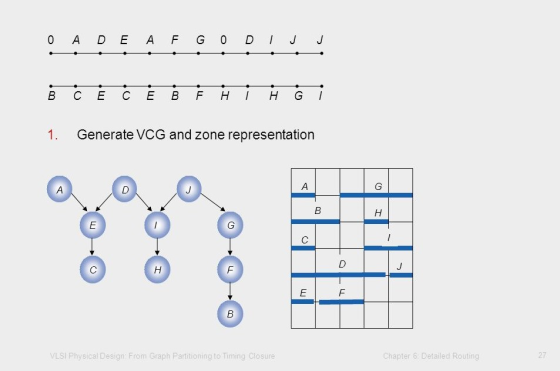
1.Vertical constraints may exist, but there are no directed cycles in the VCG
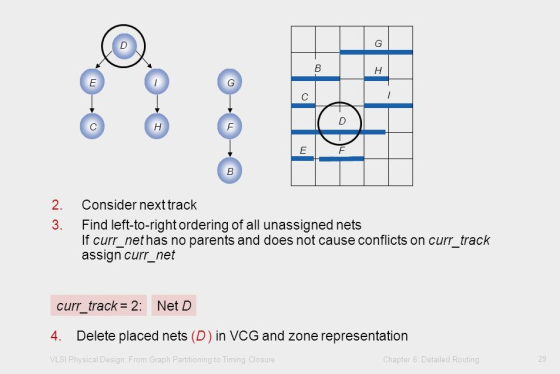
2. Select the net for routing if both the following condition are true:-
I. The x-cordinate of the leftmost terminal is the least.
II.There is no edge incident on the vertex corresponding to that net in the VCG.
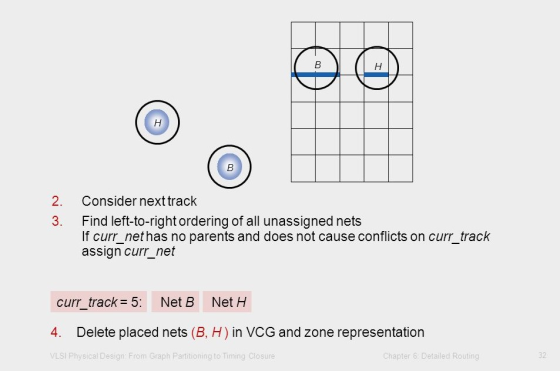
3. Afterrouting a net, the corresponding vertex and the incident edges are deleted from the VCG.
4.Other constraints are the same as the basic left edge algorithm.
Drawback of left edge algorithm-
1.The entire net is on the single track.
2. sometimes leads to routing with more tracks then necessary.
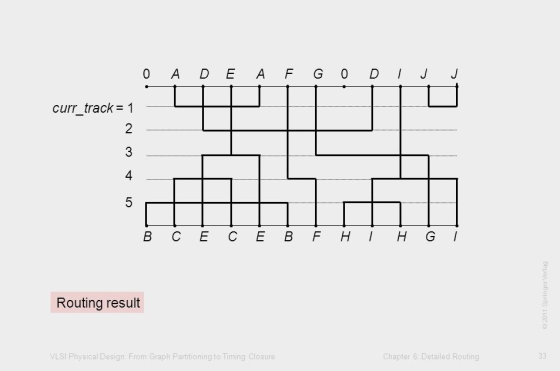
The steps wise solution of an example-
S. Sait and H. Youssef, VLSI Physical Design Automation, McGraw Hill, 1995. 3. Given the following...
 S.
Sait and H. Youssef, VLSI Physical Design Automation, McGraw Hill,
1995.
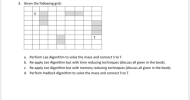
3. Given the following grid: a. Perform Lee Algorithm to solve the maze and connect S to T. b. Re-apply Lee Algorithm but with time reducing techniques (discuss all given in the book). C. Re-apply Lee Algorithm but with memory reducing techniques (discuss all given in the book). d. Perform Hadlock Algorithm to solve the maze and connect Sto T.
S.
Sait and H. Youssef, VLSI Physical Design Automation, McGraw Hill,
1995.
3. Given the following grid: a. Perform Lee Algorithm to solve the maze and connect S to T. b. Re-apply Lee Algorithm but with time reducing techniques (discuss all given in the book). C. Re-apply Lee Algorithm but with memory reducing techniques (discuss all given in the book). d. Perform Hadlock Algorithm to solve the maze and connect Sto T.
PRINCETON UNIVERSITY 12. Algorithm design. (8 points) Given an edge-weighted digraph G the bottleneck capacity of a path is the minimum weight of an edge on the path. For each part elow, give a c...
 PRINCETON UNIVERSITY 12. Algorithm design. (8 points) Given an edge-weighted digraph G the bottleneck capacity of a path is the minimum weight of an edge on the path. For each part elow, give a crisp and concise English description of your algorithm in the space provided. Your ansuer will be graded on correctness, eficieney, clarity, and conciseness (a) Given an edge-weighted digraph G, two distinguished vertices s and t, and a threshold value T, design an algorithm to find any...
Draw the layout of an XOR gate using polysilicone, metals, P/N diffusions, and contacts. VLSI design
Draw the layout of an XOR gate using polysilicone, metals, P/N diffusions, and contacts. VLSI design
need help with vlsi design good hand writing please thank you What is the difference between...
 need help with vlsi design
good hand writing please
thank you
What is the difference between the depletion mode and the enhancement mode? What do we understand by threshold voltage for the enhancement mode nMOS transistor, will it be positive or negative? Support your answer with a logical reason. (15 points)
need help with vlsi design
good hand writing please
thank you
What is the difference between the depletion mode and the enhancement mode? What do we understand by threshold voltage for the enhancement mode nMOS transistor, will it be positive or negative? Support your answer with a logical reason. (15 points)
The physical layout of a VLSI circuit is tightly linked to overall circuit performance; moreover, determining...
 The physical layout of a VLSI circuit is tightly linked to overall circuit performance; moreover, determining the wiring layout of a circuit is one of the most difficult steps in the VLSI chip design process. In particular, you are given a set of components that must be connected by wires, preferably as cheaply as possible. Obviously you will use a tree to connect up your components, but unlike the minimum spanning tree problem, you are permitted to construct or select...
Describe Hough Transform algorithm for line detection. Explain parameter space. Give the steps on the algorithm....
Describe Hough Transform algorithm for line detection. Explain parameter space. Give the steps on the algorithm. Suggest two implementations: (a) using edge point locations only, (b) using edge location and edge direction information.
1.Explain how the nearest neighbor algorithm works. 2. Explain how the backpropagation algorithm works.
1.Explain how the nearest neighbor algorithm works. 2. Explain how the backpropagation algorithm works.
Quiz# 5 & 6: Intro to VLSI Design Name: Use Cadence to find the VTC (Voltage Transfer Characteris...
 Quiz# 5 & 6: Intro to VLSI Design Name: Use Cadence to find the VTC (Voltage Transfer Characteristics) plot for a CMOS inverter to get Vout Vs Vin. From those plots find the NMi. and NMH for following two W/L ratio: 1. a. Both nMOS and pMOS transistor with same W/L: 1.5 μm /06μm b. Both nMOS and pMOS transistor with same W/L: 15 μm /0.6μm
Quiz# 5 & 6: Intro to VLSI Design Name: Use Cadence to find the...
Quiz# 5 & 6: Intro to VLSI Design Name: Use Cadence to find the VTC (Voltage Transfer Characteristics) plot for a CMOS inverter to get Vout Vs Vin. From those plots find the NMi. and NMH for following two W/L ratio: 1. a. Both nMOS and pMOS transistor with same W/L: 1.5 μm /06μm b. Both nMOS and pMOS transistor with same W/L: 15 μm /0.6μm
Quiz# 5 & 6: Intro to VLSI Design Name: Use Cadence to find the...
how is prim's algorithm and dijkstra algorithm similar explain
how is prim's algorithm and dijkstra algorithm similar explain
6. Dijkstra's Algorithm assumes that all edge weights in a given weighted directed graph G =...
 6. Dijkstra's Algorithm assumes that all edge weights in a given weighted directed graph G = (VAE) are nonnegative. However, if we apply Dijkstra's Algorithm to the graph G where the edge weights may be negative, Dijkstra's Algorithm may produce incorrect answers. Show such an example where Dijkstra's Algorithm may produce incorrect answers. Then, explain why such incorrect answers happen. (15 pts]
 S.
Sait and H. Youssef, VLSI Physical Design Automation, McGraw Hill,
1995.
3. Given the following grid: a. Perform Lee Algorithm to solve the maze and connect S to T. b. Re-apply Lee Algorithm but with time reducing techniques (discuss all given in the book). C. Re-apply Lee Algorithm but with memory reducing techniques (discuss all given in the book). d. Perform Hadlock Algorithm to solve the maze and connect Sto T.
S.
Sait and H. Youssef, VLSI Physical Design Automation, McGraw Hill,
1995.
3. Given the following grid: a. Perform Lee Algorithm to solve the maze and connect S to T. b. Re-apply Lee Algorithm but with time reducing techniques (discuss all given in the book). C. Re-apply Lee Algorithm but with memory reducing techniques (discuss all given in the book). d. Perform Hadlock Algorithm to solve the maze and connect Sto T.
 PRINCETON UNIVERSITY 12. Algorithm design. (8 points) Given an edge-weighted digraph G the bottleneck capacity of a path is the minimum weight of an edge on the path. For each part elow, give a crisp and concise English description of your algorithm in the space provided. Your ansuer will be graded on correctness, eficieney, clarity, and conciseness (a) Given an edge-weighted digraph G, two distinguished vertices s and t, and a threshold value T, design an algorithm to find any...
 need help with vlsi design
good hand writing please
thank you
What is the difference between the depletion mode and the enhancement mode? What do we understand by threshold voltage for the enhancement mode nMOS transistor, will it be positive or negative? Support your answer with a logical reason. (15 points)
need help with vlsi design
good hand writing please
thank you
What is the difference between the depletion mode and the enhancement mode? What do we understand by threshold voltage for the enhancement mode nMOS transistor, will it be positive or negative? Support your answer with a logical reason. (15 points)
 The physical layout of a VLSI circuit is tightly linked to overall circuit performance; moreover, determining the wiring layout of a circuit is one of the most difficult steps in the VLSI chip design process. In particular, you are given a set of components that must be connected by wires, preferably as cheaply as possible. Obviously you will use a tree to connect up your components, but unlike the minimum spanning tree problem, you are permitted to construct or select...
 Quiz# 5 & 6: Intro to VLSI Design Name: Use Cadence to find the VTC (Voltage Transfer Characteristics) plot for a CMOS inverter to get Vout Vs Vin. From those plots find the NMi. and NMH for following two W/L ratio: 1. a. Both nMOS and pMOS transistor with same W/L: 1.5 μm /06μm b. Both nMOS and pMOS transistor with same W/L: 15 μm /0.6μm
Quiz# 5 & 6: Intro to VLSI Design Name: Use Cadence to find the...
Quiz# 5 & 6: Intro to VLSI Design Name: Use Cadence to find the VTC (Voltage Transfer Characteristics) plot for a CMOS inverter to get Vout Vs Vin. From those plots find the NMi. and NMH for following two W/L ratio: 1. a. Both nMOS and pMOS transistor with same W/L: 1.5 μm /06μm b. Both nMOS and pMOS transistor with same W/L: 15 μm /0.6μm
Quiz# 5 & 6: Intro to VLSI Design Name: Use Cadence to find the...
 6. Dijkstra's Algorithm assumes that all edge weights in a given weighted directed graph G = (VAE) are nonnegative. However, if we apply Dijkstra's Algorithm to the graph G where the edge weights may be negative, Dijkstra's Algorithm may produce incorrect answers. Show such an example where Dijkstra's Algorithm may produce incorrect answers. Then, explain why such incorrect answers happen. (15 pts]
Most questions answered within 3 hours.
-
Where is the error in this code sequence?
String s1 = "Hello";
String s2 = "ello";...
asked 10 months ago -
Financial data for Joel de Paris, Inc., for last year
follow:
Joel de Paris, Inc.
Balance...
asked 10 months ago -
Consider this reaction:
Al2(SO4)3 (aq)+ BaCl3
(aq) Al2Cl6 (aq)- +
3BaSO4(s) . What is the...
asked 10 months ago -
Suppose that Savneet is considering increasing her
recent random sample from 20 car rentals to 40...
asked 10 months ago -
Trucks arrive at an unloading terminal at an average rate of 120
per hour.
Trucks arrive...
asked 10 months ago -
Why are methanol and ethanol completely soluble in water while
octanol is not very little soluble....
asked 10 months ago -
A facilities manager at a university reads in a research report
that the mean amount of...
asked 10 months ago -
When the CuSO4 is rehydrated by adding water to the anhydrous
compound, is this an endothermic...
asked 10 months ago -
A ray of sunlight is passing from diamond into crown glass; the
angle of incidence is...
asked 10 months ago -
A block of mass 0.249 kg is placed on top of a light, vertical
spring of...
asked 10 months ago -
how do the kidneys compensate in the presences of acidosis
a) trigger hyperventilate
b) reserve acid...
asked 10 months ago -
Question 501 pts
The rental rate of capital to the firm increases. Which of the
following...
asked 10 months ago