To calculate the adjusted present value, one will: divide the project's cash flow by the risk-adjusted...
To calculate the adjusted present value, one will:
divide the project's cash flow by the risk-adjusted rate.
multiply the additional effects by the all equity project value.
divide the project's cash flow by the risk-free rate.
add the risk-free rate to the market portfolio when B equals 1.
add the additional effects of financing to the all equity project value.
Homework Answers
Adjusted present value = Present value without considering the effect of debt + Present value of saving due to financing
To calculate the adjusted present value, one will:
add the additional effects of financing to the all equity project value.
Add Answer to:
To calculate the adjusted present value, one will:
divide the project's cash flow by the risk-adjusted...
Calculate the present value of a growing perpetuity with the first cash flow (occurring in one...
Calculate the present value of a growing perpetuity with the first cash flow (occurring in one year) being $10 million and every subsequent year’s cash flow growing at a constant 6% rate (i.e, the cash flow at the end of two years is $10M(1.06) = $10.6 million, the cash flow at the end of three years is 10M(1.06)^2 = $11.236 million, etc.). The cost of capital for this calculation is 12%. The firm has to spend $50 million immediately and...
Consider a project with free cash flow in one year of $138,445 or $189,120, with either outcome being equally likely. The initial investment required for the project is $95,000, and the project's cost of capital is 25%. The risk-free interest rate is 7%.
Consider a project with free cash flow in one year of $138,445 or $189,120, with either outcome being equally likely. The initial investment required for the project is $95,000, and the project's cost of capital is 25%. The risk-free interest rate is 7%. (Assume no taxes or distresscosts.) a. What is the NPV of this project?b. Suppose that to raise the funds for the initial investment, the project is sold to investors as an all-equity firm. The equity holders will receive the cash flows of the project in one year. How much money can be raised...
Consider a project with free cash flow in one year of $130,000 in a weak market...
 Consider a project with free cash flow in one year of $130,000 in a weak market or $180,000 in a strong market, with each outcome being equally likely. The initial investment required for the project is $100,000, and the project's unlevered cost of capital is 20%. The risk-free interest rate is 10%. (Assume no taxes or distress costs.) a. What is the NPV of this project? b. Suppose that to raise the funds for the initial investment, the project is...
Consider a project with free cash flow in one year of $130,000 in a weak market...
 Consider a project with free cash flow in one year of $130,000 in a weak market or $180,000 in a strong market, with each outcome being equally likely. The initial investment required for the project is $100,000, and the project's unlevered cost of capital is 20%. The risk-free interest rate is 10%. (Assume no taxes or distress costs. a. What is the NPV of this project? b. Suppose that to raise the funds for the initial investment, the project is...
Consider a project with free cash flow in one year of $131,129 or $198,043, with each...
 Consider a project with free cash flow in one year of $131,129 or $198,043, with each outcome being equally likely. The initial investment required for the project is $80,000, and the project's unlevered cost of capital is 16%. The risk-free interest rate is 6%. (Assume no taxes or distress costs.) a. What is the NPV of this project? b. Suppose that to raise the funds for the initial investment, the project is sold to investors as an all-equity firm. The...
Consider a project with free cash flow in one year of $145,930 or $160,062, with either...
 Consider a project with free cash flow in one year of $145,930 or $160,062, with either outcome being equally likely. The initial investment required for the project is $105,000, and the project's cost of capital is 20%. The risk-free interest rate is 6%. (Assume no taxes or distress costs.) a. What is the NPV of this project? b. Suppose that to raise the funds for the initial investment, the project is sold to investors as an all-equity firm. The equity...
3. Which one of the following statements is TRUE about a project's net present value? A....
3. Which one of the following statements is TRUE about a project's net present value? A. When choosing between projects, a company should take on the project with the lowest net present value B. When deciding to accept or reject a project, a company should reject the project if its net present value is positive C. A project's net present value provides the payback period of an investment B. When deciding to accept or reject a project, the project's net...
6. From the information below: Determine each project's risk adjusted net present value. Project A (10,000)...
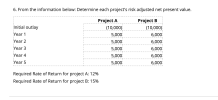 6. From the information below: Determine each project's risk adjusted net present value. Project A (10,000) 5,000 5,000 5,000 5,000 - -- - - - - Initial outlay Year 1 Year 2 Year 3 Year 4 - Project B (10,000) 6,000 6,000 6,000 6,000 6,000 - - Year 5 5,000 Required Rate of Return for project A: 12% Required Rate of Return for project B: 15%
I need to find the risk-adjusted present value for Project E, F, and G. Please show the work in E...
 I need to find the risk-adjusted present value for Project E, F,
and G. Please show the work in Excel.
Risk adjusted discount rates -Basic Country Wallpapers s considering investing in one of three mutually exclusive projects, E F and G The firm's cost of capita r is 14.9%, and the risk-free rate, RF S 9.9%. The firm a. Find the net present value (NPV) of each project using the firm's cost of capital. Which project is preferred in this...
I need to find the risk-adjusted present value for Project E, F,
and G. Please show the work in Excel.
Risk adjusted discount rates -Basic Country Wallpapers s considering investing in one of three mutually exclusive projects, E F and G The firm's cost of capita r is 14.9%, and the risk-free rate, RF S 9.9%. The firm a. Find the net present value (NPV) of each project using the firm's cost of capital. Which project is preferred in this...
Consider a project with a free cash flows in one year of 149,546 or 179,003, with...
Consider a project with a free cash flows in one year of 149,546 or 179,003, with each of outcome being equally likely, the initial investment required for the project is 93,227 and the project's cost of capital is 17%, the risk-free interest rate is 7%. e funds f A) What is the NVP of this project B) Suppose that to raise the funds for the initial investment the project is sold to investors as an all-equity firm. The equity holders...
 Consider a project with free cash flow in one year of $130,000 in a weak market or $180,000 in a strong market, with each outcome being equally likely. The initial investment required for the project is $100,000, and the project's unlevered cost of capital is 20%. The risk-free interest rate is 10%. (Assume no taxes or distress costs.) a. What is the NPV of this project? b. Suppose that to raise the funds for the initial investment, the project is...
 Consider a project with free cash flow in one year of $130,000 in a weak market or $180,000 in a strong market, with each outcome being equally likely. The initial investment required for the project is $100,000, and the project's unlevered cost of capital is 20%. The risk-free interest rate is 10%. (Assume no taxes or distress costs. a. What is the NPV of this project? b. Suppose that to raise the funds for the initial investment, the project is...
 Consider a project with free cash flow in one year of $131,129 or $198,043, with each outcome being equally likely. The initial investment required for the project is $80,000, and the project's unlevered cost of capital is 16%. The risk-free interest rate is 6%. (Assume no taxes or distress costs.) a. What is the NPV of this project? b. Suppose that to raise the funds for the initial investment, the project is sold to investors as an all-equity firm. The...
 Consider a project with free cash flow in one year of $145,930 or $160,062, with either outcome being equally likely. The initial investment required for the project is $105,000, and the project's cost of capital is 20%. The risk-free interest rate is 6%. (Assume no taxes or distress costs.) a. What is the NPV of this project? b. Suppose that to raise the funds for the initial investment, the project is sold to investors as an all-equity firm. The equity...
 6. From the information below: Determine each project's risk adjusted net present value. Project A (10,000) 5,000 5,000 5,000 5,000 - -- - - - - Initial outlay Year 1 Year 2 Year 3 Year 4 - Project B (10,000) 6,000 6,000 6,000 6,000 6,000 - - Year 5 5,000 Required Rate of Return for project A: 12% Required Rate of Return for project B: 15%
 I need to find the risk-adjusted present value for Project E, F,
and G. Please show the work in Excel.
Risk adjusted discount rates -Basic Country Wallpapers s considering investing in one of three mutually exclusive projects, E F and G The firm's cost of capita r is 14.9%, and the risk-free rate, RF S 9.9%. The firm a. Find the net present value (NPV) of each project using the firm's cost of capital. Which project is preferred in this...
I need to find the risk-adjusted present value for Project E, F,
and G. Please show the work in Excel.
Risk adjusted discount rates -Basic Country Wallpapers s considering investing in one of three mutually exclusive projects, E F and G The firm's cost of capita r is 14.9%, and the risk-free rate, RF S 9.9%. The firm a. Find the net present value (NPV) of each project using the firm's cost of capital. Which project is preferred in this...
Most questions answered within 3 hours.
-
Where is the error in this code sequence?
String s1 = "Hello";
String s2 = "ello";...
asked 10 months ago -
Financial data for Joel de Paris, Inc., for last year
follow:
Joel de Paris, Inc.
Balance...
asked 10 months ago -
Consider this reaction:
Al2(SO4)3 (aq)+ BaCl3
(aq) Al2Cl6 (aq)- +
3BaSO4(s) . What is the...
asked 10 months ago -
Suppose that Savneet is considering increasing her
recent random sample from 20 car rentals to 40...
asked 10 months ago -
Trucks arrive at an unloading terminal at an average rate of 120
per hour.
Trucks arrive...
asked 10 months ago -
Why are methanol and ethanol completely soluble in water while
octanol is not very little soluble....
asked 10 months ago -
A facilities manager at a university reads in a research report
that the mean amount of...
asked 10 months ago -
When the CuSO4 is rehydrated by adding water to the anhydrous
compound, is this an endothermic...
asked 10 months ago -
A ray of sunlight is passing from diamond into crown glass; the
angle of incidence is...
asked 10 months ago -
A block of mass 0.249 kg is placed on top of a light, vertical
spring of...
asked 10 months ago -
how do the kidneys compensate in the presences of acidosis
a) trigger hyperventilate
b) reserve acid...
asked 10 months ago -
Question 501 pts
The rental rate of capital to the firm increases. Which of the
following...
asked 10 months ago