1)The all-cis isomer of 1,2,3,4,5,6-hexafluorocyclohexane (for example, all six fluorines on the same face of the...
1)The all-cis isomer of 1,2,3,4,5,6-hexafluorocyclohexane (for example, all six fluorines on the same face of the molecule) is one of the most polar non-ionic compounds known. explain why this is the case using chair structure to illustrate.
2) based on the above answer, what would happen to the polarity of the molecule if all the fluorines were on alternating faces (example, 1,3,5 on top face and 2,4,6 on the bottom face)?
Homework Answers
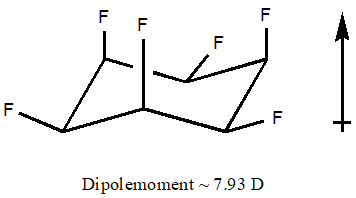
1. All cis isomer of 1,2,3,4,5,6-hexafluorocyclohexane is polar molecule having dipole moment ~ 7.93 D. All the polar C-F bonds are in same direction due to which the resultant dipole vector is in the upward direct making the molecule highly polar.
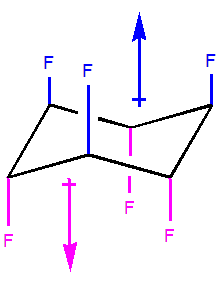
2. However, the other isomer of the above molecule where all the F atoms occupy axial position is considered to be non polar since the corresponding resultant vectors are opposite to each other.
Add Answer to:
1)The all-cis isomer of 1,2,3,4,5,6-hexafluorocyclohexane (for
example, all six fluorines on the same face of the...
1. The most polar non-aromatic organic compound ever prepared is an isomer of 1,2,3,4,5,6- hexafluorocyclohexane. It...
1. The most polar non-aromatic organic compound ever prepared is an isomer of 1,2,3,4,5,6- hexafluorocyclohexane. It has an all-cis arrangement of fluorine atoms. a. Draw the line-bond structure for this compound b. Convert the line bond structure to a chair conformation, then draw its flipped chair. c. Is there a preferred conformation? Why or why not? d. Why is this molecule so polar? Use dipole moment arrows to explain.
4-chloro-3, 4-dimethylnonan-1-amine Assignment 3: Chiral Carbons and Stereoisomers On a page titled Chiral Carbons...
 4-chloro-3, 4-dimethylnonan-1-amine
Assignment 3: Chiral Carbons and Stereoisomers On a page titled Chiral Carbons draw using a chemical drawing program or other computer generated form the expanded structure of your molecule. No hand drawn structures will be accepted. O Determine if your molecule contains any chiral carbons. If there are chiral carbons in your molecule, circle or highlight all of them. If your molecule does not contain any chiral carbons explain why none of the carbons are chiral. One a...
4-chloro-3, 4-dimethylnonan-1-amine
Assignment 3: Chiral Carbons and Stereoisomers On a page titled Chiral Carbons draw using a chemical drawing program or other computer generated form the expanded structure of your molecule. No hand drawn structures will be accepted. O Determine if your molecule contains any chiral carbons. If there are chiral carbons in your molecule, circle or highlight all of them. If your molecule does not contain any chiral carbons explain why none of the carbons are chiral. One a...
2-methylocta-4,6-dien-1-amine Assignment 1: Draw your molecule from IUPAC name
 2-methylocta-4,6-dien-1-amineAssignment 1: Draw your molecule from IUPAC
name Using the given IUPAC name, draw your molecule Complete the cover page (p.1) of your portfolio with the
following:o Structural formula of the moleculeo IUPAC name Use a thin, clear binder or report cover to protect the
portfolio Submit the following in the binder:o Cover page as described above (page 1)Assignment 2: Formula, Molar Mass and Functional
Groups On a page titled Expanded Structural Formula draw the expanded
structure of themolecule.o Show...
2-methylocta-4,6-dien-1-amineAssignment 1: Draw your molecule from IUPAC
name Using the given IUPAC name, draw your molecule Complete the cover page (p.1) of your portfolio with the
following:o Structural formula of the moleculeo IUPAC name Use a thin, clear binder or report cover to protect the
portfolio Submit the following in the binder:o Cover page as described above (page 1)Assignment 2: Formula, Molar Mass and Functional
Groups On a page titled Expanded Structural Formula draw the expanded
structure of themolecule.o Show...
What would be my percent yield if i retrieved 3.1020 grams of soap? thank you, please show all work.
 what would be my percent yield if i retrieved 3.1020 grams of
soap? thank you, please show all work.
SAPONIFICATION (HYDROLYSIS OF A FAD Fats and edible oils consitute a special class of esters called riglycerides in which alcohol part of the molecule, the trihydroxy compound glycerol, forms with three molecules of various long-chain carboxylic acids (called fatty acids). Ty reactions of simple esters can also be carried out on fats and oils,i acid-or-base-catalyzed hydrolysis. three ester linkages carboxylic acids...
what would be my percent yield if i retrieved 3.1020 grams of
soap? thank you, please show all work.
SAPONIFICATION (HYDROLYSIS OF A FAD Fats and edible oils consitute a special class of esters called riglycerides in which alcohol part of the molecule, the trihydroxy compound glycerol, forms with three molecules of various long-chain carboxylic acids (called fatty acids). Ty reactions of simple esters can also be carried out on fats and oils,i acid-or-base-catalyzed hydrolysis. three ester linkages carboxylic acids...
What are the instruments that have been utilized for the review article discussions? ` 1. Introduction...
 What are the instruments that have been utilized for the
review article discussions?
`
1. Introduction In recent years, nanoclays have been the object of particular interest for many scientists and researchers in chemistry, physics, engineering and biology due to their excellent properties as well as their sustain- ability [1-3]. For instance, they represent the starting point to the de velopment of smart materials for drug delivery (4-9), food packaging [10-12), environmental remediation and wastewater treatment [13], cultural heritage [14–17and...
What are the instruments that have been utilized for the
review article discussions?
`
1. Introduction In recent years, nanoclays have been the object of particular interest for many scientists and researchers in chemistry, physics, engineering and biology due to their excellent properties as well as their sustain- ability [1-3]. For instance, they represent the starting point to the de velopment of smart materials for drug delivery (4-9), food packaging [10-12), environmental remediation and wastewater treatment [13], cultural heritage [14–17and...
 4-chloro-3, 4-dimethylnonan-1-amine
Assignment 3: Chiral Carbons and Stereoisomers On a page titled Chiral Carbons draw using a chemical drawing program or other computer generated form the expanded structure of your molecule. No hand drawn structures will be accepted. O Determine if your molecule contains any chiral carbons. If there are chiral carbons in your molecule, circle or highlight all of them. If your molecule does not contain any chiral carbons explain why none of the carbons are chiral. One a...
4-chloro-3, 4-dimethylnonan-1-amine
Assignment 3: Chiral Carbons and Stereoisomers On a page titled Chiral Carbons draw using a chemical drawing program or other computer generated form the expanded structure of your molecule. No hand drawn structures will be accepted. O Determine if your molecule contains any chiral carbons. If there are chiral carbons in your molecule, circle or highlight all of them. If your molecule does not contain any chiral carbons explain why none of the carbons are chiral. One a...
 2-methylocta-4,6-dien-1-amineAssignment 1: Draw your molecule from IUPAC
name Using the given IUPAC name, draw your molecule Complete the cover page (p.1) of your portfolio with the
following:o Structural formula of the moleculeo IUPAC name Use a thin, clear binder or report cover to protect the
portfolio Submit the following in the binder:o Cover page as described above (page 1)Assignment 2: Formula, Molar Mass and Functional
Groups On a page titled Expanded Structural Formula draw the expanded
structure of themolecule.o Show...
2-methylocta-4,6-dien-1-amineAssignment 1: Draw your molecule from IUPAC
name Using the given IUPAC name, draw your molecule Complete the cover page (p.1) of your portfolio with the
following:o Structural formula of the moleculeo IUPAC name Use a thin, clear binder or report cover to protect the
portfolio Submit the following in the binder:o Cover page as described above (page 1)Assignment 2: Formula, Molar Mass and Functional
Groups On a page titled Expanded Structural Formula draw the expanded
structure of themolecule.o Show...
 what would be my percent yield if i retrieved 3.1020 grams of
soap? thank you, please show all work.
SAPONIFICATION (HYDROLYSIS OF A FAD Fats and edible oils consitute a special class of esters called riglycerides in which alcohol part of the molecule, the trihydroxy compound glycerol, forms with three molecules of various long-chain carboxylic acids (called fatty acids). Ty reactions of simple esters can also be carried out on fats and oils,i acid-or-base-catalyzed hydrolysis. three ester linkages carboxylic acids...
what would be my percent yield if i retrieved 3.1020 grams of
soap? thank you, please show all work.
SAPONIFICATION (HYDROLYSIS OF A FAD Fats and edible oils consitute a special class of esters called riglycerides in which alcohol part of the molecule, the trihydroxy compound glycerol, forms with three molecules of various long-chain carboxylic acids (called fatty acids). Ty reactions of simple esters can also be carried out on fats and oils,i acid-or-base-catalyzed hydrolysis. three ester linkages carboxylic acids...
 What are the instruments that have been utilized for the
review article discussions?
`
1. Introduction In recent years, nanoclays have been the object of particular interest for many scientists and researchers in chemistry, physics, engineering and biology due to their excellent properties as well as their sustain- ability [1-3]. For instance, they represent the starting point to the de velopment of smart materials for drug delivery (4-9), food packaging [10-12), environmental remediation and wastewater treatment [13], cultural heritage [14–17and...
What are the instruments that have been utilized for the
review article discussions?
`
1. Introduction In recent years, nanoclays have been the object of particular interest for many scientists and researchers in chemistry, physics, engineering and biology due to their excellent properties as well as their sustain- ability [1-3]. For instance, they represent the starting point to the de velopment of smart materials for drug delivery (4-9), food packaging [10-12), environmental remediation and wastewater treatment [13], cultural heritage [14–17and...
Most questions answered within 3 hours.
-
Where is the error in this code sequence?
String s1 = "Hello";
String s2 = "ello";...
asked 11 months ago -
Financial data for Joel de Paris, Inc., for last year
follow:
Joel de Paris, Inc.
Balance...
asked 11 months ago -
Consider this reaction:
Al2(SO4)3 (aq)+ BaCl3
(aq) Al2Cl6 (aq)- +
3BaSO4(s) . What is the...
asked 11 months ago -
Suppose that Savneet is considering increasing her
recent random sample from 20 car rentals to 40...
asked 11 months ago -
Trucks arrive at an unloading terminal at an average rate of 120
per hour.
Trucks arrive...
asked 11 months ago -
Why are methanol and ethanol completely soluble in water while
octanol is not very little soluble....
asked 11 months ago -
A facilities manager at a university reads in a research report
that the mean amount of...
asked 11 months ago -
When the CuSO4 is rehydrated by adding water to the anhydrous
compound, is this an endothermic...
asked 11 months ago -
A ray of sunlight is passing from diamond into crown glass; the
angle of incidence is...
asked 11 months ago -
A block of mass 0.249 kg is placed on top of a light, vertical
spring of...
asked 11 months ago -
how do the kidneys compensate in the presences of acidosis
a) trigger hyperventilate
b) reserve acid...
asked 11 months ago -
Question 501 pts
The rental rate of capital to the firm increases. Which of the
following...
asked 11 months ago