PTC is a substance that has a strong bitter tatse for some people and is tasteless...
PTC is a substance that has a strong bitter tatse for some people and is tasteless for others. The ability to taste PTC is inherited. About 77% of people from a certain country can taste PTC, for example. You want to estimate the proportion of people with at least one grandparent from this country who can taste PTC. (round your answer to the nearest person).
(a) Starting with the 77% estimate, how large a sample must you collect in order to estimate the proportion of PTC tasters within plus or minus 0.01 with 90% confidence?
(b) Estimate the sample size required if you made no assumptions about the value of the proportion who could taste PTC.
(c) How much has the required sample size changed? Decreased or increased by more or less than a hundred or no change
Homework Answers
Ans:
a)Prior estimate=0.77
Margin of error=0.01
z=1.645
Sample size required,n=1.645^2*0.77*(1-0.77)/0.01^2=4792
b)
When no prior estimate,then p=0.5
Sample size required,n=1.645^2*0.5*(1-0.5)/0.01^2=6765
c)
Increased by more than a hundred
Add Answer to:
PTC is a substance that has a strong bitter tatse for some
people and is tasteless...
PTC is a substance that has a strong bitter taste for some people and is tasteless...
PTC is a substance that has a strong bitter taste for some people and is tasteless for others. The ability to taste PTC is inherited. About 75% of Italians can taste PTC, for example. You want to estimate the proportion of Americans with at least one Italian grandparent who can taste PTC. Starting with the 75% estimate for Italians, how large a sample must you collect in order to estimate the proportion of PTC tasters within ±0.06 with 90 %...
PTC is a substance that has a strong bitter taste for some people and is tasteless...
PTC is a substance that has a strong bitter taste for some people and is tasteless for others. The ability to taste PTC is inherited. About 75% of Italians can taste PTC, for example. You want to estimate the proportion of Americans with at least one Italian grandparent who can taste PTC. Starting with the 75% estimate for Italians, how large a sample must you collect in order to estimate the proportion of PTC tasters within ±0.04 with 98 %...
6. About 70% of Americans get a bitter taste from the substance called phenylthiocarbamide (PTC). It...
6. About 70% of Americans get a bitter taste from the substance called phenylthiocarbamide (PTC). It is tasteless to the rest. The "taster" allele is dominant to non-taster. Also, normal skin pigmentation is dominant to albino. A normally pigmented woman who is taste-blind for PTC has an albino-taster father. She marries an albino man who is a taster, though the man's mother is a non-taster. 1 pt A. What are the genotypes of the woman and man? B. What phenotypes...
Phenylthiocarbamide (PTC) is an organosulfur thiourea that has an excessively bitter taste to some individuals and...
Phenylthiocarbamide (PTC) is an organosulfur thiourea that has an excessively bitter taste to some individuals and is virtually tasteless to others. This taste response is due to a single gene, where the tasting allele (T) is dominant to the non-tasting allele (t). a. If two tasters that are both heterozygous at the tasting locus have 6 children, what is the probability that they are: non-taster, non-taster, taster, taster, taster and taster in that exact order? b. What is the probability...
The compound phenylthiocarbamide (PTC) tastes very bitter to most people. The inability to taste PTC is...
The compound phenylthiocarbamide (PTC) tastes very bitter to most people. The inability to taste PTC is controlled by a single autosomal recessive allele. In the American white population, about 70% can taste PTC while 30% cannot (are non-tasters). Estimate the frequencies of the Taster (T) and non-taster (t) alleles in this population. How common are carriers (those carrying the allele, but not displaying the phenotype) of the non-taster allele? What assumption did you make to carry out your calculations how...
3. Can you find any pattern related to PTC tasters vs. nontasters? You will have to...
3. Can you find any pattern related to PTC tasters vs. nontasters? You will have to “interview” other members of the class to get information. (For example, do tasters appear to be predominantly male or female? Is taste perception of PTC correlated with PROP or SB? Do PTC tasters like bitter foods more less? Etc.) 4. Would people who are strong tasters of PTC and/or PROP be likely to find beer particularly bitter or not? Explain your conclusion. 5. A...
(3) Some people can taste the bitter compound phenylthiocarbamide while others cannot. This trait is governed...
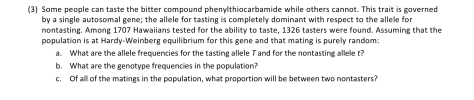 (3) Some people can taste the bitter compound phenylthiocarbamide while others cannot. This trait is governed by a single autosomal gene; the allele for tasting is completely dominant with respect to the allele for nontasting. Among 1707 Hawaiians tested for the ability to taste, 1326 tasters were found. Assuming that the population is at Hardy-Weinberg equilibrium for this gene and that mating is purely random: a. What are the allele frequencies for the tasting allele T and for the nontasting...
Cilantro tastes like soap to some people. This soap taste is inherited through the olfactory receptor...
Cilantro tastes like soap to some people. This soap taste is inherited through the olfactory receptor gene OR6A2. About 14% of the population has this gene. You want to estimate the proportion of Americans who have this gene. How large a sample must you test, with a 3% margin of error and 95% confidence, to estimate the proportion of people who carry the OR6A2 gene
In spite of the potential safety hazards, some people would like to have an Internet connection...
In spite of the potential safety hazards, some people would like to have an Internet connection in their car. A preliminary survey of adult Americans has estimated this proportion to be somewhere around 0.30. Use the given preliminary estimate to determine the sample size required to estimate the proportion of adult Americans who would like an Internet connection in their car to within 0.02 with 90% confidence.
You have been given the task of organizing a poll regarding an upcoming election. The object...
 You have been given the task of organizing a poll regarding an upcoming election. The object is to estimate the proportion of the country that will vote to keep the current government in power. You have been told to collect a sample and find a 95% confidence interval for the proportion. This interval is allowed to have a margin of error of 4%. A preliminary investigation suggests that the proportion of people that will vote to keep the current government...
 (3) Some people can taste the bitter compound phenylthiocarbamide while others cannot. This trait is governed by a single autosomal gene; the allele for tasting is completely dominant with respect to the allele for nontasting. Among 1707 Hawaiians tested for the ability to taste, 1326 tasters were found. Assuming that the population is at Hardy-Weinberg equilibrium for this gene and that mating is purely random: a. What are the allele frequencies for the tasting allele T and for the nontasting...
 You have been given the task of organizing a poll regarding an upcoming election. The object is to estimate the proportion of the country that will vote to keep the current government in power. You have been told to collect a sample and find a 95% confidence interval for the proportion. This interval is allowed to have a margin of error of 4%. A preliminary investigation suggests that the proportion of people that will vote to keep the current government...
Most questions answered within 3 hours.
-
Where is the error in this code sequence?
String s1 = "Hello";
String s2 = "ello";...
asked 10 months ago -
Financial data for Joel de Paris, Inc., for last year
follow:
Joel de Paris, Inc.
Balance...
asked 10 months ago -
Consider this reaction:
Al2(SO4)3 (aq)+ BaCl3
(aq) Al2Cl6 (aq)- +
3BaSO4(s) . What is the...
asked 10 months ago -
Suppose that Savneet is considering increasing her
recent random sample from 20 car rentals to 40...
asked 10 months ago -
Trucks arrive at an unloading terminal at an average rate of 120
per hour.
Trucks arrive...
asked 10 months ago -
Why are methanol and ethanol completely soluble in water while
octanol is not very little soluble....
asked 10 months ago -
A facilities manager at a university reads in a research report
that the mean amount of...
asked 10 months ago -
When the CuSO4 is rehydrated by adding water to the anhydrous
compound, is this an endothermic...
asked 10 months ago -
A ray of sunlight is passing from diamond into crown glass; the
angle of incidence is...
asked 10 months ago -
A block of mass 0.249 kg is placed on top of a light, vertical
spring of...
asked 10 months ago -
how do the kidneys compensate in the presences of acidosis
a) trigger hyperventilate
b) reserve acid...
asked 10 months ago -
Question 501 pts
The rental rate of capital to the firm increases. Which of the
following...
asked 10 months ago