Consider 15 mL of an aqueous solution containing 2.0 g of an organic solute.If the distribution...
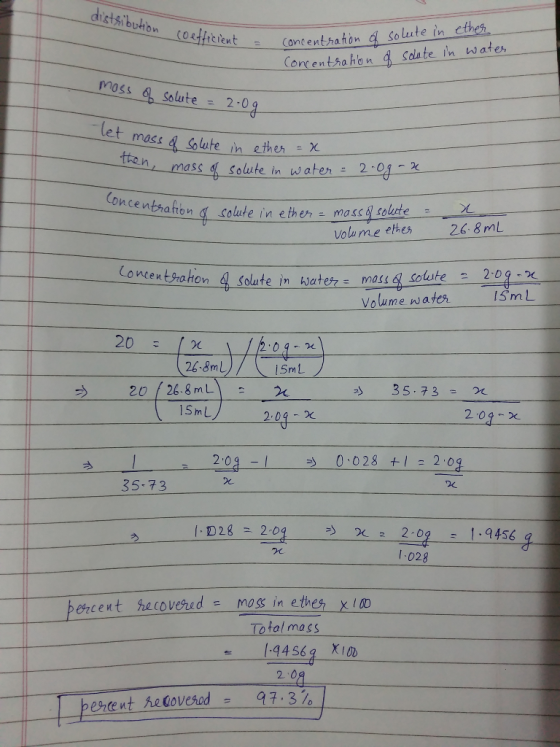
Consider 15 mL of an aqueous solution containing 2.0 g of an organic solute.If the distribution coefficient for the solute between ether and water is 20, calculate the percent of the compound that can be recovered with a single extraction with 26.8 mL of ether. (2 sig figs)
Homework Answers
The percent of the compound that can be recovered with a single extraction = 97 %
Add Answer to:
Consider 15 mL of an aqueous solution containing 2.0 g of an
organic solute.If the distribution...
A solution containing 105 mg of compound C in 1.0 mL of water is to be extracted with CH2Cl2. The distribution coefficie...
 A solution containing 105 mg of compound C in 1.0 mL of water is
to be extracted with CH2Cl2. The distribution coefficient
of C between CH2Cl2 and water is 1.5. Note that compound C is more
soluble in CH2Cl2.
Part 4: Total amount of compound C removed from the aqueous
solution after three 0.70 mL extractions with CH2Cl2.
In Asolution containing 105 mg of compound C in 1.0 mL of water is to be extracted with CH2C12. The distribution coefficient...
A solution containing 105 mg of compound C in 1.0 mL of water is
to be extracted with CH2Cl2. The distribution coefficient
of C between CH2Cl2 and water is 1.5. Note that compound C is more
soluble in CH2Cl2.
Part 4: Total amount of compound C removed from the aqueous
solution after three 0.70 mL extractions with CH2Cl2.
In Asolution containing 105 mg of compound C in 1.0 mL of water is to be extracted with CH2C12. The distribution coefficient...
5) A 100.0 mL aqueous solution containing 2.50 g of compound Z results is extracted with...
 5) A 100.0 mL aqueous solution containing 2.50 g of compound Z results is extracted with 25.0 mL of ethyl acetate. The ethyl acetate is evaporated to yield 0.95 g of compound Z. 4 points Calculate the partition coefficient (also known as the distribution coefficient) K, for compound Z in ethyl acetate and water, where K = (concentration of Z in diethyl ether) + (concentration of Z in water): Calculations Answer
An aqueous solution containing 5.00 g of solute X in 100. mL is extracted five times...
An aqueous solution containing 5.00 g of solute X in 100. mL is extracted five times with 25.0 mL portions of organic solvent A each. What is the total amount of solute X that will be extracted by the solvent A. Given Ksolvent A/water = 3.75
Extractions rely on differences in solubility of the components that are being separated
 Extractions rely on differences in solubility of the components that are being separated. The amount of a material that will transfer into the solvent in an extraction can be calculated using a partition coefficient. This is a ratio of the solubility of the material in each solvent that can be used to predict outcomes of extractions. A certain organic compound, Z, has the distribution coefficient (partition coefficient), Kp = 10.45 when partitioned between ether and water. Therefore, the equation used...
The extraction of 8.0 g of a particular organic compound dissolved in 100 ml of water...
The extraction of 8.0 g of a particular organic compound dissolved in 100 ml of water into diethyl ether proceeds with a distribution coefficient of 5. How much of the compound is extracted after three separate extractions using 50 ml of diethyl ether each time? ***Please show work as I am not 100% sure how to solve for X**** Thank you!
Assume an organic compound has a partition coefficient between water and ether equal to 8.48. If...
Assume an organic compound has a partition coefficient between water and ether equal to 8.48. If there are initially 7.52 grams of the compound dissolved in 70.0 mL of water, how many grams will remain in the aqueous layer after extraction with two 25.0 mL portions of ether? Mass: ________ g
Using 10 mL of an organic solvent to extract a solute A from 20 mL of...
Using 10 mL of an organic solvent to extract a solute A from 20 mL of an aqueous solution and assuming the distribution ratio D is 60, calculate the efficiency of extraction E .
2) The distribution coefficient between methylene chloride and water for solute Y is 9. An amount...
2) The distribution coefficient between methylene chloride and water for solute Y is 9. An amount of 107.0 g of Y is dissolved in 150 mL of water. a) What weight of Y would be removed from water with a single extraction with 150-mL of methylene chloride? Report to 1 decimal place. b) What weight of Y would be removed from water (the original solution) with twosuccessive extractions with 75-mLportions each of methylene chloride? Report to 1 decimal place. 3)...
An aqueous solution containing 7.17 g of an optically pure compound was diluted to 300.0 mL...
 An aqueous solution containing 7.17 g of an optically pure
compound was diluted to 300.0 mL with water and placed in a
polarimeter tube 15.0 cm long. The measured rotation was –2.15° at
25 °C. Calculate the specific rotation of the compound. The
specific reoation equation is determined by the equation:
An aqueous solution containing 7.17 g of an optically pure compound was diluted to 300.0 mL with water and placed in a polarimeter tube 15.0 cm long. The measured...
An aqueous solution containing 7.17 g of an optically pure
compound was diluted to 300.0 mL with water and placed in a
polarimeter tube 15.0 cm long. The measured rotation was –2.15° at
25 °C. Calculate the specific rotation of the compound. The
specific reoation equation is determined by the equation:
An aqueous solution containing 7.17 g of an optically pure compound was diluted to 300.0 mL with water and placed in a polarimeter tube 15.0 cm long. The measured...
Question 22 of 22 > Attempt 3 Assume an organic compound has a partition coefficient between...
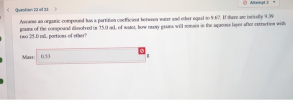 Question 22 of 22 > Attempt 3 Assume an organic compound has a partition coefficient between water and ether equal to 9.67. If there are initially 9.39 grams of the compound dissolved in 75.0 mL of water, how many grams will remain in the aqueous layer after extraction with two 25.0 mL portions of ether? Mass: 0,53
 A solution containing 105 mg of compound C in 1.0 mL of water is
to be extracted with CH2Cl2. The distribution coefficient
of C between CH2Cl2 and water is 1.5. Note that compound C is more
soluble in CH2Cl2.
Part 4: Total amount of compound C removed from the aqueous
solution after three 0.70 mL extractions with CH2Cl2.
In Asolution containing 105 mg of compound C in 1.0 mL of water is to be extracted with CH2C12. The distribution coefficient...
A solution containing 105 mg of compound C in 1.0 mL of water is
to be extracted with CH2Cl2. The distribution coefficient
of C between CH2Cl2 and water is 1.5. Note that compound C is more
soluble in CH2Cl2.
Part 4: Total amount of compound C removed from the aqueous
solution after three 0.70 mL extractions with CH2Cl2.
In Asolution containing 105 mg of compound C in 1.0 mL of water is to be extracted with CH2C12. The distribution coefficient...
 5) A 100.0 mL aqueous solution containing 2.50 g of compound Z results is extracted with 25.0 mL of ethyl acetate. The ethyl acetate is evaporated to yield 0.95 g of compound Z. 4 points Calculate the partition coefficient (also known as the distribution coefficient) K, for compound Z in ethyl acetate and water, where K = (concentration of Z in diethyl ether) + (concentration of Z in water): Calculations Answer
 An aqueous solution containing 7.17 g of an optically pure
compound was diluted to 300.0 mL with water and placed in a
polarimeter tube 15.0 cm long. The measured rotation was –2.15° at
25 °C. Calculate the specific rotation of the compound. The
specific reoation equation is determined by the equation:
An aqueous solution containing 7.17 g of an optically pure compound was diluted to 300.0 mL with water and placed in a polarimeter tube 15.0 cm long. The measured...
An aqueous solution containing 7.17 g of an optically pure
compound was diluted to 300.0 mL with water and placed in a
polarimeter tube 15.0 cm long. The measured rotation was –2.15° at
25 °C. Calculate the specific rotation of the compound. The
specific reoation equation is determined by the equation:
An aqueous solution containing 7.17 g of an optically pure compound was diluted to 300.0 mL with water and placed in a polarimeter tube 15.0 cm long. The measured...
 Question 22 of 22 > Attempt 3 Assume an organic compound has a partition coefficient between water and ether equal to 9.67. If there are initially 9.39 grams of the compound dissolved in 75.0 mL of water, how many grams will remain in the aqueous layer after extraction with two 25.0 mL portions of ether? Mass: 0,53
Most questions answered within 3 hours.
-
Where is the error in this code sequence?
String s1 = "Hello";
String s2 = "ello";...
asked 10 months ago -
Financial data for Joel de Paris, Inc., for last year
follow:
Joel de Paris, Inc.
Balance...
asked 10 months ago -
Consider this reaction:
Al2(SO4)3 (aq)+ BaCl3
(aq) Al2Cl6 (aq)- +
3BaSO4(s) . What is the...
asked 10 months ago -
Suppose that Savneet is considering increasing her
recent random sample from 20 car rentals to 40...
asked 10 months ago -
Trucks arrive at an unloading terminal at an average rate of 120
per hour.
Trucks arrive...
asked 10 months ago -
Why are methanol and ethanol completely soluble in water while
octanol is not very little soluble....
asked 10 months ago -
A facilities manager at a university reads in a research report
that the mean amount of...
asked 10 months ago -
When the CuSO4 is rehydrated by adding water to the anhydrous
compound, is this an endothermic...
asked 10 months ago -
A ray of sunlight is passing from diamond into crown glass; the
angle of incidence is...
asked 10 months ago -
A block of mass 0.249 kg is placed on top of a light, vertical
spring of...
asked 10 months ago -
how do the kidneys compensate in the presences of acidosis
a) trigger hyperventilate
b) reserve acid...
asked 10 months ago -
Question 501 pts
The rental rate of capital to the firm increases. Which of the
following...
asked 10 months ago