How does the amount of silica gel used change separation?
How does the amount of silica gel used change separation?
Homework Answers
The chromatography is used for separating the compounds based on their polarity. Based on the polarity, the compounds get partitioned between silica gel and the mobile phase. As the mixture travels along the column, the separation between the components of the mixture happens depending on their relative solubility in mobile phase and their adsorption on silica gel
When you increase the amount of silica gel, the adsorption of compounds on silica gel will increase. This will lead to better separation of the compounds.
More silica gel should be used when the compounds in the mixture have similar Rf values.
Discuss how silica gel column chromatography can be used to purify a mixture of compounds.
Discuss how silica gel column chromatography can be used to purify a mixture of compounds.
Silica Gel
The small bags of silica gel you often see in a new shoe box are placed there to control humidity. Despite its name, silica gel is a solid. It is a chemicallyinert, highly porous, amorphous form of SiO2. Water vapor readily adsorbs onto the surface of silica gel, so it acts as a desiccant. Despite not knowingmechanistic details of the adsorption of water onto silica gel, from the information provided, you should be able to make an educated guess about...
Why is it so important to keep the silica gel saturated with solvent at all times...
 Why is it so important to keep the silica gel saturated with solvent at all times during preparation and development of a column? How would the quality of separation be affected if the column was allowed to run dry? 3.
What is the affinity toward the silica gel surface for a compound with a high Re...
 What is the affinity toward the silica gel surface for a compound with a high Re in a non-polar solvent? How would you expect the affinity to change in a more polar solvent? 5
is it possible to regenerate silica gel using superheated steam? if possible, i understand that superheated...
is it possible to regenerate silica gel using superheated steam? if possible, i understand that superheated steam provides enough enthalpy for adsorbed water to be released as vapor, but how can mass transfer of water from silica gel to steam happen, since steam has more water concentration than silica gel, so shouldn't mass transfer occur from steam to silica gel, not the other way around? (if it helps, perhaps we should think about zeolite 3A as liquid dessicant, instead of...
Why does 4-bromonitrobenzene have a larger ? value than 2-bromonitrobenzene in silica gel TLC? R
 Why does 4-bromonitrobenzene have a larger
? value than 2-bromonitrobenzene in silica gel TLC?
R
Why does 4-bromonitrobenzene have a larger
? value than 2-bromonitrobenzene in silica gel TLC?
R
1-) Silica gel has a bulk density of about 0.3 g/cm3, so 15 g would occupy...
1-) Silica gel has a bulk density of about 0.3 g/cm3, so 15 g would occupy a volume of 45-50 cm3 (45-50 mL). This quantity is called the: 2-) You are carrying out a chromatographic separation on a 15 mg sample using 6.5 g of silica gel in your column. If you aim for a column height of 10 cm of silica gel, what is the inside diameter of the necessary chromatography column in units of cm? 3-) Consider the...
TLC Consider the following silica gel TLC plate of compounds A, B, and developed in hexanes:...
 TLC Consider the following silica gel TLC plate of compounds A, B, and developed in hexanes: solvent front 0 D origin A B C 22. Determine the Ry values of compounds A, B, and Crun on a silica gel TLC plate using hexanes as the solvent. 23. Which compound, A, B, or C, is the most polar? 24. What would you expect to happen to the Ry values if you used acetone instead of hexanes as the eluting solvent? 25.TLC...
kindly answer the following thank you! 3. Since the surface of the silica gel on a...
 kindly answer the following thank you!
3. Since the surface of the silica gel on a silica gel TLC plate is covered in SI-O-H groups, organic molecules that can hydrogen bond will be much more attracted to the silica gel surface. Given that which of the following compounds would have the lowest Rf value if each of these was analyzed using a slica gel TLC plate and dichloromethane as a solvent? OH 4. Determine the Rf values for the two...
kindly answer the following thank you!
3. Since the surface of the silica gel on a silica gel TLC plate is covered in SI-O-H groups, organic molecules that can hydrogen bond will be much more attracted to the silica gel surface. Given that which of the following compounds would have the lowest Rf value if each of these was analyzed using a slica gel TLC plate and dichloromethane as a solvent? OH 4. Determine the Rf values for the two...
QUESTION 18 conditions Silica Gel we have used for plasmid purification binds DNA in the presence...
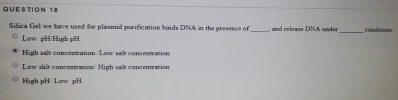 QUESTION 18 conditions Silica Gel we have used for plasmid purification binds DNA in the presence of __, and release DNA under Low PH High pH • High salt concentration Low salt concentration Low salt concentration High salt concentration High pH Low pH
 Why is it so important to keep the silica gel saturated with solvent at all times during preparation and development of a column? How would the quality of separation be affected if the column was allowed to run dry? 3.
 What is the affinity toward the silica gel surface for a compound with a high Re in a non-polar solvent? How would you expect the affinity to change in a more polar solvent? 5
 Why does 4-bromonitrobenzene have a larger
? value than 2-bromonitrobenzene in silica gel TLC?
R
Why does 4-bromonitrobenzene have a larger
? value than 2-bromonitrobenzene in silica gel TLC?
R
 TLC Consider the following silica gel TLC plate of compounds A, B, and developed in hexanes: solvent front 0 D origin A B C 22. Determine the Ry values of compounds A, B, and Crun on a silica gel TLC plate using hexanes as the solvent. 23. Which compound, A, B, or C, is the most polar? 24. What would you expect to happen to the Ry values if you used acetone instead of hexanes as the eluting solvent? 25.TLC...
 kindly answer the following thank you!
3. Since the surface of the silica gel on a silica gel TLC plate is covered in SI-O-H groups, organic molecules that can hydrogen bond will be much more attracted to the silica gel surface. Given that which of the following compounds would have the lowest Rf value if each of these was analyzed using a slica gel TLC plate and dichloromethane as a solvent? OH 4. Determine the Rf values for the two...
kindly answer the following thank you!
3. Since the surface of the silica gel on a silica gel TLC plate is covered in SI-O-H groups, organic molecules that can hydrogen bond will be much more attracted to the silica gel surface. Given that which of the following compounds would have the lowest Rf value if each of these was analyzed using a slica gel TLC plate and dichloromethane as a solvent? OH 4. Determine the Rf values for the two...
 QUESTION 18 conditions Silica Gel we have used for plasmid purification binds DNA in the presence of __, and release DNA under Low PH High pH • High salt concentration Low salt concentration Low salt concentration High salt concentration High pH Low pH
Most questions answered within 3 hours.
-
Where is the error in this code sequence?
String s1 = "Hello";
String s2 = "ello";...
asked 11 months ago -
Financial data for Joel de Paris, Inc., for last year
follow:
Joel de Paris, Inc.
Balance...
asked 11 months ago -
Consider this reaction:
Al2(SO4)3 (aq)+ BaCl3
(aq) Al2Cl6 (aq)- +
3BaSO4(s) . What is the...
asked 11 months ago -
Suppose that Savneet is considering increasing her
recent random sample from 20 car rentals to 40...
asked 11 months ago -
Trucks arrive at an unloading terminal at an average rate of 120
per hour.
Trucks arrive...
asked 11 months ago -
Why are methanol and ethanol completely soluble in water while
octanol is not very little soluble....
asked 11 months ago -
A facilities manager at a university reads in a research report
that the mean amount of...
asked 11 months ago -
When the CuSO4 is rehydrated by adding water to the anhydrous
compound, is this an endothermic...
asked 11 months ago -
A ray of sunlight is passing from diamond into crown glass; the
angle of incidence is...
asked 11 months ago -
A block of mass 0.249 kg is placed on top of a light, vertical
spring of...
asked 11 months ago -
how do the kidneys compensate in the presences of acidosis
a) trigger hyperventilate
b) reserve acid...
asked 11 months ago -
Question 501 pts
The rental rate of capital to the firm increases. Which of the
following...
asked 11 months ago