Sandy wins $2 million in the lottery and she has to choose between the following options:...
Sandy wins $2 million in the lottery and she has to choose between the following options:
Option 1) $2,000,000 today
Option 2) 10 annual payments of $245,000 per year starting today.
Option 3) $80,000 per year every year forever starting one year from today.
Option 4) 10 payments of $255,000 per year starting 2 years from today.
Regardless of the option she chooses, she would invest the funds in an investment earning 4% compounded quarterly.
Which option would she choose? Show your work.
Homework Answers
| EAR = [(1 +stated rate/no. of compounding periods) ^no. of compounding periods - 1]* 100 |
| ? = ((1+4/(4*100))^4-1)*100 |
| Effective Annual Rate% = 4.06 |
2
| PVAnnuity Due = c*((1-(1+ i)^(-n))/i)*(1 + i ) |
| C = Cash flow per period |
| i = interest rate |
| n = number of payments |
| PV= 245000*((1-(1+ 4.06/100)^-10)/(4.06/100))*(1+4.06/100) |
| PV = 2061685.92 |
3
| PV of perpetual CF = Perpetual CF/interest rate |
| PV of perpetual CF = 80000/0.0406 |
| PV of perpetual CF = 1970443.35 |
4
| PVOrdinary Annuity = C*[(1-(1+i/100)^(-n))/(i/100)] |
| C = Cash flow per period |
| i = interest rate |
| n = number of payments |
| PV= 255000*((1-(1+ 4.06/100)^-10)/(4.06/100)) |
| PV = 2062114.52 |
| Future value = present value*(1+ rate)^time |
| 2062114.52 = Present value*(1+0.0406)^1 |
| Present value = 1981659.16 |
Choose option 2
Add Answer to:
Sandy wins $2 million in the lottery and she has to choose
between the following options:...
2. Kelsey just won the lottery, and she must choose among three award options .She can...
2. Kelsey just won the lottery, and she must choose among three award options .She can elect to receive a lump sum today of $62 million, to receive end-of-month payments of $0.8 million for 10 years or to receive end-of month payments of $0.47 million for 30 years. If she can earn 8% annually (i.e., the discount rate is 8% per year), which is the best choice based on the PV of the three award options? a) PV of 1st...
Suppose you win a 100 million lottery and you can choose the following two payment options:...
Suppose you win a 100 million lottery and you can choose the following two payment options: 1) receive 25 equal payments of $4,000,000- one payment today and one payment at the end of each of next 24 years. 2) one time lump sum payment of $59 million. Question 1: If you can invest your proceeds and earn 6 percent, which payment option you will choose? Questions 2: At what rate of return, would you be indifferent between the lump sum...
You are the winner of a $10 million lottery where you get to choose between (option...
You are the winner of a $10 million lottery where you get to choose between (option 1) $5 million today or (option 2) $500,000 at the beginning of each year, starting today, for the next 20 years. If the annual interest rate (EAR) is 9%, which option should you pick and why? What if the interest rate (EAR) is 6%?
Rosie won the lottery today. She can receive 30 annual payments of $5,000,000 starting immediately. (So,...
Rosie won the lottery today. She can receive 30 annual payments of $5,000,000 starting immediately. (So, the last installment will be received 29 years from today.) Alternatively, Rosie can opt to receive her entire winnings all at once today (a lump sum). If Rosie can invest at 6% per year, what minimum lump sum would make her choose to take her winnings at all once today?
Jill has just won the lottery. She will receive semi-annual payments of $24,000 commencing in 6...
Jill has just won the lottery. She will receive semi-annual payments of $24,000 commencing in 6 months time and growing at 1.8% each half-year, forever. If the interest rate is 7.1% per annum compounded semi-annually, the value of this stream of cash flows today is (to the nearest whole dollar; don’t include $ sign or commas):
You have just won the lottery and you can choose between the following payout options. The...
You have just won the lottery and you can choose between the following payout options. The annual interest rate (EAR) is 10%. a) $100,000 right now and $60,000 every two years starting 3 years from now and ending 17 years from now (i.e., payments are at t = 0, t = 3, t = 5, … , t = 15, t = 17). b) $60,000 a year for 25 years with the first payment one year from today (i.e., payments...
Juan has just won a lottery. He can get $14 million now (after-tax, lumpsum or one-time...
Juan has just won a lottery. He can get $14 million now (after-tax, lumpsum or one-time option), or he can get $1 million annually for 25 years starting today (after-tax, 25 payments of $1 million each). Whichever option he chooses, he can save his money at a local bank, which is offering a 7% per year return on deposits. Juan is not sure if he should pick a lumpsum option or 25-payments option. He comes to you for help. What...
a) You just won $1,000,000 on the lottery. If you chose the payments over 20 years...
a) You just won $1,000,000 on the lottery. If you chose the payments over 20 years ($50,000 per year) how much is the value of the up-front cash option (present value) if the state uses a 6% rate of return (interest)? b) Katey needs $10,000 in 4 years to use as a down payment on a house. What amount must she invest today if her investment earns 10%? c) Linda invested $1500 today in a fund that earns 8% annually....
Shayla's fridge died and she needs to buy a replacement right away. Her payment options are...
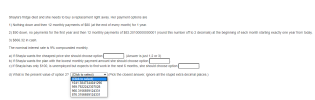 Shayla's fridge died and she needs to buy a replacement right away. Her payment options are 1) Nothing down and then 12 monthly payments of $80 (at the end of every month) for 1 year. 2) $90 down, no payments for the first year and then 12 monthly payments of $83.20100000000001 (round this number off to 2 decimals) at the beginning of each month starting exactly one year from today. 3) $866.32 in cash. The nominal interest rate is 9%...
Jessica has just won a game organized by her community. As a reward, she needs to choose among three options: (A) She ca...
Jessica has just won a game organized by her community. As a reward, she needs to choose among three options: (A) She can choose to receive a lump-sum today of $55, (B) to receive 10 end-of-year payments of $9, or (C) to receive 30 end-of-year payments of $5. If we assume that she can earn 6% annually, which option should she choose? Why do we use PV when solving instead of FV?
 Shayla's fridge died and she needs to buy a replacement right away. Her payment options are 1) Nothing down and then 12 monthly payments of $80 (at the end of every month) for 1 year. 2) $90 down, no payments for the first year and then 12 monthly payments of $83.20100000000001 (round this number off to 2 decimals) at the beginning of each month starting exactly one year from today. 3) $866.32 in cash. The nominal interest rate is 9%...
Most questions answered within 3 hours.
-
Where is the error in this code sequence?
String s1 = "Hello";
String s2 = "ello";...
asked 11 months ago -
Financial data for Joel de Paris, Inc., for last year
follow:
Joel de Paris, Inc.
Balance...
asked 11 months ago -
Consider this reaction:
Al2(SO4)3 (aq)+ BaCl3
(aq) Al2Cl6 (aq)- +
3BaSO4(s) . What is the...
asked 11 months ago -
Suppose that Savneet is considering increasing her
recent random sample from 20 car rentals to 40...
asked 11 months ago -
Trucks arrive at an unloading terminal at an average rate of 120
per hour.
Trucks arrive...
asked 11 months ago -
Why are methanol and ethanol completely soluble in water while
octanol is not very little soluble....
asked 11 months ago -
A facilities manager at a university reads in a research report
that the mean amount of...
asked 11 months ago -
When the CuSO4 is rehydrated by adding water to the anhydrous
compound, is this an endothermic...
asked 11 months ago -
A ray of sunlight is passing from diamond into crown glass; the
angle of incidence is...
asked 11 months ago -
A block of mass 0.249 kg is placed on top of a light, vertical
spring of...
asked 11 months ago -
how do the kidneys compensate in the presences of acidosis
a) trigger hyperventilate
b) reserve acid...
asked 11 months ago -
Question 501 pts
The rental rate of capital to the firm increases. Which of the
following...
asked 11 months ago